Paul Wonner
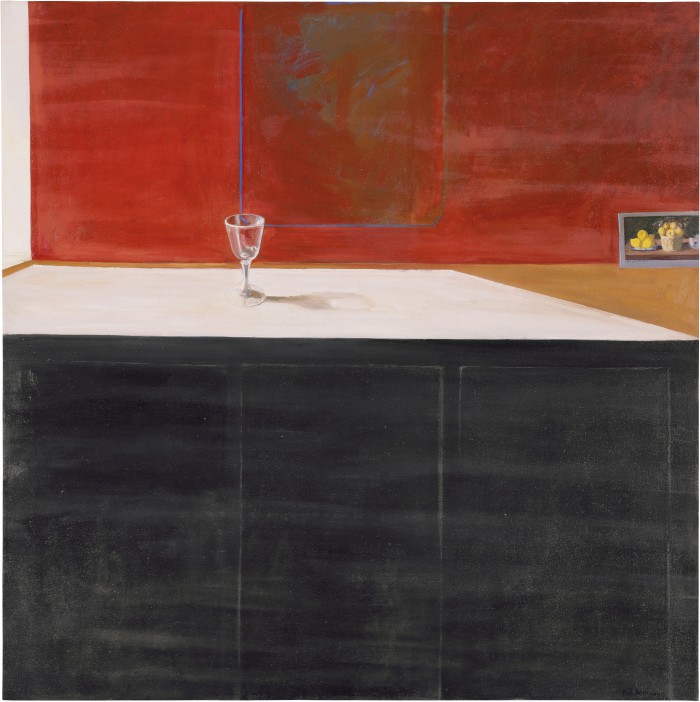
Wine Glass and Postcard (Zurbarán) 1968
© Estate of Paul Wonner and William Theophilus Brown, Crocker Art Museum.
Audio Description (03:19)
Full Audio Transcript (Expand)
Paul Wonner’s 1968 Wine Glass and Postcard (Zurbarán) is an oil-on-canvas meditation on a countertop with a sunny patch on the left side and the wall behind. The scene is crisp, clean, and nearly empty except for a solitary, gleaming wine glass on the counter, left of center, its shadow falling to the right, and a postcard standing against the back wall on the right side. The postcard is a rendering of Spanish painter Francisco de Zurbarán’s oil painting from 1633 called Still Life with Lemons, Oranges and a Rose. Wonner’s painting is on a four-foot-square canvas, and everything gets cut off, other than the wine glass and its shadow: The bottom of the front face of the counter, most of the wall on the left, the top of the back wall, and the right edge of the postcard are all simply left out. This makes the painting feel like a cropped photograph. But the artwork is not photo-realistic. It is very much a painting, and Wonner used an abstract style to play with perspective and detail.
The top third of the painting is a red wall, dark burgundy with wide, horizontal strokes of lighter vermillion. Along the left border is a vertical sliver of white, hinting at a window through which the sun glares so brightly that it–and most of the countertop–dazzles. Near the center of the back wall is a thin, azure rectangle like a picture frame with beveled corners. Within this frame, the burgundy paint is more plentiful. The center features wide, choppy strokes of olive green accented with shorter, narrow strokes of cerulean. The bottom half of the painting is the black and slate-gray accented front face of the counter, which resembles cupboards without handles or knobs. The painting style here is similar to the wall above: the darker color is mixed with horizontal strokes and streaks of the lighter color. The border between the red wall and the black cupboards is the relatively narrow countertop, which is a dark khaki color on the right, where the sunlight pouring in from the left does not reach. The featured wine glass seems quite realistic in size, shape, and how the sunlight shimmers on the glass. Yet, it seems to be almost tilted forward in a slightly unrealistic way. The bottom right corner of the picture frame shows through the transparent glass without any distortion.
While the real Zurbarán still life from centuries ago is extremely lifelike, the version on display on the right edge of the countertop here is pared down. The four bright-yellow lemons on their shiny saucer, the pile of pale yellowish oranges in their wicker basket, and the foliage adorning the oranges lack the detail, texture, and shadowing of the original. The light pink rose on a saucer is a murky shape, and the cup of water next to the rose is cut off by the right border of Wonner’s canvas. Like with the larger painting, in the postcard, the light streams into the tableau from the left. Even though the postcard is partially cut out of the scene, by making the wine glass’s shadow and the postcard fruits’ shadow fall in the same direction, the painting brings the two into not only the same space but also into the same time of day.
Up Close: One Painting Tours With Artists
Wine Glass and Postcard (Zurbarán)
Hosted by art historian and the associate director of ITALIC at Stanford, Kim Beil, the micro-video series focuses on a single object in the Anderson Collection, sparking dialogue with a guest artist.
Kim spoke with artist Marcela Pardo Ariza about Paul Wonner’s Wine Glass and Postcard (Zurbarán).
Artwork Details
- Paul Wonner
- b. 1920, Tucson, AZ
- d. 2008, San Francisco, CA
- Wine Glass and Postcard (Zurbarán)
- 1968
- oil on canvas
- 48 x 48 in.
- 2014.1.002
- Decade:1961-1970
- Medium:oil
- Movement:Bay Area Figuration
- Currently not on view