Jennifer Bartlett
At the Lake, Morning 1979
© Jennifer Bartlett. Reproduction of this image, including downloading, is prohibited.
Audio Description (04:03)
Full Audio Transcript (Expand)
At the Lake, Morning
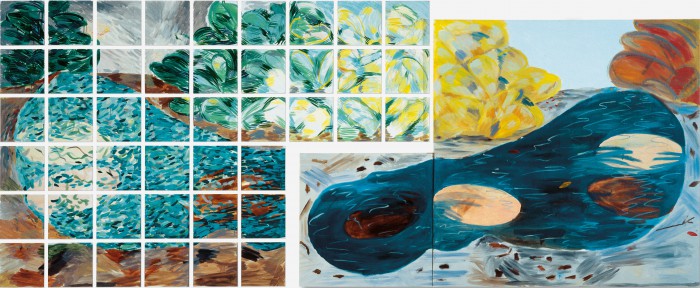
At the Lake, Morning by Jennifer Bartlett is an abstract study looking down on a lake that was created from 47 individual paintings in 1979. On the left is a grid of 45 nearly paper-thin enameled steel plates that are all twelve inches by twelve inches. Enamel paint was applied to the plates by silk screening over a pale grid that only shows through the lightest parts of the work. The plates are held to the wall by one tiny nail at each of their four corners with one inch of white wall between them. These blank spaces do not disrupt the image at all. The lines of one plate flow perfectly to the next, painted to feel as if the whole thing began as one large piece that was only later cut into squares. On the right side of the piece are two differently-sized, oil-painted canvases stretched over wood frames that more or less repeat the imagery from the plates. One canvas is three feet square, and the other is six feet square. Altogether, the piece reaches nearly sixteen-and-a-half feet wide by just under six-and-a-half feet high.
As the name suggests, this artwork brings the viewer to two views of a small lake when the sun is low enough that the sky is pale blue. Taken on their own, the lakes could be large or small, and the dark blue used for them suggests the water is deep. But when compared to the size of the shrubs lining the far edge, the bodies of water suddenly seem like they could hardly be larger than puddles. Dark brown-red and peach colored discs decorate the surface of the lakes. They could be reflections of something high above, but they are all partly covered by the blue of the water. This makes them appear more like oddly-colored oval lily pads.
Let’s explore the work in more detail, starting with the view on the left. The grid of steel plates shows dark green shrubs and green-accented yellow shrubs at the back, and most of the lake, which is set in brown and red sand. The far-right edge of the lake is cut off. The silk-screened images are highly abstracted: Everything is made of long or short lines or thick bars. In a few places, very slender drips of paint fall from a line of water or a line of sand.
The painted canvases on the right repeat the image of the lake, except perhaps now in autumn: The green shrubs are yellow; the yellow shrubs are red and burnt orange. Here, the lake is shown in full. The earth around this lake view is blue-gray and dotted with bits of red-brown like fallen leaves and a bare branch all from a tree not captured in the paintings. While there are thin squiggles and short, thick bars used as accents all around, the painted canvases are less abstract and more solid feeling than the enameled plates.
The way these two lake views are arranged is intriguing, very orderly but uneven. The top three rows on the left are nine plates long. The bottom three rows are only six plates long. This creates a nook into which Bartlett has nestled the smaller canvas with a little bit of white space around it. The larger canvas is snug against the small one, but not snug against the upper three rows of plates, and it falls six inches short of being even with the top edge of the top row of plates. Each of the 47 pieces could be displayed as its own work of art. Placed together, they remind the viewer of the way that memories may splinter over time, while each fragment always remains part of a larger whole.
Up Close: One Painting Tours With Artists
At The Lake, Morning
Hosted by art historian and the associate director of ITALIC at Stanford, Kim Beil, the micro-video series focuses on a single object in the Anderson Collection, sparking dialogue with a guest artist.
Kim spoke with artist Erica Deeman about Jennifer Bartlett’s At The Lake, Morning.
Artwork Details
- Jennifer Bartlett
- b. 1941, Long Beach, CA
- d. 2022, Amagansett, NY
- At the Lake, Morning
- 1979
- enamel, serigraph on steel/oil on canvas
- 77 x 197 in.
- 2014.1.050