



Lynda Benglis
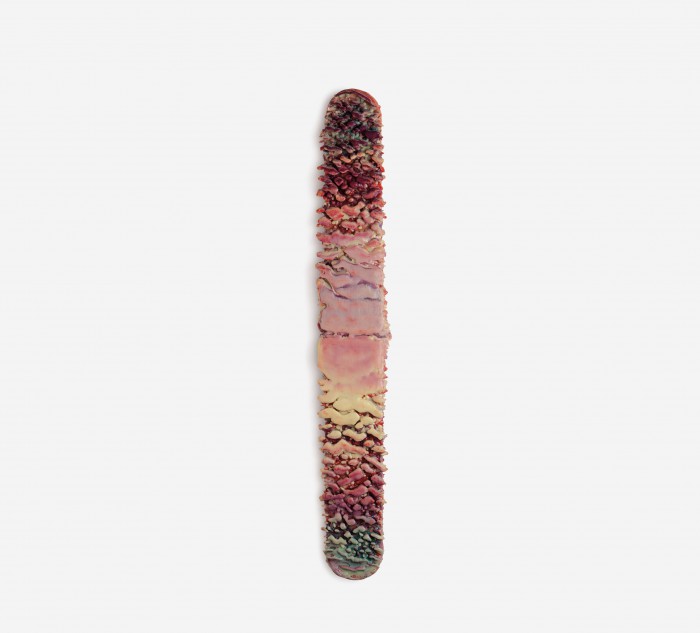
Plum 1971
Art © Lynda Benglis/Licensed by VAGA, New York, NY. Reproduction of this image, including downloading, is prohibited.
Audio Description (02:03)
Full Audio Transcript (Expand)
Plum
In 1971, Lynda Benglis created the sculptural painting Plum from purified pigmented beeswax mixed with damar resin on masonite and wood. It hangs on the wall at three feet tall by just over five inches wide. The work is shaped like a popsicle stick with long, straight edges and rounded top and bottom. It is covered in colorful, wavy beeswax lumps and bumps, none of which is identical to any other. These sculptural elements extend up from the masonite and wood base to nearly three inches forward from the wall and out to the sides like little jagged crystals. The lumps are colored a dark burgundy red, with the addition of deep teal at the top and bottom. Spread on top is a glossy, light-beige layer. The light-beige layer was applied the thickest at the center where it heavily mutes, or even completely hides, the burgundy and serves to meld many of the bumps together into big smeary chunks. The beige becomes thinner as it radiates out toward the top and bottom, allowing more of the burgundy and teal to show through. In places, the beige has dripped down into the spaces between the lumps.
The lumps are organic, resembling drops of water that spray out from a crashing ocean wave. Some are like tiny, individual droplets, while others are relatively larger like multiple droplets that have merged into spills or short, fat, rippling lines. In the upper left of the work are a few very small bare areas where the masonite’s grid texture peeks through. From a distance, it may appear like there are actually many gaps among and between the bumps and waves. Moving in closer reveals that these spaces are all filled with smaller, shorter bumps and globs of the pigmented beeswax. This gives the artwork the feel of being light and airy, and solid at the same time.
Artwork Details
- Lynda Benglis
- b. 1941, Lake Charles, LA
- Plum
- 1971
- purified pigmented beeswax, damar resin on masonite and wood
- 36 x 5 1/8 x 2 3/4 in.
- 2014.1.030
- Decade:1971-1980
- Medium:pigment, wax
- Movement:Post-Minimalism
- On view


![Japanese Dancer Series No. 12 [Makiko], 1980](https://anderson.stanford.edu/wp-content/uploads/2017/07/MN.1980.DWG_.045-220x311.jpg)