Richard Diebenkorn
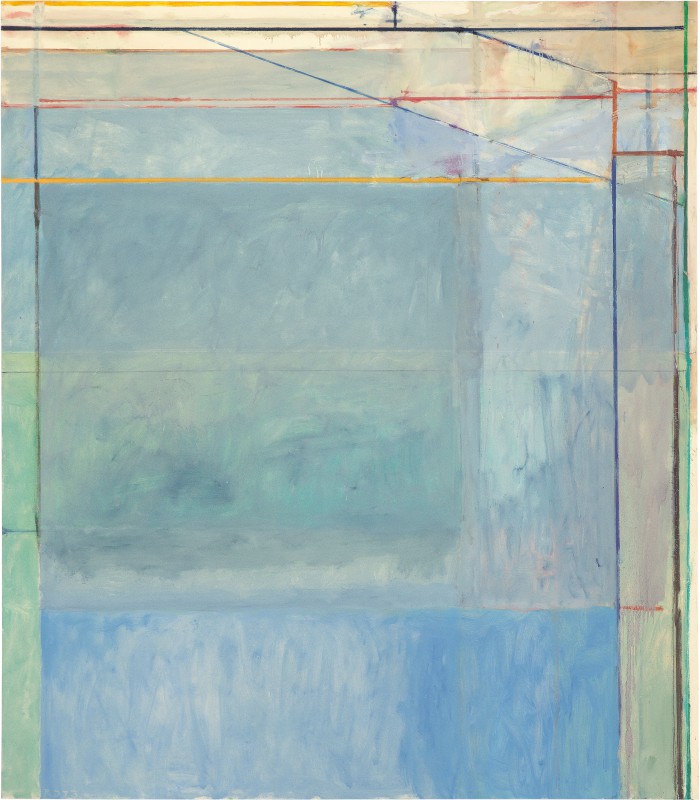
Ocean Park #60 1973
©The Richard Diebenkorn Foundation. Reproduction of this image, including downloading, is prohibited.
Audio Description (02:31)
Full Audio Transcript (Expand)
Ocean Park #60 is from a series of 145 oil paintings that Richard Diebenkorn made over a 20-year period. This one, from 1973, spans seven-and-three-quarters feet tall by just a touch over six-and-three-quarters feet wide. It could be a study of splotchy and softly-blended pale blues, greens, and tans, with some accent lines. But as Ocean Park is the neighborhood where Diebenkorn resided when he made the painting, it seems to be capturing, and abstracting, the area’s cloudy sky, ocean waves, and light sand as if viewed through a multi-paned window. Or even windows stacked above and next to other windows.
A sandy tan color makes a wide border along the top, and a very slim right-side border. Much of the painting is pale, marbly blue-greens that mostly become darker and bluer toward the bottom. On the sides are more blues, greens, and lilac. All of these soft colors that one might find at a beach are made with wide, overlapping strokes and drippy smudges. Unlike water and sand on a beach, however, even as these colors flow, they are somewhat contained by sets of straight lines—some very dark and slim, some wide and pale—that span horizontally, vertically, and just a couple diagonally.
The thin, dark lines feel almost like they come from architectural plans of a building. Along the top quarter of the canvas, red, black, and gold lines stretch partway or all the way across, perfectly horizontal. Down the right edge, thin green, red, blue, and orange lines form one wide and one narrow column. Partial lines that match in style trace down the left side. Two blue diagonals slope from high up, down a little ways to the right-side lines like a roofline. The most windowpane-like are two wider, very pale bands crossing left to right that divide the canvas into thirds.
Despite the straightness of all the accent lines, even they are not so rigid. On close inspection, ghosting becomes apparent where some lines were begun then painted over differently. The lines are uneven in thickness, and tiny splotches, speckles, and drips can be found almost everywhere. A surprise spot of purple makes an appearance tucked into the angle where one diagonal meets one horizontal thin line near the top, and the drippy nature of even the lilac and tan spots gives this serene painting a sense that it just might still be a little wet.
Though he resisted being categorized as a “California artist,” Richard Diebenkorn spent the majority of his career on the West Coast. In the fall of 1966, Diebenkorn moved from Berkeley to Santa Monica, where he found an art studio in Ocean Park, a gritty neighborhood along the oceanfront that was a hub of artistic activity. It was here that Diebenkorn painted the 145 paintings in his Ocean Park series, which he developed over the course of twenty years. The Ocean Park series represents a moment when Diebenkorn shifted back to abstraction after a number of years of working on representational forms. Although Ocean Park #60 doesn’t portray the ocean in a recognizable way, the layered blue and green hues evoke both the light of the ocean and a sense of depth. In contrast to this impression of limitlessness, the sharp spatial divisions along the perimeter of the canvas convey order and containment.
-Linden Hill, PhD Candidate in the Department of Art & Art History
From Left of Center, opened Sept 20, 2019
Ocean Park Series
In 1966, Richard Diebenkorn and his wife Phyllis moved from the Bay Area to the Ocean Park neighborhood of Santa Monica in Southern California where they lived for more than twenty years. The area and its surroundings led to a radical shift in the artist’s work-the Ocean Park period-where he precisely balanced form, space, and color. Recording his new environment, the artist painted and sketched the interior studio space and the view from his windows overlooking landscapes and rooftop scenes. As remembered by friend, Wayne Thiebaud, “I went … several times, to his Ocean Park studio … And he had these transom windows. And you’d look out there and you’d see this little patch [of] blue and green, or the concrete abutments that would come, and you could … see what he was processing and essentializing … You have to have that sense of ambiguity … in order to … drive the painting into something other than something obvious and too predictable.” (Courtesy The Diebenkorn Foundation and Acquavella Galleries.)
Up Close: One Painting Tours With Artists
Ocean Park #60
Hosted by art historian and the associate director of ITALIC at Stanford, Kim Beil, the micro-video series focuses on a single object in the Anderson Collection, sparking dialogue with a guest artist.
Kim spoke with San Francisco-based painter Rebekah Goldstein about Richard Diebenkorn’s Ocean Park #60.
Artwork Details
- Richard Diebenkorn
- b. 1922, Portland, OR
- d. 1993, Berkeley, CA
- Ocean Park #60
- 1973
- oil on canvas
- 93 x 81 1/4 in.
- verso upper right: R. Diebenkorn Ocean Park #60 1973 CA 60 verso: photo from SFMOMA Conservation
- 2014.1.044
- Decade:1971-1980
- Medium:oil
- Movement:Bay Area Figuration
- On view