Richard Diebenkorn
Girl on the Beach 1957
©The Richard Diebenkorn Foundation. Reproduction of this image, including downloading, is prohibited.
Audio Description (02:07)
Full Audio Transcript (Expand)
Girl on the Beach
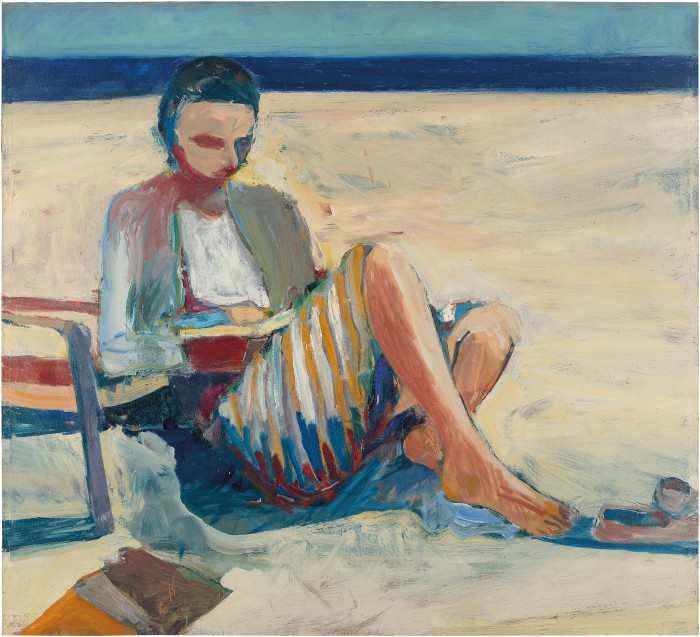
A bright beach portrait of a slender, young white woman reading, with the ocean behind her, Richard Diebenkorn’s Girl on the Beach is a semi-abstract oil painting about four-feet-four-inches tall by four-and-three-quarter-feet wide–painted in 1957. Roughly realistic in color, form and perspective overall, at the same time it has an expressionistic and sketch-like quality. It shows the smeary tracks and turns of the brushes with which paint was applied, and regular glimpses of incompletely incorporated colors.
The woman sits upright on the sand in a slight recline, facing to the right and angled away from the shore, no one else in sight. Wearing a long-sleeved, gray-green cardigan over a plain white shirt, and colorful, knee-length, capris pants: she has planted her right foot and bare-right-lower leg close to her and elevated a bent knee–to the exact center of the painting. The bright stripes and close fit of her capris illuminate the contours of her ascending thigh and bottom where they meet the sand.
Stylishly framed by a close-cropped pixie-cut of dark hair, the young woman’s face and eyelids are turned down to her book–leaning against and across her raised thigh. A second book lies open beside her, face-down in the painting’s lower left corner, extending partly out of view.
She appears to be propping her back against the unseen left arm of a beach chair obscured partially behind her, while her right elbow rests on the chair’s cloth seat bottom. With her wrist she is holding the book open against her thigh. The bend and position of her wrist suggests her fingertips are touching the page out of view and moving down it as she reads. Bits of shadow close around her show the sun to be high, and exactly at her back, at the angle she has positioned herself. A narrow shadow line stretches from her right foot across the back and toplines of a pair of flat shoes in front of her and pointing away in the lower right corner of the painting.
In the brightness, the beach around her is featureless, and fills all but the top of the frame. A light-blue band across the top depicts the sky, and a parallel band of dark-blue directly beneath it depicts the sea. Bent over her book, the top of the young woman’s almost perfectly oval head just touches the horizon.
Richard Diebenkorn entered Stanford in 1940, where he would receive his first formal art training. One of Diebenkorn’s earliest works is a Hopper-like cityscape from 1943 called Palo Alto Circle. Diebenkorn started painting abstract work in the late 1940s, but returned to representational painting after moving to Berkeley in the 1950s, becoming a key player and teacher in the Bay Area Figurative Movement. Girl on the Beach is from the artist’s prolific Berkeley years (1953-1966), and shows Diebenkorn’s interest in the relationship between landscape and the human figure. Geometric shapes, like the band of sky and sand and the triangular form of the thigh, interact with the organic curves of shadow and color in Girl on Beach. Although the girl is depicted reading outside, there is a feeling of domestic intimacy to her restful position on the sand and beach chair. Rather than the interior trappings of domestic space, elements of the natural world—light, sand, and the horizon—are home for Diebenkorn’s girl.
Artwork Details
- Richard Diebenkorn
- b. 1922, Portland, OR
- d. 1993, Berkeley, CA
- Girl on the Beach
- 1957
- oil on canvas
- 52 1/8 x 57 1/4 in.
- 2014.1.005
- Decade:1951-1960
- Medium:oil
- Movement:Bay Area Figuration
- On view