Kenneth Noland
Rose 1961
Art © Estate of Kenneth Noland/Licensed by VAGA, New York, NY. Reproduction of this image, including downloading, is prohibited.
Audio Description (01:55)
Full Audio Transcript (Expand)
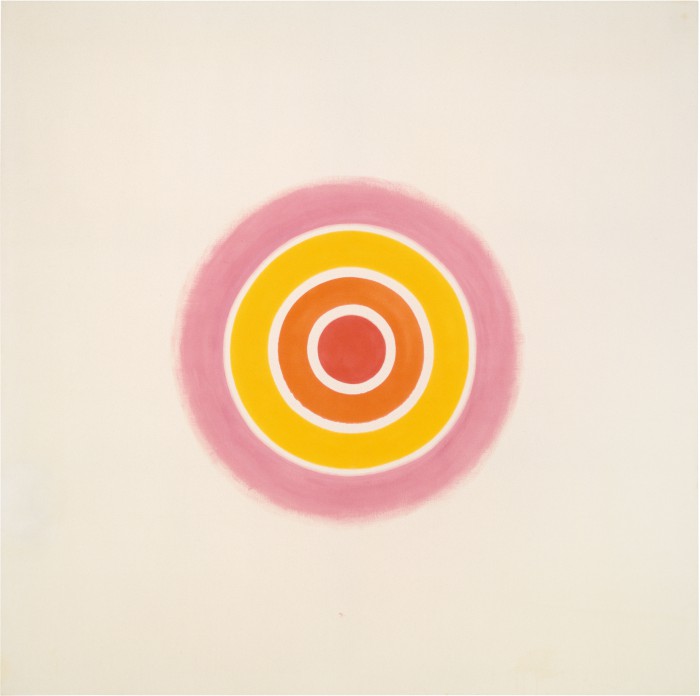
Kenneth Noland’s Rose is a roughly 7-foot-by-7-foot square canvas painting– showing a simple target pattern in mellow colors–which spans half the frame, and seems both to be floating out of–but also at its edges partially merging into—the luminous field around it.
White lines divide the pattern into three broad concentric rings and a central bullseye. The perimeter is murky: An even, rose-pink tint that colors the outermost ring becomes a dwindling dapple of color at its edge–and thins to nothing within the breadth of a line. The center bullseye and the first ring are both a rich, almost vibrant hue of orange. The middle ring, sandwiched between the orange and the rose-pink, is amber-yellow. The lines dividing the rings, on close inspection, are unpainted gaps, which the brightness of the canvas shines through. The luminous field around the target likewise is unpainted. Noland completed Rose in 1961, using acrylic paint.
Studying the pattern reveals other less obvious aspects to it.
The bands of color are not equally wide but, from inside to outside, each ring of color is wider than the last: Amber-yellow wider than the orange band around the bullseye, and rose-pink widest of all. Hand in hand, however, the bright gaps separating them become narrower inside to outside. The result is an appearance of uniformity, which isn’t really there.
Noland has built in subtly also a scheme of incrementally diminishing color intensity, which likewise progresses from inside to outside, and could be said to culminate at the perimeter, where the rose-pink dissolves into the pale unpainted background. The orange of the interior is the most intense and saturated of the colors. Meanwhile, the amber-yellow middle appears neatly intermediate in saturation between the orange and the rose-pink. But the orange has an amplified presence–Noland having painted orange the bullseye and the first ring alike–which appears more dramatic than incremental, and more organic than deliberate.
Beginning in the late 1950s, Kenneth Noland and the color field painters turned away from the expressive brushwork of action painting to focus primarily on color as a phenomenon. Noland chose diagonal bands, chevrons, stripes, and targets as neutral vehicles for color. Using thinned plastic based pigments, he stained unprimed canvas with translucent washes. Noland’s targets hover as free-floating rings on ambiguous grounds. In Rose, strips of raw canvas separate concentric bands of orange, yellow, and pink. The hot inner circles, their edges hard and sharply defined, push out from the canvas, while the outer ring of vaporous pink blurs softly into the ground.
Artwork Details
- Kenneth Noland
- b. 1924, Asheville, NC
- d. 2010, Port Clyde, ME
- Rose
- 1961
- acrylic on canvas
- 81 1/2 x 81 1/2 in.
- 2014.1.032
- Decade:1961-1970
- Medium:acrylic
- Movement:Color Field Painting
- On view