Richard Diebenkorn
Berkeley #26 1954
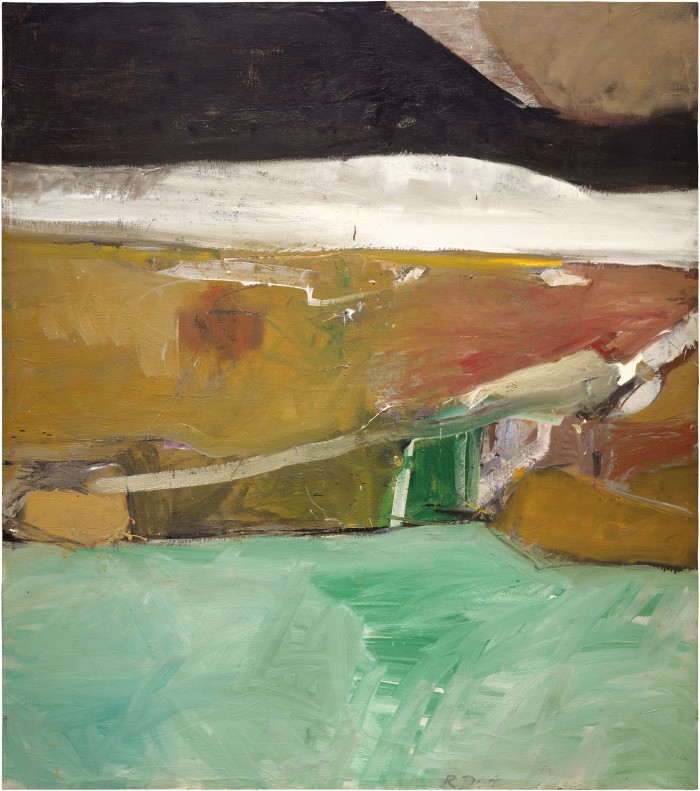
©The Richard Diebenkorn Foundation. Reproduction of this image, including downloading, is prohibited.
Audio Description (02:19)
Full Audio Transcript (Expand)
Berkeley #26
For at least a moment, Richard Diebenkorn’s 1954 painting, Berkeley #26, seems possibly to depict an aerial view of the San Francisco Bay city of Berkeley—in some abstract and low-resolution way. An oil-painted canvas about four feet across and closer-to-five feet tall, much like any coastal town, it shows a continuous band of watery color across the bottom third of the painting: Diebenkorn has painted this portion a pearly pale green and, as if to suggest swirling sediments, unevenly blended the green with varying amounts of white applied with varying angles of brush stroke. Above a roughly level boundary-line resembling a coast, he has painted another third of the painting predominantly the color of mustard, but almost equally intermixed it with blushes of red and green; and, to the right of center, Diebenkorn has applied single strokes and smeary patches of white, as well as a bold green upright rectangle in contact with the seeming coast. In the upper third of the painting, a wide, slightly lumpy, white ribbon runs level from end to end across the section below, and a larger, dark brown band runs with it, rising to the top of the canvas on the left, then descending and narrowing to fit beneath a rounded light-brown shape in the right corner. If Berkeley #26 were simply Berkeley, the large, brown shapes would be the Coast Range hills of Berkeley’s upper outskirts. The lumpy white ribbon could represent the fog that descends from the hills nightly in the summers all around the Bay.
Except that Berkeley #26 appears about equally a work of pure imagination. The multicolored, smeary featured middle of the painting could depict any downtown or no place at all. A bright beige stripe ascending roughly diagonally from the lower left tints darkly green where it grazes the bold rectangle; transitions back to beige, in passing white smears of white and blushes of red, then continues up and right on the far side of the busy center of Diebenkorn’s activity with a roughly overpainted coat of white and a slender brown stripe that merges with it from below.
Ultimately and overall, it seems Diebenkorn has painted shapes, colors, lines and patterns to balance, complement and so to correspond mainly with each other across Berkeley #26. If Berkeley geography was a starting point, the painting shows he ranged very wide.
Richard Diebenkorn entered Stanford in 1940, where he would receive his first formal art training. One of Diebenkorn’s earliest works is a Hopper-like cityscape from 1943 called Palo Alto Circle. Diebenkorn started painting abstract work in the late 1940s, but returned to representational painting after moving to Berkeley in the 1950s, becoming a key player and teacher in the Bay Area Figurative Movement.
Artwork Details
- Richard Diebenkorn
- b. 1922, Portland, OR
- d. 1993, Berkeley, CA
- Berkeley #26
- 1954
- oil on canvas
- 56 1/4 x 49 1/4 in.
- verso, upper right quadrant: Diebenkorn/Berkeley #26 (in black oil stick) lower right quadrant: RD 54 (in black paint)
- 2014.1.004
- Decade:1951-1960
- Medium:oil
- Movement:Bay Area Figuration
- On view