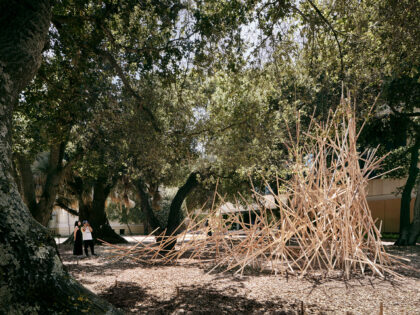
Salvaged redwood and oak
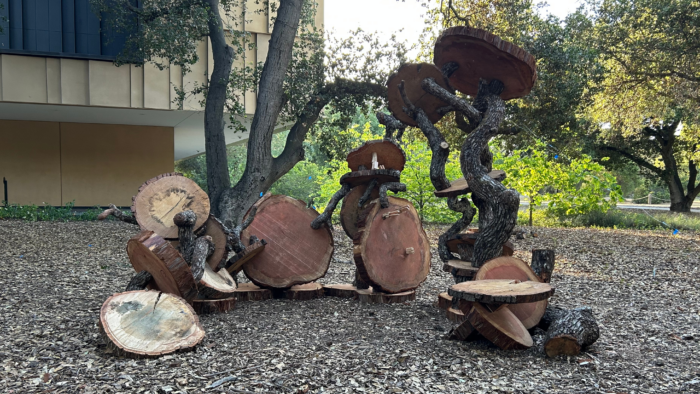
Image: Civil and Environmental Engineering students at Stanford use salvaged redwood and oak trees felled on campus to assemble a structure using traditional mortise-and-tenon joinery.
Grotto: /noun/ an artificial recess or structure made to resemble a natural cave
The Floating Grotto is both artificial and natural. By borrowing from nature to create an artifice, the installation possesses both the terrifying grotesque and the delicate beauty found within nature itself. Beyond those naturally occurring, grottos historically appeared in English picturesque gardens to elicit thrilling emotional effects of fear and horror; this, in contrast to the beautiful aspects of the sinuous circulation paths and landforms, was intended to induce the sublime.
The architectural power of the grotto lies in its ability to obscure and deconstruct one’s spatial awareness and imagination. Floating Grotto is formed from salvaged redwood and oak trees that were felled on Stanford’s campus, assembled using a traditional mortise and tenon joinery technique. The joint is formed by inserting a chiseled oak branch head (tenon) into a hollowed cookie sliced from a tree trunk (mortise), and then fixed into place through the insertion of a wedge. Coarse bark is intentionally left on the wood, preserving its rough, irregular texture.
In this installation, every hollowness is filled, whether it be the mortise and tenon or the antispace created by the structure. The sublime peeks through the contrast of opposites: the planar cookies against the randomness of rough organic branch formations, and the “hard” oak against the “soft” redwood. The idea of “floating” is central to the experience, lifting up the heavy while simultaneously existing under the weight of the trees— suspended in the space between. By standing beneath this mass, the body is placed in this liminal zone, creating an overwhelming feeling of the sublime.
Course and Workshop:
This installation was designed and built by Stanford students taking the course CEE132H: Responsive Structures, led by Jun Sato, a Japanese structural engineer and Visiting Shimizu Professor from the University of Tokyo and Beverly Choe, Associate Director of Sustainable Architecture & Engineering.
Students:
Heber Alvarez, Zarrin Askari, Linshi Furgerson, Carly Green, Sze Chun Liu, Morgan Huang Marsh, Yana Kim, Tambla Mbawa, Eliza Siebers, Wade’a Tadros