Mark Tansey
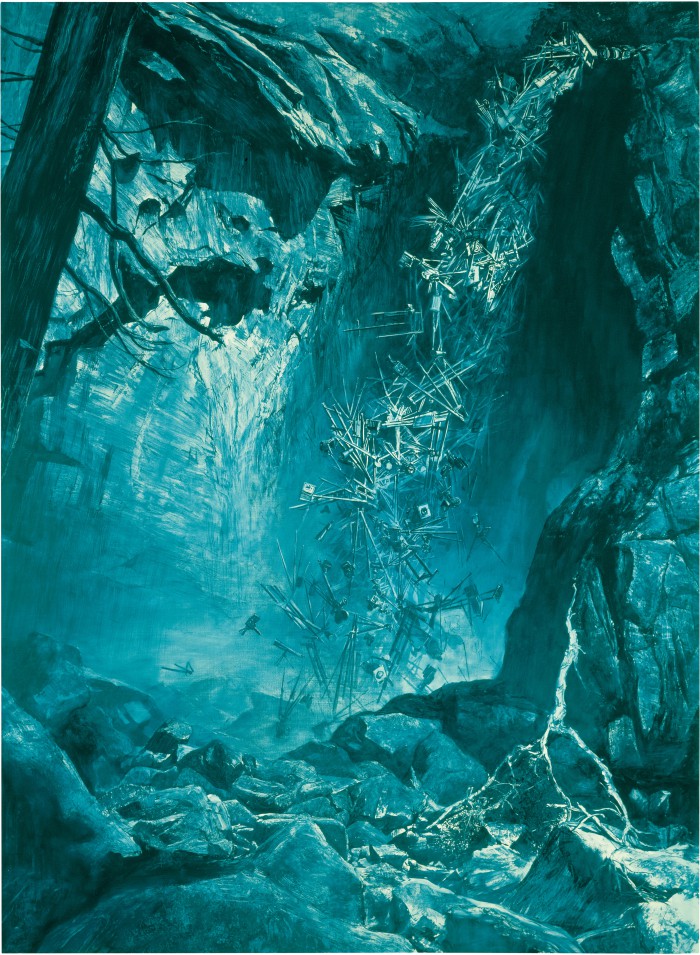
Yosemite Falls (Homage to Watkins) 1993
© Mark Tansey. Courtesy Gagosian Gallery. Photography by Robert McKeever. Reproduction of this image, including downloading, is prohibited.
Audio Description (03:25)
Full Audio Transcript (Expand)
Mark Tansey painted Yosemite Falls (Homage to Watkins) in 1993 in oil on canvas. Stretching nine feet tall by just over six-and-a-half feet wide, the painting may at first feel imposing: An icy teal blue and black outdoor scene filled with sharp lines, angular objects, and winter-bare, scraggy trees by scratchy, rough rock. It feels imposing, perhaps even off putting. But step in closer, and a bit of dark humor jumps right off the canvas.
In the 1800s, Carleton Watkins made incredible black-and-white photos of Yosemite Falls that arguably played a role in the US government’s preservation efforts for Yosemite. This paved the way for the development of the national parks, which have become tourist attractions much photographed and video recorded to this day.
This painting was made more than 100 years after Watkins’ photo of Lower Yosemite Fall, a 320-foot waterfall on the right side tucked into a curving rock face that creates a bit of a cozy nook. But here, instead of water tumbling over the cliff to the bumpy rocks below, it is a jumble of cameras and tripods roaring down. Just about any type of camera from the 1800s to the early 1990s can be found in this version of the fall. Plate cameras like Watkins used look like an accordion with a round glass lens sticking out the flat front. Vintage movie cameras with two reels on top like mouse ears barrel down alongside modern digital cameras, studio lights on tall stands, and even a tall rolling desk someone might use to lay out negatives or prints for review. There must be at least hundreds of objects frozen in time in this painting. It would be impossible to count everything that makes up the camera-fall tangle.
Aside from replacing water with photo gear, the rest of this painting feels fairly true to the original to which it pays homage. Jutting into the painting in the upper left corner is a leafless tree with short branches, leaning slightly toward the fall on the right. Behind the tree, sunlight pours in and highlights the rough rock wall. There, narrow brush strokes are mixed with choppy lines where the paint was piled up and scraped away to reveal the white below and create texture. High up, thick outcroppings create shadows just below them. The rock face directly behind the fall on the right is dark and shaded. Pale blue paint and white punctuate the otherwise dark blue and black assortment in spots near the top of the falling cameras and accessories and a few bright places midway down. Where the equipment lands, the otherwise precise brushwork becomes murky and gauzy. It feels like mist created by the fast-moving gear hitting the pool below. On the lower right, a small tree looks as if it was split by lightning, with dead branches spreading out left and right on the ground like tentacles. At the lower center, the ground is littered with large rocks, some sharp, and others worn smooth from years of actual water coursing over them.
Artwork Details
- Mark Tansey
- b. 1949, San Jose, CA
- Yosemite Falls (Homage to Watkins)
- 1993
- oil on canvas
- 108 x 79 in.
- verso, upper right: 1993, Mark Tansey, Yosemite Falls (Homage to Watkins), oil on canvas
- 2014.1.113
- Decade:1991-2000
- Medium:oil
- Movement:Contemporary Painting
- On view