Susan Rothenberg
Wishbone 1979
© 2014 Susan Rothenberg / Artists Rights Society (ARS), New York. Reproduction, including downloading of ARS member works is prohibited by copyright laws and international conventions without the express written permission of Artists Rights Society (ARS), New York.
Audio Description (02:37)
Full Audio Transcript (Expand)
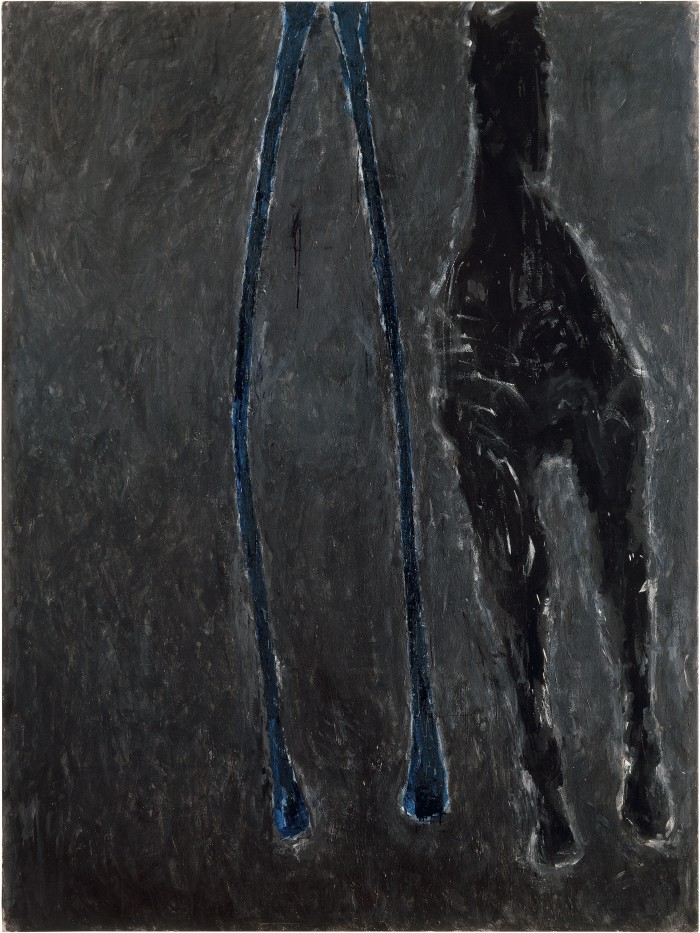
Susan Rothenberg’s dusky 1979 painting Wishbone plays with bodies and scale in a surprising way. The eight-and-a-half-foot tall by six-and-a-third-foot wide canvas is charcoal gray at the top. It gradually darkens to black at the bottom. All over, short, rough strokes of acrylic and flashe are highlighted with touches of white and pale gray, like a lace of fog over the scene. On the right third of the painting stands a full-grown black horse, facing front. The tips of the horse’s ears are cut off by the top border of the canvas. Not completely realistic, the horse resembles a distorted bird’s wishbone. Its muscular neck is like the small nub at the top of a wishbone, its body forms a thick, but short segment that widens, and two long legs fork off from the body and stretch down the canvas. Floating just to the left of the horse, the middle third of the painting contains a bird’s wishbone in royal blue that is simply huge. To give a sense of just how huge, the wishbone is slightly taller than the horse. In reality, this bone from a bird’s chest could be smaller than a horseshoe. Only the forked pieces of the giant wishbone are in view. The top segment where the bone’s two long legs connect and the nub-like portion atop it can only be imagined stretching above the canvas itself. The bottoms of the slender wishbone are wider, reminiscent of the horse hooves next to them and near, but not quite at, the painting’s bottom border. The left third of the painting is free from imagery, with only the gray, white, and black strokes filling the space.
Rothenberg brings energy and a sense of movement with the strategic use of white highlights. They are scattered lightly around the gray and black background. But the horse’s body is outlined almost entirely by little, smeared white strokes, and many smudged, chalky short lines course over its body and legs. The right leg is slightly bent, hoof partially raised up, and body leaning just a bit to the left as if in mid-stride. The raised hoof, along with the white smears outlining the horse, give the illusion of it running through the dark, its sleek body cutting through midnight fog. The wishbone is also brightened around its edges with white. Placing the horse and the larger-than-horse-sized wishbone side by side as nearly equals feels playful and curious, bringing levity to an otherwise rather dark artwork.
Artwork Details
- Susan Rothenberg
- b. 1945, Buffalo, NY
- d. 2020, Galisteo, NM
- Wishbone
- 1979
- acrylic and flashe on canvas
- 102 X 76 in.
- Verso: Susan Rothenberg, 1979
- 2014.1.083
- Decade:1971-1980
- Medium:acrylic
- Movement:Contemporary Painting
- Currently not on view