Mark Tobey
Window 1953
© 2014 Mark Tobey / Seattle Art Museum, Artists Rights Society (ARS), New York. Reproduction, including downloading of ARS member works is prohibited by copyright laws and international conventions without the express written permission of Artists Rights Society (ARS), New York.
Audio Description (03:29)
Full Audio Transcript (Expand)
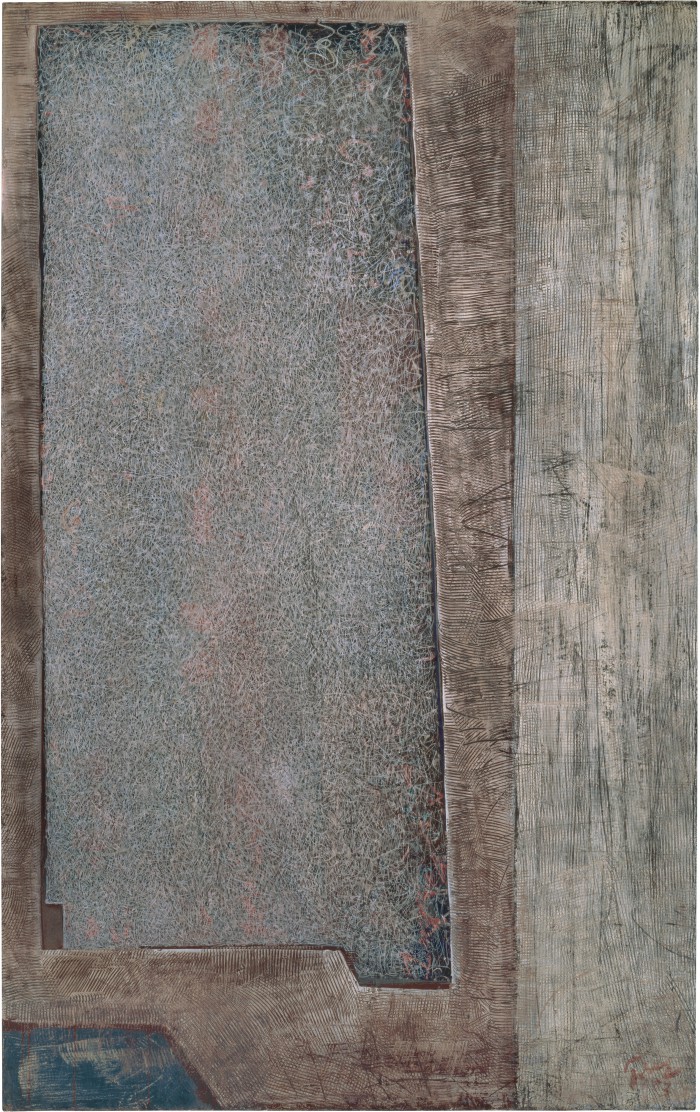
Nearly half of Mark Tobey’s Window is a not-quite-rectangular window area on the left. This window-like space is filled in with painting in his signature style called “white writing”: a densely layered tangle of extremely fine, swirling pale lines, here, atop a mocha-brown background. The rest of the artwork could be thought of as an off-kilter frame for this window area. It was painted by carefully pulling a comb through a top layer of paint. The comb carves groups of short lines right through to reveal stripes of another color beneath. Tobey used soft colors: bubble-gum pink, caramel and mocha brown, Prussian blue, oceanic teal, forest green, and white. The artwork feels muted overall by the laciness of the curving lines inside the window and by the use of pale colors for the base paint of the window’s frame. This 1953 artwork was made with casein paint on a board mounted on masonite. It stands around four-and-a-half-feet tall and nearly two-and-a-half-feet wide.
The top of the window starts as a rectangle that fills about half the width of the board and reaches almost the whole height. The top and left window edges are fairly straight, and the right edge gently widens toward the bottom. A small hunk of the lower right corner of the window is cut away from an otherwise straight bottom border. A companion spot in the lower left corner of the window was left free of the white writing and is covered simply with a light layer of teal. Though the white writing lines feel spontaneous and improvised, Tobey carefully left a border of the background mocha around the edges, which creates a feeling of three-dimensionality to the window’s frame.
The frame-like area could be thought of as three parts: Caramel brown over light pink frames the window itself, save for a polygon in the lower left corner of the board in Prussian blue with pink. The top and left sides of the frame are slim, the bottom and right sides wider. Altogether, these elements fill the left and center of the board. The last quarter, the right side, is a thick bar in pale pink with comb stripes in forest green. The sinuous white writing in the window might seem like it would be in contrast with the straight lines adorning the frame. But the comb lines also have an organic feel. Each pull of the comb reaches a different distance, from less than an inch to several inches without break. Some curve, others are quite straight. Some areas contain only one pull, while others are adorned with criss-crossing pulls, the lines turning into fine hashmarks and grids. A handful of slightly thicker zig zags overlay the stripes here and there.
While very similar in style to Jackson Pollock’s artworks made with poured, dripped, or splattered paint, Window feels more serene. The fine lines inside the window are more plentiful, and nowhere are the large splatters and drips that paintings such as Pollock’s Lucifer contain. From far away, the white writing resembles multi-colored fog; stepping in close, it feels more like lace laid in stacks with the meticulous care one takes when writing in calligraphy.
Mark Tobey is considered a leader of the Northwest School, a group of artists working in the Seattle area who were influenced by both the nature of the Pacific Northwest and East Asian philosophy. In his late twenties, Tobey became fascinated by haiku, Japanese and Chinese calligraphy, and mysticism, and he subsequently converted to the Baha’i World Faith. He believed that there could be no break between nature, art, science, religion, and one’s personal life. The unity in his personal worldview manifests itself in Tobey’s signature painting style, which he called “white writing”: densely packed calligraphic symbols overlaying an abstracted field. Resembling lacey spiderwebs, this textured mass of lines animates the painting, giving a sense of vibration within the image and simultaneously evokes a window that one is unable to fully see through. Though Tobey was more interested in contemplation than action, his layered and rhythmic use of line can be understood in dialogue with Jackson Pollock’s Lucifer, also on view in this gallery.
-Linden Hill, PhD candidate in the department of Art & Art History
From Left of Center, opened Sept 20, 2019
Although he has frequently been linked to Jackson Pollock and other New York School painters because of his abstract, all-over pictorial style, Tobey put himself and his work at a geographic and philosophical remove. In the paintings he made after converting to the Baha’i faith in 1918, Tobey sought to convey the sense of unity preached by his religion. He explained, “I’ve tried to decentralize and interpenetrate so that all parts of a painting are of related value. Perhaps I’ve hoped even to penetrate perspective and bring the far near.”
Tobey was based for much of his career in Seattle, what he thought of as a gateway to the Pacific Rim, and drew aesthetic inspiration from Asian cultures and travel. Window features his signature “white writing,” a delicate, labyrinthine network of luminescent lines, here encased in an irregular frame. Though its title evokes the idea of the painting as the archetypal window onto the world, the intensely worked surface encourages one’s eye to move across, rather than through, the composition.
Artwork Details
- Mark Tobey
- b. 1890, Centerville, WI
- d. 1976, Basel, Switzerland
- Window
- 1953
- casein on board on masonite
- 44 3/8 x 28 1/2 in.
- 2014.1.014
- Decade:1951-1960
- Movement:New York School
- Currently not on view