Manuel Neri
Standing Figure II 1982
Courtesy of Hackett | Mill, and the Manuel Neri Trust, San Francisco, CA. Reproduction of this image, including downloading, is prohibited.
Audio Description (02:37)
Full Audio Transcript (Expand)
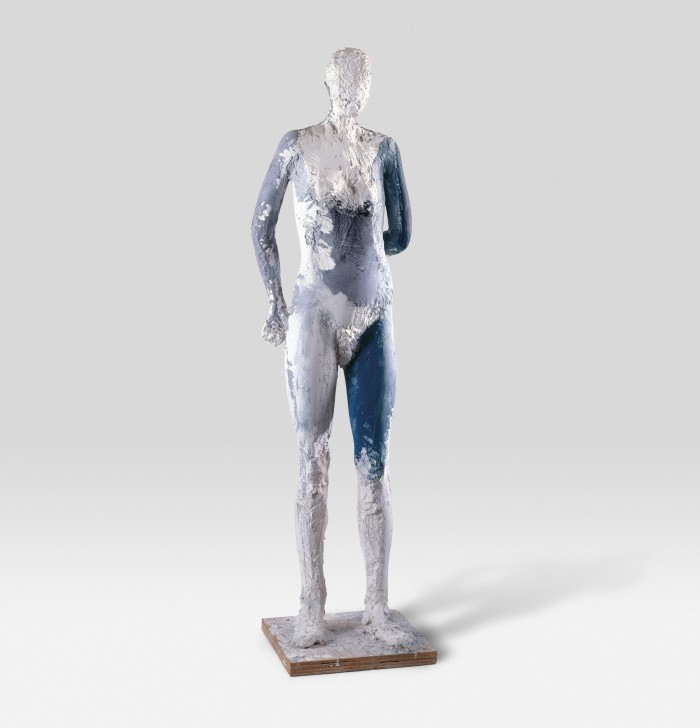
Standing Figure II (two in Roman numerals) is a life-sized plaster figure modeled after poet Mary Julia Klimenko by Manuel Neri. The plaster gleams a bright white, and various swaths of her body are accented with black, royal blue, or light gray pigment. The sculpture was made in 1982 and reaches five-and-three-quarters feet tall, and around a-foot-and-a-half across as well as front to back. She is slender and stands atop a two-foot-square informal pedestal of unfinished plywood just a couple of inches high. While this wood square elevates her a bit, she is also rooted firmly to it by the very plaster she is made of. The plaster was molded around her feet, essentially gluing them in place when it dried and set. Drips and light smudges lightly coat the surface of the pedestal. A few small drops strayed to land on the pedestal’s sides.
Like so many of Neri’s sculptures, this untitled artwork is rendered anonymous because the figure lacks facial features and hair on her head. While very distinguishable as a nude woman, she is not like a mannequin with its symmetry and all-over extremely smooth texture. Her head and face are rough and bubbly with scrapes and peaks. While most of her body has a smooth enough surface–mostly the sections with pigment–even these are marked by lumpy ridges, sharp furrows from a palette knife, thin criss-crosses scratched across her, bubbly breaks in the color, and globs of pigmented plaster flung lightly onto the white parts.
She stands with her feet about hip distance, the left an inch in front of the right. Her left arm is bent and hooked behind her back. Her left thigh and arm are painted the darkest and most thoroughly, the thigh royal blue and the arm black. Her face and chest are white save for a few gray splatters, and her breasts are small. Gray pigment like an apron courses down her belly and stops a few inches above ample pubic hair made by mounding up and carving the wet plaster. Her right thigh has a few strokes and large dots of gray, and her right arm is mostly gray, with a slight bend in the elbow. Her right hand is balled into a fist that rests against her right buttock.
The figure’s lower legs, especially her right, are unrealistic, like her face and head; they are punctuated by gouges and sharply carved ridges. Even faceless, and with so many un-human-like lines and scratches, her size and proportions are so realistic that it is no surprise she was modeled after a real person.
This life-size plaster figure was modeled after Neri’s long-time muse and model, the poet Mary Julia Klimenko, who became his principal model in 1972. It is not a portrait but a figure—one of hundreds Neri has made in plaster over the course of his seven-decade-long career. Plaster is the medium for which he is best known. Affordable and readily available, it can be worked quickly and easily—molded when wet and carved when dry. Every inch of the sculpture’s surface has been handled; scratched, gouged, dimpled, and scraped, it is alive with the artist’s presence. The vagueness of the figure’s head and face pushes our gaze to the subtle yet dynamic thrust of her body: thighs flexed, hips pushed slightly forward, arms pulled back. These gestures are highlighted by expressive strokes of paint in moody blues and grays. Modeling the plaster from life, Neri remade Klimenko’s lithe body from an intimate knowledge gained and imparted by touch.
-Sidney Simon ’18
Artwork Details
- Manuel Neri
- b. 1930, Sanger, CA
- d. 2021, Sacramento, CA
- Standing Figure II
- 1982
- pigment on plaster
- 69 1/4 x 17 7/8 x 19 1/2 in.
- 2014.1.059
- Decade:1981-1990
- Medium:pigment
- Movement:Bay Area Figuration
- Currently not on view