Peter Voulkos
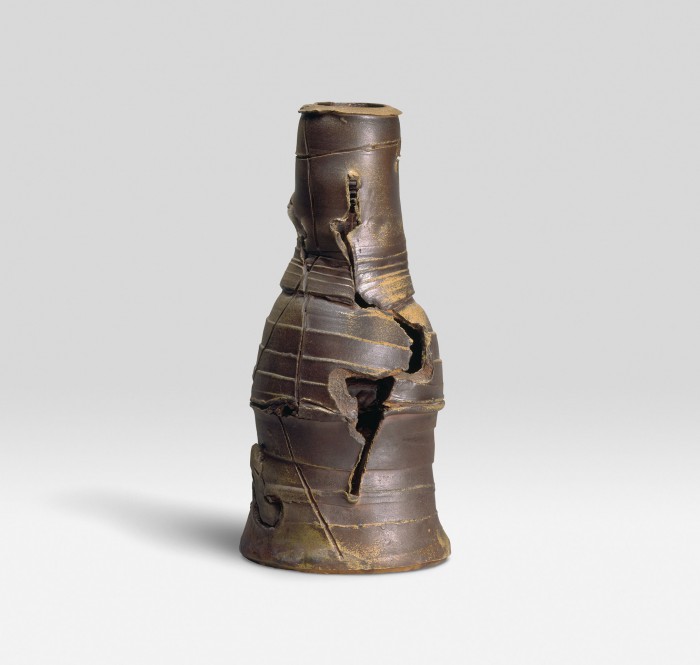
Untitled Stack 1981
© Voulkos Family Trust. Reproduction of this image, including downloading, is prohibited.
Audio Description (04:24)
Full Audio Transcript (Expand)
Untitled Stack
Untitled Stack, by Peter Voulkos in 1981, is a scraped, gouged and misshapen-looking stoneware vessel, otherwise dark copper-brown and smooth, in the overall shape of a bottle, which stands about three feet tall and a foot and a half wide at the base. On display atop a podium, the artwork appears to have been assembled, or re-pieced together, crudely from three stacked sections, each about a foot-tall. The glinting edges and dark depths of the grooves and the hollows give the sides a busy look, and a-misaligned-series of parallel encircling seams, or scars, appears subtly decorative. In profile, Untitled Stack most resembles an old-fashioned Coca-Cola bottle, but with a stouter neck and, with a flare at the bottom, having a slightly wider footing.
A sense of the design and the construction arises as you walk around the vessel and survey the variety of reckless-looking scars.
The sides of the neck and shoulders portion, rather than seamlessly merging with the parts below, drape over and around the wider middle in the way of a shawl or a split skirt. In fact, this top section has a skirt-like split running down to its hem in the form of a gash, which continues nearly to the base of the artwork. Within the middle section the gash jags, widens and re-narrows twice before ending in a straightaway. Voulkos seems to have created the widening jags by tearing a piece away from the right side of the gash and from the left side below it.
The bottom and the middle sections appear flushly joined across a seam, which encircles the vessel at its widest and slightly protrudes like a pair of lips. These appear parted around most of the circumference, and in different stages of collapse around the rest.
The similarly tidy look of the top and bottom ends of the gash suggest the use of a one inch carving tool, which Voulkos used to make an initial cut in a straight line before brutalizing it into a gash. Voulkos has clearly used just such a tool to carve two channels, which run up and down the sides of vessel at intersecting diagonals, and at the top of one he has carved it all the way through the vessel wall to create a short gash just a quarter turn around the neck from the top of the long one. Deformations suggest he applied the same tool to both as a pry bar after he carved them.
A third channel takes a spiral turn around the neck a few inches above. Lower, Voulkos has carved an X or maybe the Greek letter chi in two places with the tool. In the middle and the bottom sections he made stab marks.
For all that Voulkos seems to have made obvious, his ultimate purpose may have been to obscure or confound. It seems the sections of Untitled Stack might just have stacked or otherwise been together originally in a different order. Below the seam between the middle and the bottom, one of the diagonals fails to continue from where it arrived, but seems to resume a few inches to the left—as if the two sections had slightly twisted position relative to one another. Had Voulkos not made it obvious that he created Untitled Stack in stages, this possibility of a twist would seem to be excluded by the straight cuts that the other diagonal and the long gash make through the seam. But Voulkos could have made these cuts after he applied a twist. The overhanging skirt of the top section suggests it might have been lopped off a wider one than Voulkos has parked beneath it—or else match the wider end, were it to be flipped. The symmetrical shape of the bottom section suggests it could be flipped.
Approaching Voulkos’s sculpture, the initially coppery shimmer of the ceramic surface appears instead to be sprays of droplets splattered in places around the shoulders and the base. Up close, they are simply a very light tan color, resembling a pale liquid clay, or slip. They appear to have been sprayed at a grazing angle to highlight the raised encircling lines and the edges of the cuts, and the wider splatter seems liable to have come about incidentally. A speckle of black flecks visible elsewhere may be ashes or embers that floated by and fused during the firing.
Gazing down through the mouth of the vessel, faint grooves densely encircling the inside suggest that the construction of the neck, at least, began on a potter’s wheel. Looking through the gashes, there are also finger-wide grooves that run up and down visible, where a cut-out in the vessel wall was stoppered or plugged from the inside.
Shallowly plugged cut-outs are visible especially near the bottom of the vessel on one side, some roughly the shape and size of small shoe prints, angled diagonally, others smaller and roughly round or oval—with a neat array of stab marks amidst and around them.
Peter Voulkos was among the first American artists to explore the sculptural possibilities of clay. Influenced by abstract expressionism and Japanese pottery, he departed from the regular forms of wheel-throw vessels to push clay toward expressive rather than utilitarian ends. Known as an innovative sculptor, he attracted students to his workshop at the University of California, Berkeley, where he set up the ceramics department in 1959. The work shown here reveals Voulkos’ exploration of the physical properties of his material. Using the form of a traditional vessel, he has squeezed, scored, and dented the clay, activating the rounded form with protuberances and scooped-out caves. Roughly torn and jagged edges split the surface. As the pot sags and leans, the wounding rifts render it functionless as a vessel.
Artwork Details
- Peter Voulkos
- b. 1924, Bozeman, MT
- d. 2002, Bowling Green, OH
- Untitled Stack
- 1981
- wood-fired stoneware
- 35 1/8 x 16 3/8 diameter in.
- 2014.1.056


![Japanese Dancer Series No. 12 [Makiko], 1980](https://anderson.stanford.edu/wp-content/uploads/2017/07/MN.1980.DWG_.045-220x311.jpg)
![Japanese Dancer Series No. 2 [Makiko], 1980](https://anderson.stanford.edu/wp-content/uploads/2017/07/TAC-58666-220x311.jpg)