Terry Winters
Theophrastus’ Garden 1982
© Terry Winters. Reproduction of this image, including downloading, is prohibited.
Audio Description (03:16)
Full Audio Transcript (Expand)
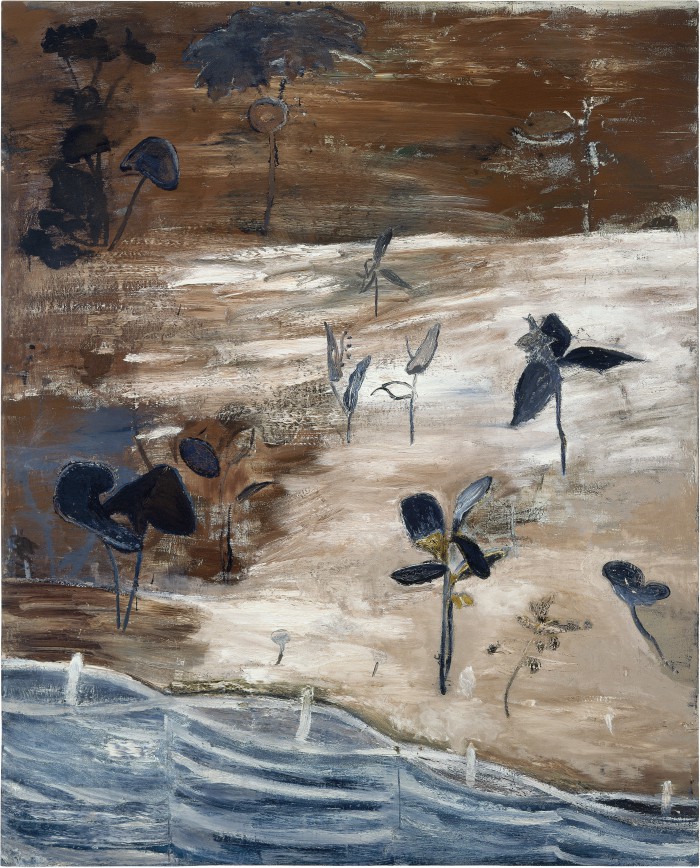
Theophrastus’ Garden by Terry Winters is one of a series of four paintings sharing the name of the Greek philosopher and father of botany, Theophrastus. Painted in 1982 in oil on linen, this artwork towers almost seven-and-a-quarter feet high by six feet wide and features plantlife on a sandy riverbank. Growing solo, or in small clusters here and there, are around two dozen midnight- and Prussian-blue short, flowering plants and tall, slender-stalked mushrooms. It could be more, but several were painted over, scratched away, or appear to have been left unfinished. Some can be ghostlike and hard to spot. One plant near the front has a few coppery highlights, while all the rest are blue all over. Winters made no attempt to bury the plants’ stems in the loam. This gives them an ever-so-slight sensation of floating and like they could be plucked right off the canvas. The riverbank is clay brown, much of it covered in soft, uneven, wide strokes of white. On occasion, a touch of blue from the tip of a leaf or petal is gently smeared over the white. The river is the same deep blue as the plants, and it courses along the bottom border of the canvas. White-crested ripples undulate along the surface until the river spills into a small, dusky, blue-brown marshy area on the left. A distant, lanky tree resembling a palm and a tree with tufts of leaves only at the very top stand near the upper left corner like giant, open umbrellas that stretch into a burnt umber and walnut-brown sky streaked with white.
There is little sense of perspective in this lush garden painting. Rather, Winters painted many of the further-away, blue flowering plants a little paler and a little smaller. In the top left corner, a patch of dark mushrooms with caps like bells seem nearly as tall as the tree just behind it. The palm tree next to them has a bulge near the top of its trunk, like an exceptionally large coconut, just before it splits in two, each branch with its own crown of thick, pointy fronds. While some of the plantlife might feel recognizable–a palm, a trillium, mushrooms–this painting is not trying to be a lifelike representation. The colors feel autumnal, yet the flowers bloom and the tree is in full leaf. Thick strokes and bristle lines alternate with areas of paint smudged smooth and occasional drips, giving the artwork a range of textures. Although the sky is dark, there is no sun, moon, or stars; and it somehow feels just fine that the sky is the same muddy brown as the marsh. The river and plants at the center and front are well lit but cast no shadows.
Theophrastus engaged in a practice that included taking walks while discussing philosophy. He likely would have very much enjoyed weaving through the plants in Winters’ idea of a garden and stopping to cool off at the edge of the brisk, velvety river.
Artwork Details
- Terry Winters
- b. 1949, Brooklyn, NY
- Theophrastus’ Garden
- 1982
- oil on linen
- 87 x 70 in.
- Inscribed on stretcher bar: Theophrastus' Garden, 1982 Terry Winters 87 x 70
- 2014.1.105
- Decade:1981-1990
- Medium:oil
- Movement:Contemporary Painting
- Currently not on view