Nancy Graves
Telestich 1988
Art © Nancy Graves Foundation/Licensed by VAGA, New York, NY. Reproduction of this image, including downloading, is prohibited.
Audio Description (02:59)
Full Audio Transcript (Expand)
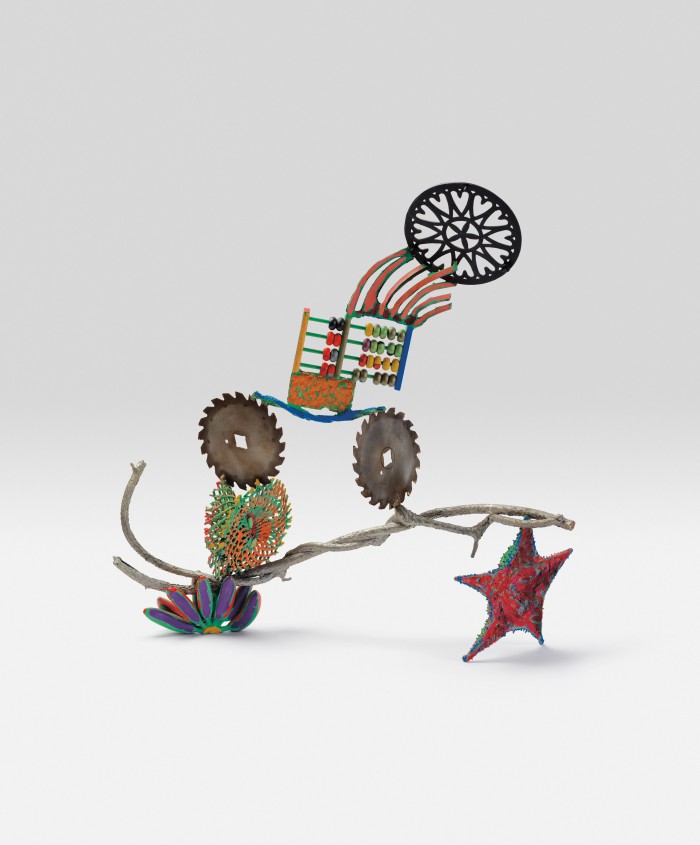
Nancy Graves’ 1988 sculpture, Telestich, is a carbon, stainless steel, iron, and bronze sculpture made of ten distinct elements. Many are cheerfully and brightly colored, while others are left unpainted so that their metallic sheens are on full display. The artwork reaches just over two-and-a-half feet long, and high, and is a little over nine inches deep. The mixed-media elements making it up do not seem like they should go together: a bunch of bananas; a pair of thick, twisted, woody vines; an abacus; and round track saw blades, to name a few. But Graves cleverly matches natural-looking and more industrial objects into an assemblage of metal pieces that is beautifully balanced. She also takes advantage of literal balance by arranging and welding the metal pieces together in a gravity-defying stack.
The base of the sculpture is a shiny set of two leafless vines floating horizontally, one twisted around the other. Their surfaces are bumpy and silver-shiny. On the left, the vines balance in an upside-down bunch of nine short, teal bananas with fire-engine-red accents and wide smears of violet. The right side of the pair of vines is welded to the top point of a five-pointed sea star, and the sea star stands on its bottom two arms. The sea star’s belly is the same red as the bananas’ accents, with little gray strokes. Its top side is turquoise, rimmed with royal blue, and studded all over with tiny spines. Standing on the vines above the bananas is a set of two shallow mesh dishes in thick lichen green and burnt orange paint with bits of red and mustard yellow. They stand back to back on the vines.
Perched atop this set of mesh dishes is a scratched-up 20-tooth circular track saw, its teeth darkened from use. A short, shiny teal and cobalt blue metal rope connects to two upper saw teeth. This short rope leads about six inches to the right, where it connects to the top of a matching track saw situated on a knot in one of the vines. Continuing higher on the sculpture, a thin bright orange and green rectangle like a Graham cracker is welded to the top of the rope. Above that, a four-rung abacus with vivid red, metallic gray and green, black, yellow, and purple beads. The abacus is divided in two. Each of the four rungs has two beads on the left side and five on the right. Springing up out of the right side of the abacus are seven strands of metal. The strands are like a rainbow, if every line of a rainbow were watermelon pink with green edges like rind and splotches of burgundy between the strands.
The sculpture is capped off by a round, vintage cast iron trivet with a repeating heart motif and a five-pointed star at its center. Five of the seven rainbow-like strands attach to the trivet like gripping fingers. It feels as if the fingers are ready to toss the trivet high in the air, if only they were not permanently fused together.
Artwork Details
- Nancy Graves
- b. 1939, Pittsfield, MA
- d. 1995, New York City, NY
- Telestich
- 1988
- carbon & stainless steel, iron & bronze
- 31 1/8 x 31 1/8 x 9 1/2 in.
- 2014.1.096
- Decade:1981-1990
- Medium:metal, mixed media
- Currently not on view