Bill Jensen
Study for Denial 1983-85
Reproduction of this image, including downloading, is prohibited.
Audio Description (06:12)
Full Audio Transcript (Expand)
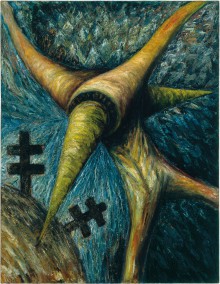
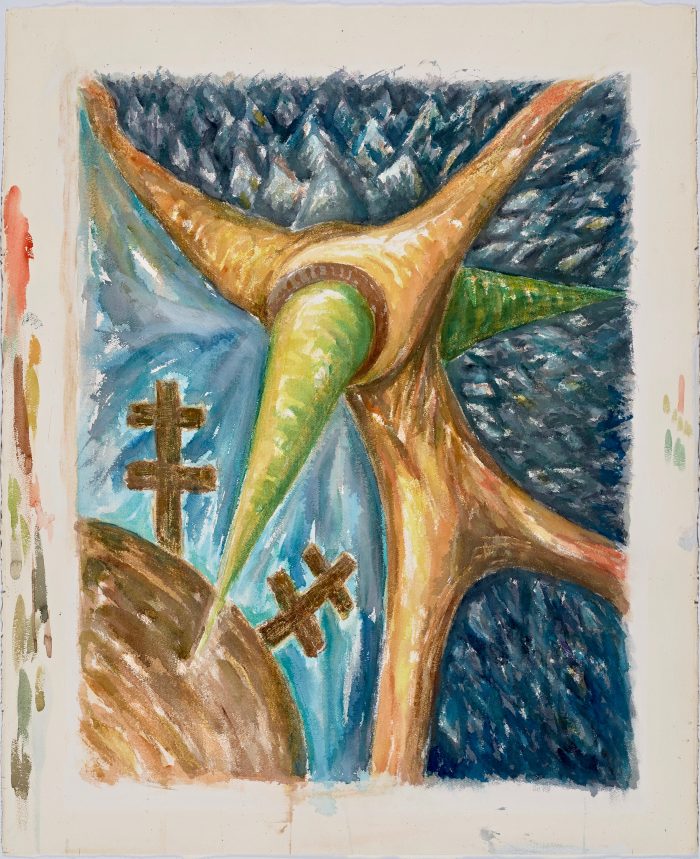
Study for Denial, by Bill Jensen, created in the years 1983-1986, is a watercolor and gouache painting of 4 feet, one inch by 3 feet, four inches. As the title suggests, it is the prototype for another Jensen artwork, the oil painting Denial.
The image that makes up the study takes up most of the paper, though there is a neat, off-white border of unpainted paper that frames the artwork. It includes running paint at the bottom of the piece, and vertical brushstrokes of varied length on either side—long and thick on the left side, short and thinner on the right—that form a dried palette, featuring the colors Jensen used in the artwork.
The painting is more of a sketch than a fully realized artwork; it presents almost a rough imitation of the final version—all of the elements of Denial are present, but only in undefined ways: the colors are delicate, though not without vibrancy; still, they sometimes appear more water than color. The shapes that make up the background elements are soft, as if seen through fogged glass, and lack detail. Light and shadow are mere suggestions, hinted at by intensity of value. Jensen’s brushstrokes feel loose, and don’t always completely cover the paper—there are many places in which naked paper peeks through paint.
Like Jensen’s later Denial, this study is dominated by large, elongated, conical forms that meet in a tangle just above the center of the frame. They have an organic quality, each shaped slightly differently.
The foregrounded form appears a bit like a carrot. It is comprised of myriad dusky oranges, ruddy browns, and russet reds, and, near its thickest part, has a roughly triangular portion that lacks any watercolor at all.
This form runs diagonally along the upper right-hand part of the work; its thickest part is at the intersection of the objects, jutting out. It tapers as it stretches upwards, its end—if it has one—a mystery, perhaps coming off panel.
Emerging from the flat top of the thickest part of this central object—like the stalk that springs from the top of a carrot—is a cone of two greens: like that of a ripe lime on the left, and like that of well-hydrated forest moss on the right. The shades mingle, the bandlike strokes with which Jensen applied his paint here overlapping. The cone punctuates in a sharp, drill-like tip that points at the bottom left section of the painting. It is nearly as long as the orange tubular form it is attached to.
Running perpendicular to the orange section of the conjoined objects is another tubular, carrotesque body, this one slightly thinner than the first. It curves upward like a tree branch searching for sunlight, running diagonally up the upper left-hand side of the piece. It is made of an array of ashen oranges, desolate browns, and a dash of grimy red.
A green cone, darker in hue than the first—featuring bands of regal emerald and dry-grass green—stretches out to the right side of the canvas, forming a roughly 45-degree angle with the first orange object described. Whether it is connected to the second carrot-like body is unclear; the place they would be joined is hidden by that first object.
A fifth flange completes the central group of objects: an object that suggests a gaunt tree trunk that runs towards the bottom right part of the painting, and that terminates in two forked limbs, that evoke the roots of a tree. Each of these “roots” run off the edges of the artwork. The trunk
itself continues the diagonal line made by the second orange object; together, they bisect the painting.
The trunk is alive with stripes of chocolate brown, lemon yellow, peach pink, plum red, and the occasional streak of white. The darker colors are concentrated on the outer parts of the trunk, the yellows and pinks populating the interior portions. Whereas the strokes of paint making up
the other parts of this central mass are often curved and horizontal, here the strokes are straight, vertical, and diagonal.
There are two parts to the background of this work.
On the left, situated in the distance behind the central element, is a quarter of a sphere, stretching from edge to edge of its corner of the painting. The object is studded with two large patriarchal crosses, each of their two horizontal lines of equal length; they appear like squat utility poles. The crosses are perhaps a third of the size of the portion of the sphere in the painting, and are cockroach brown. The same color makes up most of the orb, though watery browns and sickly yellows appear in the section closest to the edge of the artwork. The sphere and crosses have a roughhewn, textured quality, particularly the darker sections, as if so much water was applied, the paper began to turn to pulp, before drying again. The sections that are lighter in color are patchy, clearly made of quick, small strokes that failed to completely color the paper, leaving patches of white.
Behind all these elements is a confusion of blue: long diagonal strokes, and sideways strokes, applied heavily in hues that range from that of the midday sky to the near purple of twilight.
The background of the right half of the painting is filled with triangles that grow smaller as they approach the edge of the canvas; they appear as small, hazy feathers or scales, largely deep blue, but flecked often with lighter blues and whites that approach silver. These shapes grow increasingly unresolved as one moves one’s attention from the top of the artwork to the bottom right—in that region, the triangles fade completely: there is just a carpet of dark blues spanning from deep sapphire to midnight.
Artwork Details
- Bill Jensen
- b. 1945, Minneapolis, MN
- Study for Denial
- 1983-85
- Watercolor and gouache on paper.
- 49 x 40 in.
- 2016.1
- Decade:1981-1990
- Medium:gouache, watercolor
- Movement:Contemporary Painting
- On view