Donald Sultan
Street Light, February 7, 1982 1982
© Donald Sultan. Reproduction of this image, including downloading, is prohibited.
Audio Description (02:55)
Full Audio Transcript (Expand)
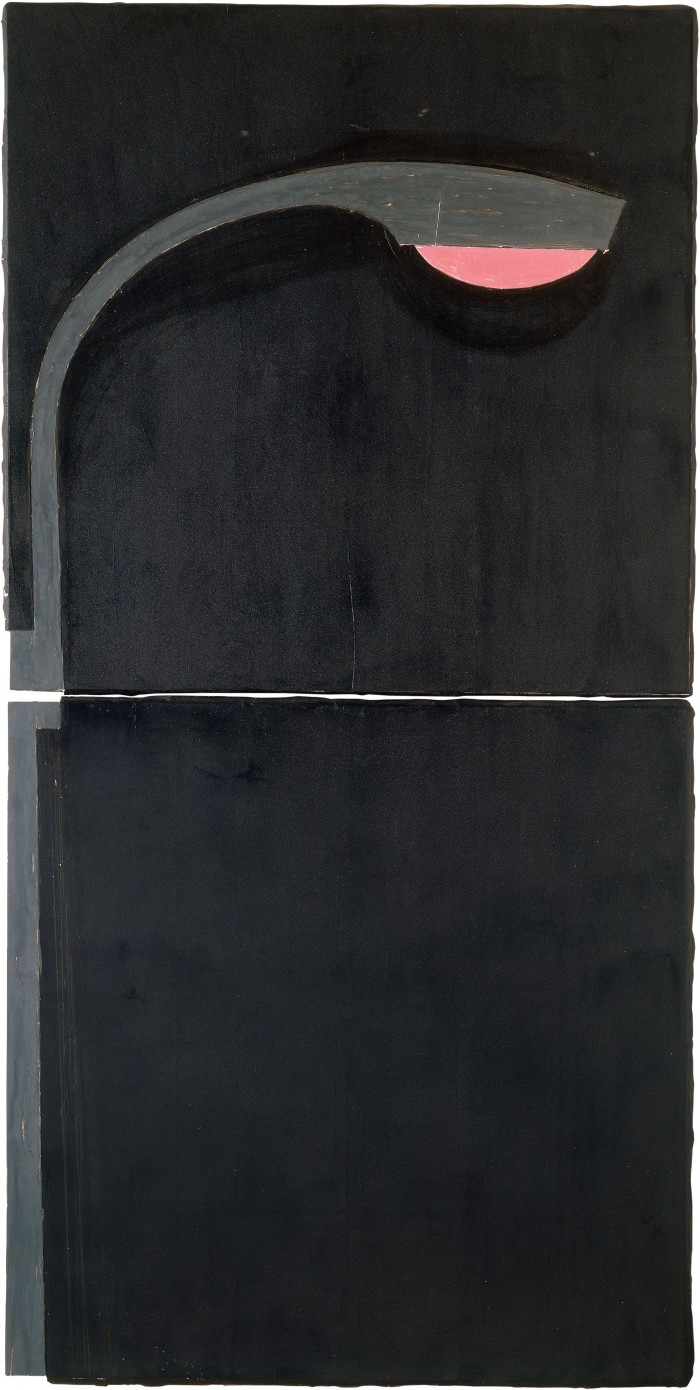
Donald Sultan’s Street Light, February 7, 1982 is a still life in two pieces from that year. The painting depicts a dark night sky and the silhouette of a lone street light. A slender line of steel-gray stretches from the bottom left edge and along the left side. About three quarters of the way up, it gently curves into a short arm that reaches almost to the right edge and holds a bulb that points downward. Faint streaks of a pale tan color and an uneven darkness to the gray paint both give the post a bit of a metallic sheen. The shape of the street light somewhat resembles a tall kitchen sink faucet. The light bulb is a dusky rose-pink orb that peaks out from the underside of the lamp like a drop of water waiting to fall from the tap.
Sultan started with two squares of masonite. He attached one-foot-square vinyl floor tiles onto four-foot squares of masonite. A layer of spackle was applied to the tiles, and the still life was made with gray and pink oil paint, and dense black tar. The pieces are hung one above the other, with a slender gap between them. Together, they are four feet and five-eighths-of-an-inch wide and a bit over eight feet tall.
The depiction is very recognizable as a residential street lamp but is not completely realistic. Sultan abstracted the street light by constructing the post of two pieces, rather than making it one long structure. It rises flush against the left border from the very bottom. Just before it reaches the top of the lower tile–and a short way up the upper tile–it is doubled in width, as if the upper portion that curves and holds the bulb is fastened to the rest of the post. This short area where the post is twice as thick is sliced through horizontally by the gap between the tiles.
From a distance, the surface of the artwork may appear even, but against the black, the gray streetlight appears ever so slightly recessed from the night sky. Pale tan streaks along the structure peek through the gray paint. The sky always hangs a fraction of an inch below the bottom border of both pieces of masonite, and has undulating, drippy edges all around.
The upper portion of the street light has a shadowy halo of tar painted all around it. Countless tiny speckles of white show through the black, as if every star in the galaxy were packed into these two tiles. Or maybe the street light is positioned near a bumpy, light-gray cement wall incompletely painted black, and another light is shining onto the scene from the side to create the shadow from the lamp against the wall. A residential street light could easily reach nine or more feet high, so Sultan’s depiction is nearly as tall as the real thing, even if its location and its function leave much to the imagination.
Artwork Details
- Donald Sultan
- b. 1951, Asheville, NC
- Street Light, February 7, 1982
- 1982
- oil, spackle, and tar on vinyl tile on masonite
- 97 3/4 x 48 5/8 in.
- Verso: Street Light Feb. 7 1982
- 2014.1.082
- Decade:1981-1990
- Medium:oil, tar
- Movement:Contemporary Painting
- Currently not on view