Terry Winters
Set 1989
© Terry Winters. Reproduction of this image, including downloading, is prohibited.
Audio Description (03:20)
Full Audio Transcript (Expand)
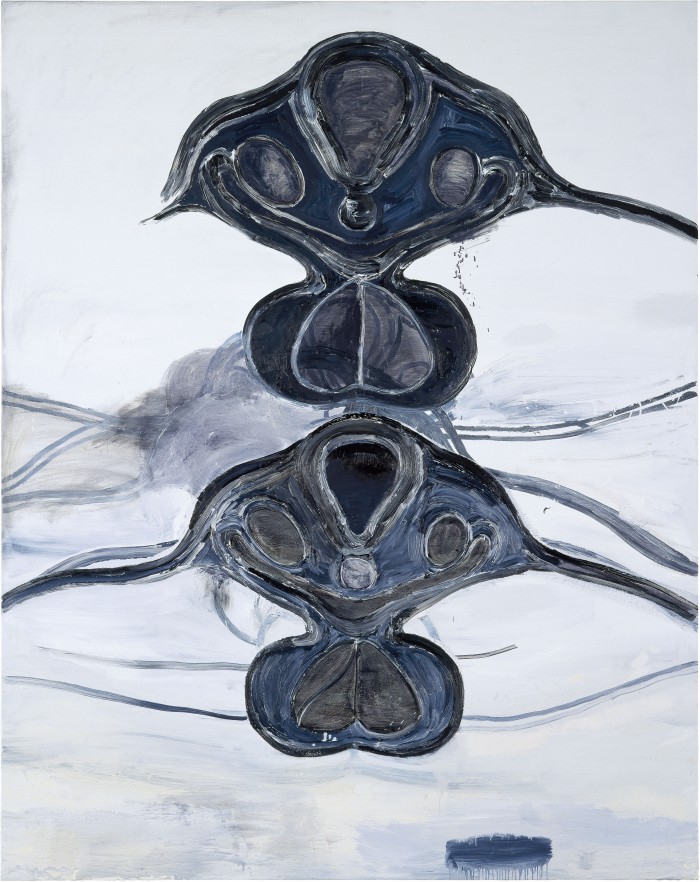
Terry Winters’ painting Set is oil on linen canvas, eight feet tall and six-and-one-third feet wide. Made in 1989, it certainly shows a set of things. What those things are is left to the viewer’s imagination. There are two dark shapes stacked in a column down the center, with smaller shapes housed within them. They nearly fill the full height of the mostly cool-white painted canvas. The painting is reminiscent of a Rorschach inkblot test, not only because the viewer can bring their own experience to interpreting it, but also because much of the set of shapes is almost symmetrical left and right. But they are far too elaborate and too deliberately detailed to be ink blots. They may be two fantastical, floating sea creatures. Or they could be like a medical scan of two spines, and nearby internal organs, viewed from above. As an artist, Winters was keen to blend the natural world with imagined ones, and to study parts of the real world that humans cannot perceive without technologies like those used in medical imaging.
The main stacked structures are outlined in black and filled in with black, slate-gray, and blues. The blues range from navy to dull lapis, where it was lightened by white. The top two thirds of each structure is a slightly lumpy, wide blob that narrows briefly near the bottom center. It then flares back out into a shorter shape nearly as wide as the top one. This lower portion is like an oval being pinched at its center. Within the two stacked structures is a light bulb shape, a set of ovals with tube-like, snaking lines; circles; and an element like a butterfly wing. These internal shapes could be recognized as the opening on a vertebra for the spinal cord to slip through, and various muscles and tissues nestled with the bone.
Though the resemblance to a medical scan is striking, there are painted lines emanating off the central shapes that bring the sea creature image to mind. One wavy, gray-and-black tendril streams off the right side of the top structure and another off the left and right sides of the bottom one. A handful of similar gray or black lines cross left to right, maybe representing ocean waves. Near where the two structures meet, the tendrils are smudged into a pale, foggy cloud. The bottom half of the canvas also contains wide, pale smears in gray and blue that invite the viewer to wonder if this is the depths of the ocean, or the surface, if these even are sea creatures. One short, thick bar of dark blue, streaky paint floats near the bottom right. Short, narrow rivulets of paint drip down from it to reach the canvas’s bottom edge as pale blueish paint drips a little onto the bar from above.
From a distance, the various colored shapes may appear either just light or just dark. Coming in closer, it becomes clear that Winters did nothing to hide the fact of painting with a brush. Darker areas are imperfect, filled with little dots of white or smudged gray. Lighter areas are often made with blue or black only partially blended with white. The brush bristle lines delineate the colors only from up close. In places, the paint appears thick, and in others thin and crackly. Drips of gray and white hover here and there. All of this creates Winters’ own world, but one to which the viewer is always warmly invited.
Artwork Details
- Terry Winters
- b. 1949, Brooklyn, NY
- Set
- 1989
- oil on linen
- 96 x 76 in.
- 2014.1.103
- Decade:1981-1990
- Medium:oil
- Movement:Contemporary Painting
- Currently not on view