Susan Rothenberg
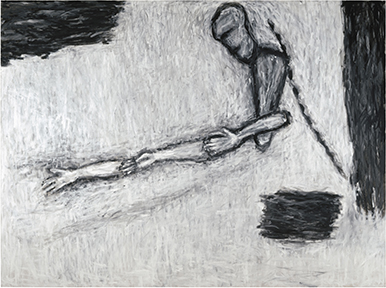
Patches 1982
© 2014 Susan Rothenberg / Artists Rights Society (ARS), New York. Reproduction, including downloading of ARS member works is prohibited by copyright laws and international conventions without the express written permission of Artists Rights Society (ARS), New York.
Audio Description (03:17)
Full Audio Transcript (Expand)
Patches by Susan Rothenberg is a black-and-white oil painting on canvas from 1982. It spans seven-and-a-quarter feet tall and nine-and-three-quarters feet wide. There are three distinct patches of black within a mostly white field, and the center of the painting features a combo of three disembodied arms, two geometric forms, and one line like a snake with a diamond pattern along its length. Nowhere is the painting purely white or purely black. The white is everywhere accented with black to make gray, and the black is accented with white. The whole artwork is painted in short, energetic strokes. The short white-and-gray lines mostly all go up and down, but in some areas, sideways strokes layer on top of them. It feels almost like an aerial view down onto a field of grains. Each gray brushstroke is like a stalk of wheat, whether standing up in packed rows or lying strewn over the remaining stubble after cutting. If this were a field, the three black patches could resemble mostly tidy stacks of cut straw. However, this is not just a possible study of agriculture because the viewer cannot ignore the bodiless arms and the shapes hovering at the center.
Here is a little more detail about the patches and the shapes. The upper left corner is filled with the white-accented black strokes in a near-rectangle wider than it is tall. The next black patch is a long pile streaming from the upper right corner to three-quarters of the way down the right side. The third patch is much more like a straw bale: a small rectangle with scraggly edges that sits on its side near the bottom of the longer right-side patch.
The diamond-patterned snake-like line is on a diagonal from near the bottom of the long right-side black patch, up and toward the left a bit, almost reaching the top border. To the left of the line sits a right triangle that points down and has rounded corners. The diamond-patterned line rests against the triangle’s top right corner. The upper left corner is attached to a bulbous shape like a worn river rock that nears the top edge of the canvas. Close to the bottom point of the triangle is where things really get fun. A human forearm lies across the triangle with its hand on the left. The fingertips curl down slightly as if to grip the forearm of another floating arm and hand. And this second limb connects to a third to create a chain. Above and below the arm chain, the sideways black strokes become more prominent, giving a sensation that the arms are part of a machine pulling through the strokes, like they are harvesting this possible wheat crop. But wheat harvest or not, maybe there are not three distinct human arms. Perhaps Rothenberg wanted to create something like a time-lapse representation of one arm being pushed or pulled by the triangle and the bulbous shape. This could be three distinct moments of one arm’s movements across the canvas in either direction. This would be a clever machine that needs no complete human body to operate it.
Artwork Details
- Susan Rothenberg
- b. 1945, Buffalo, NY
- d. 2020, Galisteo, NM
- Patches
- 1982
- oil on canvas
- 87 x 117 in.
- 2014.1.108
- Decade:1981-1990
- Medium:oil
- Movement:Contemporary Painting
- Currently not on view