Scott Burton
Pair of Steel Chairs 1987-1989
© 2014 Estate of Scott Burton/ Artist Rights Society (ARS) , NY. Reproduction, including downloading of ARS member works is prohibited by copyright laws and international conventions without the express written permission of Artists Rights Society (ARS), New York.
Audio Description (02:37)
Full Audio Transcript (Expand)
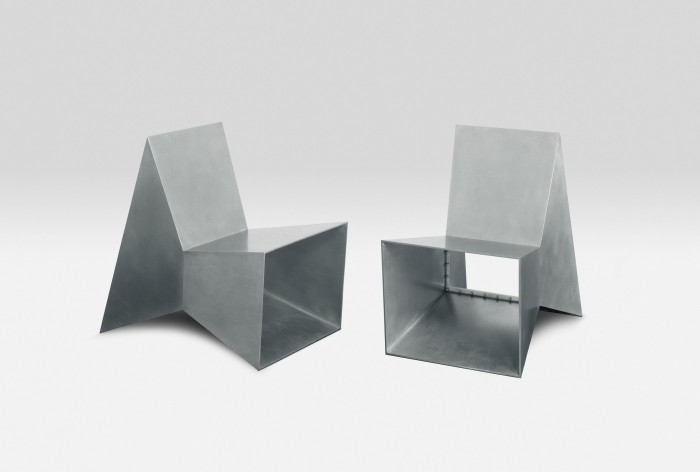
The name of Scott Burton’s post-minimalist sculpture, Pair of Steel Chairs, gives viewers only a hint about what is in store for them: a pair of steel chairs. These are identical, no-frills chairs without armrests or cushions. Each is made of two conjoined trapezoidal steel prisms like boxes turned on their sides, and the front and back sides of the chairs’ prisms are open. The open tops have a narrow lip all the way around on the inside surface, and their bottoms are completely open. Made between 1987 and 1989 of slightly rough, matte, dark-gray metal, the chairs are elegant in their simplicity. They were created from sheets of hot-rolled steel, and the two prisms per chair are fastened together at their inside lips with screws. Each chair is nearly three feet tall by almost two feet across, and almost three feet from front to back. The seat slopes down to where it meets the back. The backrest slants so that if someone were to take a seat on the sculpture, they would be supported as they lean back just a little bit.
The trapezoidal prism used for each seat part is isosceles; all eight corners are right angles, and the rectangular base is wider than the rectangular top. The prism is turned on its side, providing an unobstructed view through the chair, under the seat’s surface. On its side, the prism’s wider base makes the edge where a sitter’s knees would bend over the front of the chair, and the narrowing toward the prism’s smaller top creates the slant toward the backrest. The back trapezoidal prism is not so even. Like the seat prism, the back prism’s open top and bottom are parallel, but the sides are different lengths and slope different amounts. This creates sharper corners at the bottom and wider angles at the top. The back prism is upturned so that this prism’s open top connects to the seat prism, and the larger bottom opens to behind the chair. The backrest is longer than the side that slopes down to touch the ground in back.
From the outside, the chairs appear to be made of only sheet metal. Crouching down and peering into the base, one notices the only deviation: twenty-four screws with acorn nut caps evenly spaced along the lips of both prisms’ tops to fasten them together. Each acorn nut cap has six even sides and is topped with a round dome. The nut caps are shiny stainless steel. While parts of the chairs reflect off other parts depending on how lights are positioned around the sculpture, these reflections are somewhat dulled by the matte surface. The nut caps provide the only rounded parts of the artwork, and their mirror-shiny surface could create the illusion of tiny light bulbs inside the chair if a light were shined on them just so.
Artwork Details
- Scott Burton
- b. 1939, Greensboro, AL
- d. 1989, New York City, NY
- Pair of Steel Chairs
- 1987-1989
- stainless steel
- Two chairs: 32 3/4 x 21 3/4 x 31 l/2 in. each
- 2014.1.099
- Decade:1981-1990
- Movement:Post-Minimalism
- Currently not on view