Fletcher Benton
Oakland Maquette 1969
© 2014 Fletcher Benton / Artists Rights Society (ARS), New York. Reproduction, including downloading of ARS member works is prohibited by copyright laws and international conventions without the express written permission of Artists Rights Society (ARS), New York.
Audio Description (02:37)
Full Audio Transcript (Expand)
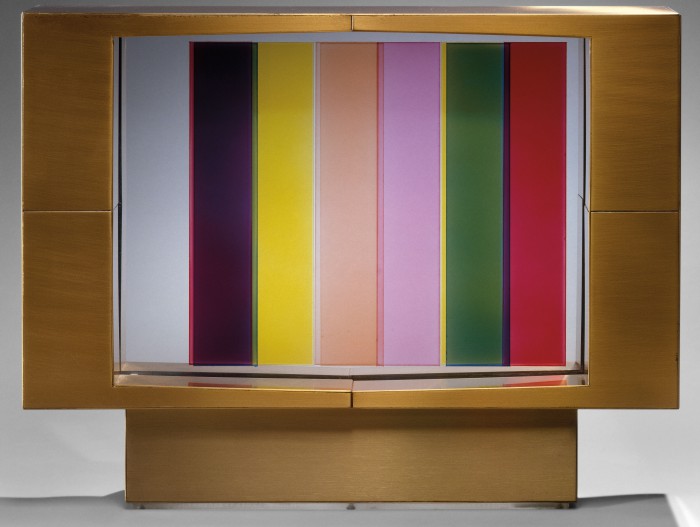
Oakland Maquette, by Fletcher Benton, resembles a futurist, design prototype-television from the mid-twentieth century. On a luminous, flat, rectangular screen, a rhythmically varying color pattern shines from a modernistically blocky surrounding frame of brushed-bronze atop a small matching base. The unit stands about a foot-and-a-half tall, two feet wide and a half foot deep.
The aspect, or width-to-height ratio, of the screen echoes the standard then well established in 1969, when Benton completed Oakland Maquette. The rhythmically varying color pattern on display somewhat resembles the stationary test patterns broadcasted during scheduled and accidental breaks–which likewise changed color and moved about when TV sets went out-of-tune or weather interfered with the signal.
But televisions in 1969 were not nearly so flat or thin as Oakland Maquette. Also, what appeared on them remained black-and-white, rather than in color, mostly: The widely watched Apollo 11 moon landing, for example. Color televisions had captured space in living rooms, but not even the best displayed colors so bright or present-seeming as the ones on-display in Oakland Maquette.
The strongest resemblance of Benton’s sculpture is to others of his so-called kinetic artworks, which he began making years earlier and for many years afterward. All of them dynamically superimposed brightly lit, multicolor transparencies within sleekly post-industrial cabinets.Their shapes varied widely, and many included other elements.
The multicolor transparencies of Oakland Maquette fill the large, rectangular opening within the bronze frame, and shine with the light of a lamp in the base out-of-view. They are clear, paper-thin, acrylic sheets, to which Benton applied colored stripes, side-by-side in parallel, and he superimposed the sheets within the frame. By way of an arrangement of gears, and a small motor, also hidden, the sandwiched sheets move to the left and right across each other, shining in new colors where different stripes align and blend.
The smooth, brushed-bronze surrounding cabinet appears to be made, on inspection, of four identical L-shaped blocks, which Benton joined into a rectangle: Joined toe-to-toe, on the left and right, to form two halves of the frame; and head-to-head top and bottom to the form the whole. Each block having a relatively thick base and a more slender ascending segment, the vertical left and right sides of the rectangular cabinet are three to four times wider than its top and bottom segments. A subtle taper in the upper arm of the L-shaped blocks makes the opening within the frame slightly taller in the middle than at the corners.
This exception to the hard-right angles elsewhere has a graceful, gentling effect. Benton created the sculpture as a test run for a larger piece, which for some time stood the full height of a wall at the Oakland Museum. Its roving, changing bands of color reflected in the floor.
Artwork Details
- Fletcher Benton
- b. 1931, Jackson, OH
- d. 2019, San Francisco, CA
- Oakland Maquette
- 1969
- silicone, bronze, acrylic, wood, lamp, and motor
- 17 1/2 x 22 7/8 x 4 7/8 in.
- 2014.1.013
- Decade:1961-1970
- Medium:acrylic, bronze
- Movement:California Light & Space
- Currently not on view