Nathan Oliveira
Nude in Environment I 1962
© Nathan Oliveira Estate courtesy John Berggruen Gallery. Reproduction of this image, including downloading, is prohibited.
Audio Description (02:39)
Full Audio Transcript (Expand)
Nude in Environment I
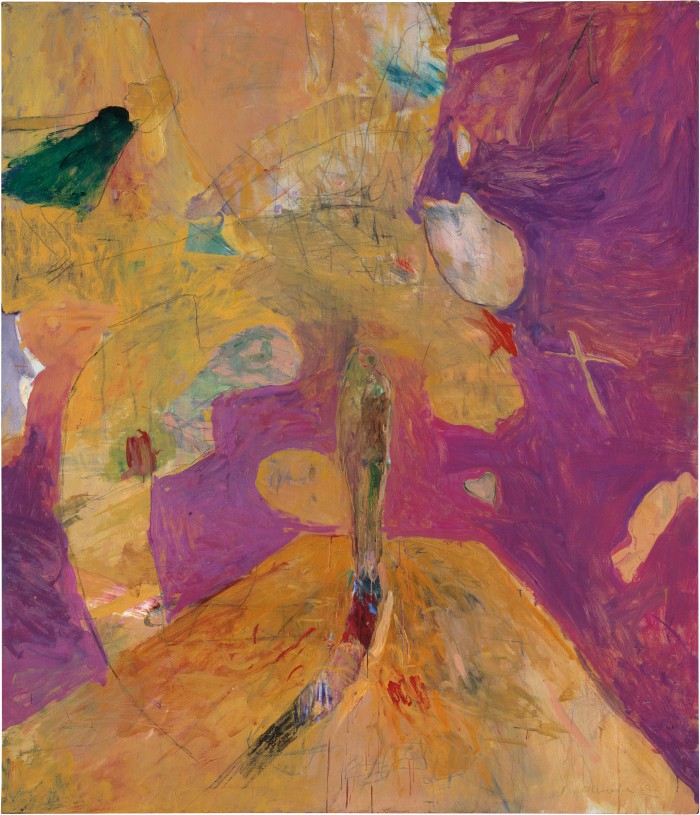
In Nude in Environment I from 1962, Nathan Oliveira uses oil paint and pencil scribbles to create a flamboyantly colorful fantasy room on a canvas just over five feet tall by just over four feet wide. Here, shadows bend, heads float, and bodies become walls. The floor and much of the wall on the left are fiery and golden with washes of teal, smudges of white, and one green patch outlined in pencil to reveal it is a dress. Slender pencil lines define the occupant of the dress with arms, one bent leg, and the head of a woman with shoulder-length hair in profile. Much of the back and right side of the space are purple accented with smears of pink and yellow. Midway up the wall is a floating yellow and green figure lying down. Its hairless head reclines into the purple side of the painting. Another head pops out below, connected to it by a bright red five-pointed star. Their featureless bodies are like the tail of a comet, crossing into the golden side. Scattered here and there are other heads, some bodiless, and others atop blocks of color that may be a body, a wall, or a door. In the purple are a heart, an eye, and a tiny figure painted yellow. At the center of this fantastical space is a thin, solitary nude figure standing near the back wall created from smudgy yellow, purple, and green. A slightly arcing dark burgundy red and black shadow stretches forward beneath her. The streaky gold floor is accented by red waves, blue lines, and colored pencil scratches in teal and purple. She has a small head, long hair in yellow and green that falls past her shoulders, and a pop of bright red for lips. Her arms rest close by her sides, and her slim legs taper off into rounded pink tips rather than feet. A head larger than her torso hangs sideways in the air, gently bumping up against her right hip and thigh. While the walls generally lack any sense of perspective or even corners, the floor is wide at the front and narrower at the back, giving a realistic sense of depth to an otherwise surreal place. The pencil scribbles that Oliveira uses are at times concrete, like the outline of the woman in the green dress high on the golden wall. At other times, they are energetic lines darting up and down, crossing over each other and curving. By painting this work with thin washes of color one over the other, the whole thing feels as if it is being viewed under rippling water. Or perhaps the sweeping strokes of color are more like flickering flames. The closer one examines the painting, the more one discovers pencil lines that might be another body, such as one lying down at the front, a leg crossed over the other, and an extra-long torso but no head. And stepping close enough, one can spot in very faint cursive in the lower right corner, “N. Oliveira 62.”
Oliveira, who was born in Oakland, was never an abstract painter; rather, he came to his expressionistic style via portraiture while he was a student at the California College of Arts and Crafts (now California College of the Arts, or CCA). He recalled, “I worked with certain aspects of Abstract Expressionism, chance, risk, gesture, but I had a responsibility to those traditional aspects of painting that dealt with an image.” Oliveira was a great admirer of Willem de Kooning; he also looked to European models of figurative expressionism, including the work of Max Beckmann and Edvard Munch.
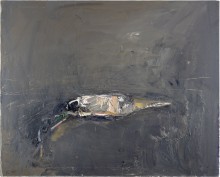
In Reclining Nude (1958), Oliveira brushed, pushed, and scraped thick paint to suggest the fleshy suppleness of a recumbent figure set against an abstract background. Nude in Environment I (1962) also imagines an environment unmoored from reality: in this case, a dreamscape with heads swirling around a rigid standing figure. Oliveira applied the colors in thin washes, articulating details with pencil scribbles.
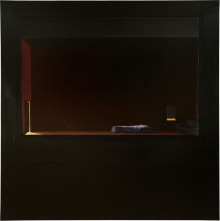
Oliveira all but gave up painting in 1963. In 1964, he moved to Palo Alto to take a teaching position at Stanford, where he stayed until his retirement in 1995. His new studio was in an abandoned theater, and it was there he began to paint again, in 1966. He set up a tableau on the stage and painted it directly. A dramatic light cuts into the dark proscenium in Stage #2 with Bed (1967). To the left of the bed, we see traces, called pentimento, of an armchair that Oliveira painted out of the composition.
Oliveira developed a close relationship with the Andersons after meeting them in the late 1960s, and offered invaluable guidance as they built a strong collection of California art. In turn, the Andersons opened their home and museum-caliber collection lo Stanford students, their way of giving back to Oliveira and the university.
-Sidney Simon, PhD ’18
The work of Nathan Oliveira is integral to the Anderson Collection for several reasons. Oliveira, born in Oakland, fuses the sensibility of abstract expressionism and European artists like Giacometti and Francis Bacon. He was a lifelong Bay Area artist and teacher, and taught as a professor of studio art at Stanford from 1964 to 1996. The Andersons befriended Professor Oliveira, who played a large role in advising and developing the scope of the collection. His works, including Reclining Nude, were some of the Andersons’ earliest acquisitions. Reclining Nude bespeaks Oliveira’s occupation with the singular human figure. His portraits are sensual, ceremonial, and meditative.
Artwork Details
- Nathan Oliveira
- b. 1928, Oakland, CA
- d. 2010, Palo Alto, CA
- Nude in Environment I
- 1962
- oil on canvas
- 72 1/8 x 62 1/4 in.
- Verso: Nude in Environment I 62" x 72" Urbana, Illinois 1962
- 2014.1.008
- Decade:1961-1970
- Medium:oil
- Movement:Bay Area Figuration
- On view