Robert Therrien
No title (red hangman relief) 1988
© 2014 Robert Therrien / Artists Rights Society (ARS), New York. Reproduction, including downloading of ARS member works is prohibited by copyright laws and international conventions without the express written permission of Artists Rights Society (ARS), New York.
Audio Description (02:29)
Full Audio Transcript (Expand)
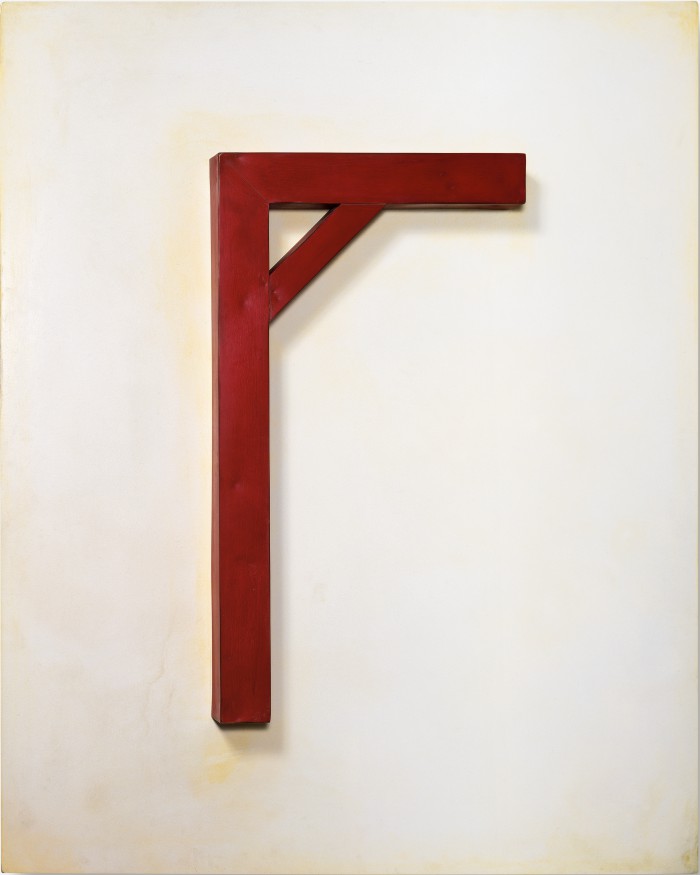
Robert Therrien’s No title (red hangman relief) from 1988 is a wall-mounted sculptural artwork made of two main elements: a red form that could resemble the corner of a tabletop and its leg–or even a corner and two sides of a picture frame–and the background on which it appears to almost float. It feels open to interpretation what the red form might be. If the title is any indication, it may depict simplified gallows. The form is made of three pieces, starting with a five-foot-tall four-by-four post standing upright. A horizontal 4-by-4 of half the length is attached to the top with a miter joint, and it points to the right. The right angle where the two meet is reinforced by a small, diagonal piece just underneath the joint. A real gallows, or even a drawing of one for the game called hangman, would be standing on a platform. Rather than being anchored to a platform, this one is affixed to a creamy-white block of aluminum so that it appears to float. Therrien has further removed the floating structure from the everyday world by creating it out of red enameled brass instead of wood.
Beveled like an ornate picture frame on the back side, the creamy-white aluminum block that serves as a background is seven-and-a-half feet tall, six feet wide, and seven inches deep. It has accents of orangey-beige, mostly at the corners, as well as clinging to the red form’s edges like shadows. Depending on how lights are angled around the artwork, the gallows’ real shadows may or may not fall along the orange shading.
Therrien’s use of color is noteworthy: The posts are painted brick red with smudges of slightly paler red for highlights and darker burgundy that echo the range of colors and tones in woodgrain. There are a few small, shallow, puckered spots in the metal structure that further resemble natural imperfections found in wood. On the aluminum block, the uneven application of the orangey-beige all around might bring to mind aging paper with faint water stains and yellowing from being exposed too long to sunlight.
Placing vibrantly enameled metal that looks like wood onto painted metal that looks like worn paper creates a wonderful illusion. From a distance, this artwork might appear to be an oil painting on paper. By focusing on the real shadows cast by the red posts onto the aluminum background, or by approaching the artwork from the side, the three-dimensionality comes to life.
Artwork Details
- Robert Therrien
- b. 1947, Chicago, IL
- d. 2019, Los Angeles, CA
- No title (red hangman relief)
- 1988
- enamel on aluminum & brass
- 90 x 72 x 12 in.
- 2014.1.097
- Decade:1981-1990
- Medium:enamel, metal
- Movement:Post-Minimalism
- Currently not on view