Robert Therrien
No title (bronze flagpole) 1985
© 2014 Robert Therrien / Artists Rights Society (ARS), New York. Reproduction, including downloading of ARS member works is prohibited by copyright laws and international conventions without the express written permission of Artists Rights Society (ARS), New York.
Audio Description (02:45)
Full Audio Transcript (Expand)
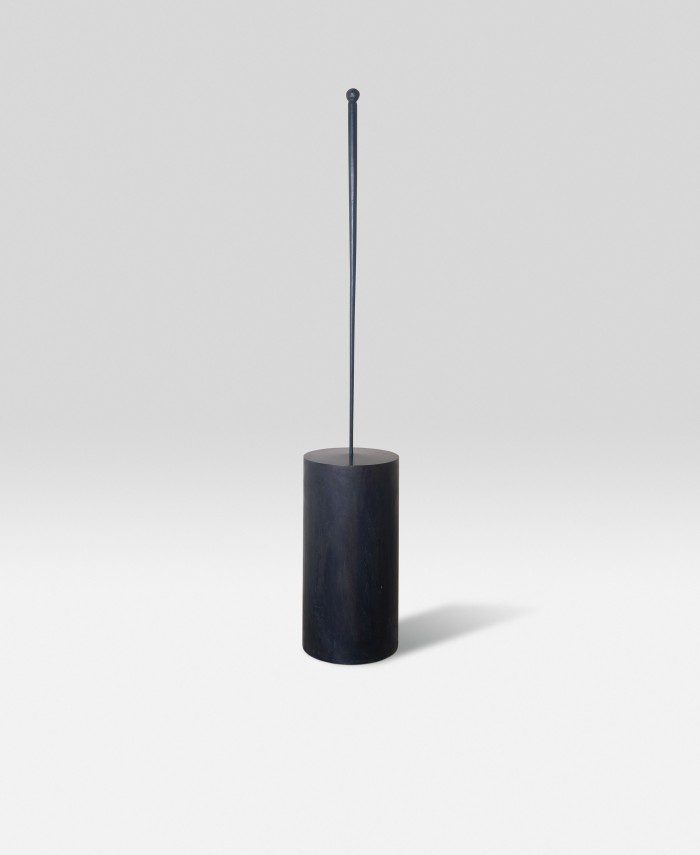
Robert Therrien has said that he hopes that, as an artist, he falls somewhere between a romantic and a realist. With his 1985 bronze sculpture No title (bronze flagpole), he has brought the irrational and imaginative features of romanticism to his rendering of a flagless flagpole. The sculpture manages to be realistic enough that a viewer might readily recognize the flagpole nature of it. And if not recognizable right away, the mere mention of the artwork’s name should make the flagpole apparent. The sculpture is made of three distinct elements all in smooth, matte black: an ornament atop the pole, the four-feet-two-inches-tall, narrow pole itself, and a fat cylindrical base the pole is anchored to that stands about two feet and one inch tall. The piece reaches six-and-one-third feet high, and the cylinder is 13 inches in diameter.
The pole is an elegantly slender stalk with a sphere-like ornament on top, just slightly bigger around than the top of the pole. Not a perfect sphere, the ball has some facets and slightly pointed angles around it. This ornament is welded to the top of the pole, and right away, the pole begins to narrow. By the time the pole reaches the base it is anchored to, it is hardly half as big around. A real flagpole does not taper like this. One might expect to experience this tapering effect only when looking down onto a flagpole from a great height. But here, the viewer approaches the flagpole just as they would in real life, from the side. The cylinder onto which the flagpole is anchored is delightfully oversized at half the height of the pole. It could easily accommodate a couple dozen of these flagpoles studding its upper surface. Instead, this one pole stands in solitude right at the center of the smooth top of the cylinder.
From a distance, the work appears uniformly black and unblemished. Coming in closer, where the lights shine turns the black metal a soft bluish color, and light nicks, scratches, and scrapes become apparent around the cylinder. Given that the sculpture is monochromatic, it requires light shining onto the artwork at the right angle to reveal these tiny marks.
Although the bottom of the flagpole is flat and welded onto the cylindrical base, it could seem as if the pole is, instead, piercing the base. That would make more sense in understanding how this slim pole manages to balance; perhaps there could be much more pole hiding within the cylinder, helping it to stand so straight. But that would be too realistic, make too much sense, and would risk losing the wonder Therrien has created with this unusual base and delightfully imaginative and self-sufficient flagpole.
On loan to The Broad.
Artwork Details
- Robert Therrien
- b. 1947, Chicago, IL
- d. 2019, Los Angeles, CA
- No title (bronze flagpole)
- 1985
- bronze
- 76 x 13 diameter in.
- 2014.1.121
- Decade:1981-1990
- Medium:bronze
- Movement:Post-Minimalism
- Currently on loan