Manuel Neri
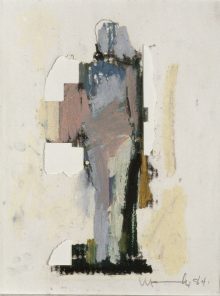
Mujer Pegada Study [Gustavo No. 12] 1985
![Mujer Pegada Study [Gustavo No. 12], 1985](https://anderson.stanford.edu/wp-content/uploads/2017/07/MN.1985.DWG_.031-700x954.jpg)
Reproduction of this image, including downloading, is prohibited.
Audio Description (02:59)
Full Audio Transcript (Expand)
Manuel Neri created Mujer Pegada Study [Gustavo No. 12] in 1985. This artwork is from a series of studies for his marble relief sculptures Mujer Pegada and was made with charcoal, oil pastel, and graphite on pale beige paper just a touch over one foot tall by a little over ten inches wide. It features a standing female form appearing attached to, or maybe emerging from, a small section of wall just left of center. Layers of slate gray, light mauve, and walnut brown oil pastel, and smudgy black charcoal provide the color. The colors sometimes define the figure and her background as separate and sometimes blur the boundaries between them.
The wall section is outlined with thin, straight graphite lines that are uneven and blocky, like steps carved out of the wall’s edges. There are two intriguing contrasts to the straight borders of the wall. First, in some places, a thick application of color does not quite reach the wall’s borders, and in other places Neri has colored outside the lines. The second contrast was created by tearing out bits of the paper the study was sketched on. One is to the left of the wall up high, and another is part of the wall next to her right leg. A layer of paper beneath is colored with the same oil pastels and charcoal. The torn edges feel reminiscent of the veins of gray that course through the Carrara marble Neri would go on to use for the sculpture based on this study.
At the center of the wall, a faceless, armless woman is not so much sketched as hinted at. Her head is outlined with dark gray, but the rest of her is imagined. Hourglass curves of black charcoal next to her define her left side from shoulder to knee. Her right upper arm, and down to her right foot is a thick streak of the walnut brown. And while much of her seems to be colored by the pale mauve, from her breasts down to the ground, she is mostly colored over in criss-crossing slate gray. A hint of the same hovers over her right shoulder.
All around the otherwise plain beige paper are tiny smudges and streaks. The figure emerging from her wall is so captivating, it could be easy to miss these imperfections in the field around her. But noticing them brings the viewer into the artist’s process to imagine his hand moving swiftly across the page and leaving behind bits of color his hand had picked up earlier.
In pencil, Neri wrote in two lines of cursive text across the top of the paper: “Arte de la verdad a nuestra vida.” Part of the “nuestra” touches the top of the figure’s head. Much of the word also overlaps with a smear of the light mauve that escaped the top edge of the wall on the left. It feels impossible to tell whether the text is over or under the pastel color, or really what order Neri composed any of the elements of the study.
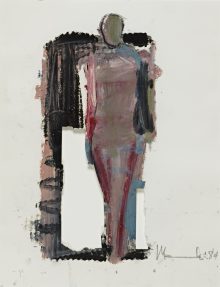
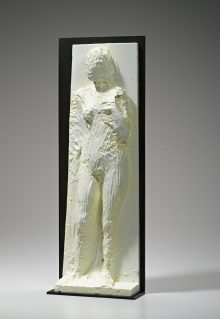
3 Mujer Pegada Studies, 1984 and 1985
These three studies relate to a major series of relief sculptures that Neri initiated in the 1980s, including the nine maquettes installed on the opposite side of this gallery. The title, Mujer Pegada, translates from Spanish as “glued” or “attached woman,” referring to the way the female figures appear encased in the walls behind them. Neri reveals the figures in these drawings using both additive and subtractive processes: he builds the images up with oil-stick, thickly applied, and carefully cuts and tears the paper away to articulate certain elements. The distinction between figure and ground is complicated, as the body and the substrate are worked with equal vigor. Fingerprints remind us of the artist’s hand in his process.
-Sidney Simon, PhD ’18
Artwork Details
- Manuel Neri
- b. 1930, Sanger, CA
- d. 2021, Sacramento, CA
- Mujer Pegada Study [Gustavo No. 12]
- 1985
- Oil paint stick, graphite, and charcoal on paper.
- 13 5/8 x 10 5/8 in.
- 2017.2.10
- Decade:1981-1990
- Medium:charcoal, graphite, oil
- Movement:Bay Area Figuration
- Currently not on view