Elizabeth Murray
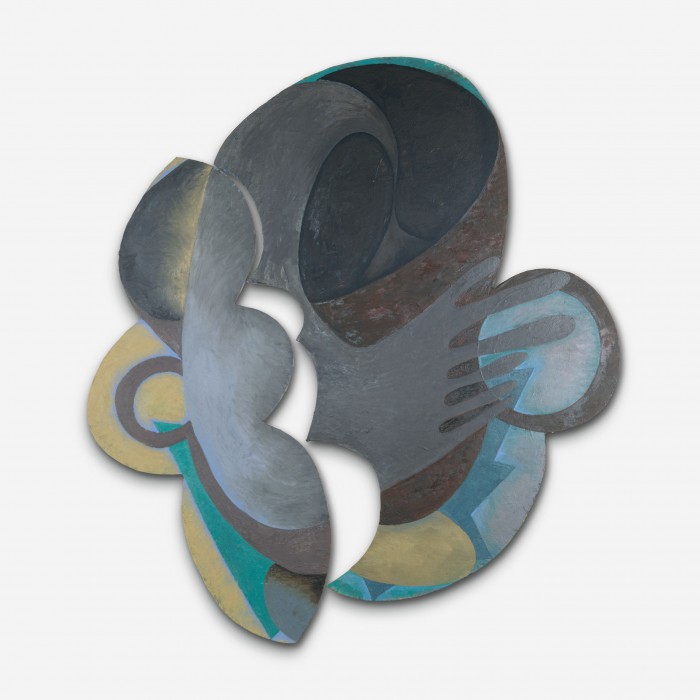
Mouse Cup 1981-1982
© 2014 The Murray-Holman Family Trust / Artists Rights Society (ARS), New York. Reproduction, including downloading of ARS member works is prohibited by copyright laws and international conventions without the express written permission of Artists Rights Society (ARS), New York.
Audio Description (02:54)
Full Audio Transcript (Expand)
Elizabeth Murray’s Mouse Cup is a surreal oil painting of a coffee cup on two unevenly shaped and sized canvases. The canvas on the left is smaller and is shaped to not quite fit into the larger right-side canvas. Murray made the painting between 1981 and 1982. In total, it reaches nine-and-a-third feet tall by a little over eight feet wide. Many of her whimsically-shaped paintings represented her take on domestic scenes and objects. This still life of a coffee cup features a coffee-brown-colored mug ruptured on its left side. The mug is two-handled. Although differently sized, these two bulging curves almost seem like round little mouse ears. Dark gray steam that may be reminiscent of mouse-fur gray hovers on the black coffee’s surface. The steam rises up like a tsunami from the canvas on the right and flows onto the left canvas. The steam curves, then heads back onto the right canvas. Here, it morphs into an abstract, gray, six-fingered hand that reaches for a circular handle on the right, which seems somehow filled with icy blue water. A possible coaster that the ruptured cup sits on is a combination of rounded, copper-colored puddles and jagged gray-blue and teal shapes with glowing edges. All over, short, thick, chalky lines are used to create highlights like red-brown and pale gray around the cup and pale gray on the steam and the coffee.
The smaller canvas on the left is shaped almost like an ant with three curvy sections. The top is like a rounded head with a pointy tip, then a shorter but bulging middle segment, and at the bottom, a long, pointy-tipped oval. This relatively narrow canvas contains only the left edge of the coffee cup with a tiny handle. The steam whooshing over it has lilac highlights over the gray. Below the brown cup, much of the canvas is copper-colored with a portion of teal triangle poking out and what might be a bit of a saucer the same shade as the cup.
The right-side canvas contains the bulk of the coffee cup. Four curves are cut into its left edge, which is a mismatch to the small left canvas’s three rounded segments. The two canvases can never be put together, though in a few places, bits of the canvases are barely a centimeter away from touching. The elements of the painting span across the canvases as if they should connect perfectly. Other than the four cut-out curves on the left side, the rest of the right canvas is shaped as the coffee cup itself and the coaster-like area beneath it. If Murray had painted a steaming mug of coffee onto a larger, rectangular canvas, it would likely be much less filled with energy. Because the canvases hardly extend beyond the outline of the cup, it feels like it springs to life and could even make a caffeine-fueled leap right off the wall.
Artwork Details
- Elizabeth Murray
- b. 1940, Chicago, IL
- d. 2007, New York City, NY
- Mouse Cup
- 1981-1982
- oil on two canvases
- 112 x 97 1/4 in.
- On back of right hand canvas, upper center: Top Mouse Cup Jan 1982/right side/ Elizabeth Murray On back of left hand canvas, upper center: Top Elizabeth Murray/ Jan 1982/ Mouse Cup left
- 2014.1.100
- Decade:1961-1970
- Medium:oil
- Movement:Contemporary Painting
- Currently not on view