H. C. Westermann
Marina 2 1960
Art © Dumbarton Arts. LLC/Licensed by VAGA, New York, NY. Reproduction of this image, including downloading, is prohibited.
Audio Description (02:15)
Full Audio Transcript (Expand)
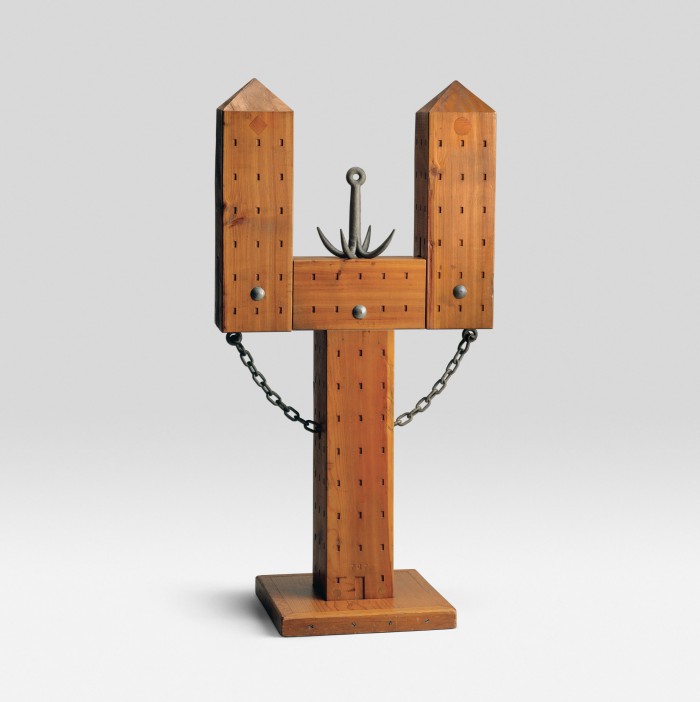
Marina 2, a sculpture created by H.C. Westermann in 1960, is nearly three-and-half feet tall, just under two feet wide, and about a foot deep.
Made primarily of a peanut butter colored wood accented with dull silver metal, the artwork evokes a tuning fork that has been planted into the ground, its prongs pointing skyward.
The sculpture rests on a polished, square wooden base that is the same color as the rest of the artwork. A rectangular beam rises from the base, perhaps 30 inches. Sitting atop it is a horizontal beam; attached to that are two more rectangular blocks of wood—these form the tines of the tuning fork—with tops that terminate in sharp, pyramidal points. In between the tines rests a diminutive, silver-grey ship’s anchor.
Two silver anchor chains drop down from the bottom edge of each tine and attach to the central, vertical beam.
All of the wooden pieces, save the tines’ points and base, are imprinted with tiny rectangles on three sides; the back side of each piece has been left unadorned, decorated only by the natural whorls of the wood, as well as dents and scratches accumulated over time. The imprinted rectangles are in neat rows and columns. The tines feature a three by six grid of rectangles, the horizontal beam a five by two grid, and the vertical beam a three by eight grid.
One little rectangle, on the front of the artwork, is different than the others: The one in the middle of the bottom row of the central beam. It’s perhaps four times the size of all the other rectangles. It seems almost like a door. The number 707 is carved into the wood above it. On either side of it are wood circles, embedded into the surface of the central beam.
On the front of each prong is an embedded shape as well: a diamond sits under the pyramidal point to the left; a circle under the pyramidal point to the right. The rounded heads of three metal screws protrude from the front face of the artwork. Two have been screwed into the prongs between the bottommost rows of rectangles; the third sits right in the center of the horizontal beam. They are held in place, a look at the back of the sculpture reveals, by square bolts pressed tightly against round washers.
Artwork Details
- H. C. Westermann
- b. 1922, Los Angeles, CA
- d. 1981, Danbury, CT
- Marina 2
- 1960
- wood and metal
- 41 1/2 x 21 x 13 1/2 in.
- 2014.1.085
- Decade:1951-1960
- Medium:metal, wood
- Movement:Funk
- Currently not on view