Manuel Neri
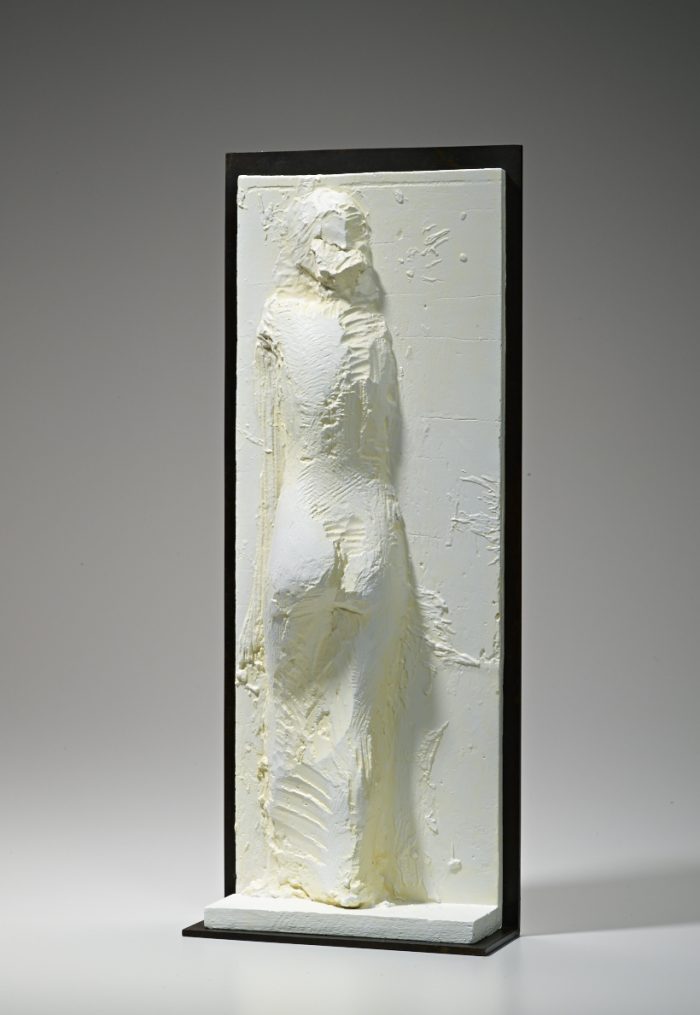
Marble Relief Maquette No. 4 1983
Reproduction of this image, including downloading, is prohibited.
Audio Description (02:36)
Full Audio Transcript (Expand)
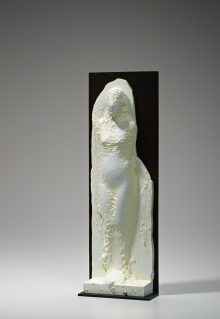
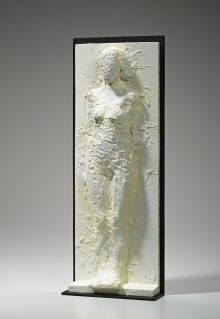
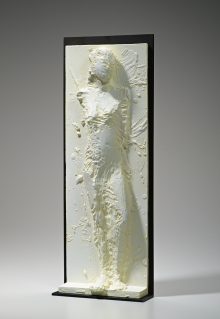
In 1983, Manuel Neri created nine plaster maquettes, or scale models, of standing female figures called Marble Relief Maquette (1-9). They were modeled after Mary Julia Klimenko and served as studies for figures that would later be carved in marble. Standing a little over two feet tall, nine inches wide, and a bit over three inches deep, each one shows the model in a different pose in Neri’s signature style: The nude figures lack faces and parts of limbs, and have incredible amounts and kinds of texture along the surfaces of their bodies. The bodies are slim, small-breasted, and made in bas-relief: Each emerges from her own narrow section of textured wall and with her feet firmly planted on a smooth rectangular attached block. There is no boundary between body and wall; the figures melt into the walls as much as they appear to be emerging from them. Most of the walls are slender and rectangular, providing something like a narrow frame around the figures. A few more closely hug the outline of the figures or appear to have chunks broken off, resembling friezes on crumbling but majestic ancient buildings.
In 2013, the original plaster maquettes from 1983 were cast in bronze, then painted with Alborada patina three years later. The patina is made from bright white oil-based pigment and pale egg-yolk-yellow glaze that makes the bronze sculptures appear to be made, again, from plaster with sunlight dancing across the surface. The patina settles into every ridge, cut, scrape, gouge, bump, bubble, drip, and creamy splatter in the female figures and their individual portions of walls.
Despite working with the same live model and materials for all nine maquettes, the differences across Neri’s versions of Klimenko are captivating. The figure most often stands flat against the wall, with a slight bend in one knee and her weight shifted a little onto the other foot. But in one, her back is turned, and she seems to peer coyly over her shoulder, likely at Neri. Some versions have sections of body that are smooth, while others are entirely textured in various ways that create energetic ripples, ridges, and slices. The viewer can practically hear the plaster drips falling onto the sculptures and feel the tension of the tools sliding through the thick plaster while still wet or scraping and cutting into it once dry.
Maquettes for Marble Reliefs
Neri created these nine maquettes, with [Mary Julia] Klimenko as his model, as scale models for a series of life-size relief sculptures to be carved later of marble in his studio in Carrara, Italy. The projected works were part of a series entitled Mujer Pegada, which translates from Spanish as “glued” or “attached woman.” In each composition, the female form is only partially articulated from the vertical surface in which she is encased. Evoking the unearthing of fragmented Roman antiquities or the weathered surfaces of ancient Etruscan friezes, each figure is simultaneously emerging from and sinking into her material ground. In contrast to Neri’s freestanding figures, which engage with viewers in a shared physical environment, these shallow reliefs are embedded in their architectural context, occupying their own, separate space akin to that of framed drawings.
The maquettes were originally created in plaster, a material considerably easier to work with and more forgiving than marble. The small size allowed Neri to see at a glance the effects of changes to the overall composition. The objects on view here are bronze casts of the plaster originals, treated with Neri’s signature Alborada patina, a white coating with yellow glazes. The bronze faithfully replicates and fixes the fugitive texture of plaster: at once wet and dry, dripping and crumbling.
-Sidney Simon, PhD ‘18
Artwork Details
- Manuel Neri
- b. 1930, Sanger, CA
- d. 2021, Sacramento, CA
- Marble Relief Maquette No. 4
- 1983
- Bronze with Alborada patina; oil-based pigments with yellow glaze. Cast 2013, patina 2016, ed. 1/4.
- 26 3/8 x 9 3/4 x 3 3/8 in.
- 2017.2.03d
- Decade:1981-1990
- Medium:bronze, pigment
- Movement:Bay Area Figuration
- Currently not on view