Manuel Neri
Makida III 1997
Reproduction of this image, including downloading, is prohibited.
Audio Description (02:32)
Full Audio Transcript (Expand)
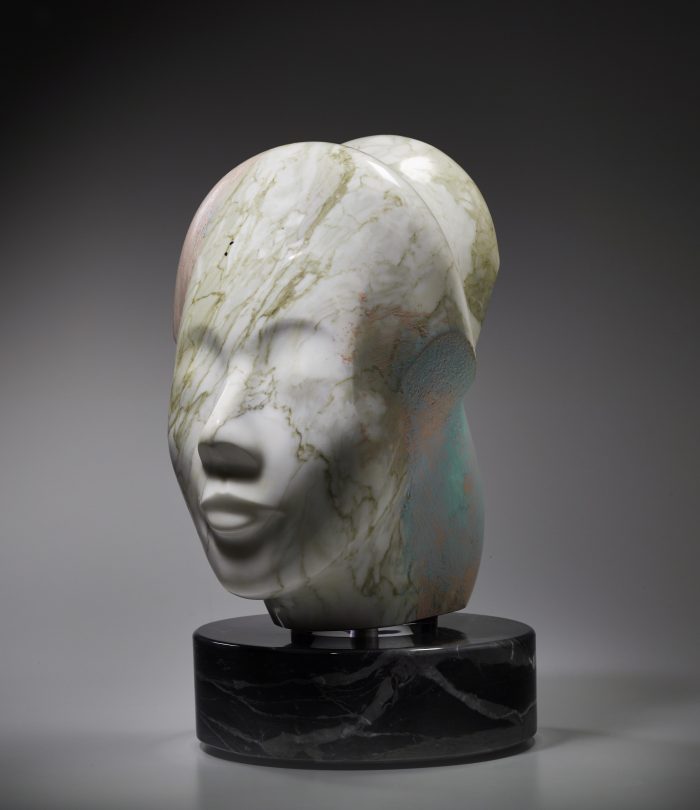
Manuel Neri’s Makida III is a marble bust of 24 by 16 by 22 inches, created in 1997. It sits upon a cylindrical plinth made of polished black marble, shot with gray streaks.
The sculpture is of a woman’s face—that of Japanese artist Makiko Nakamura.
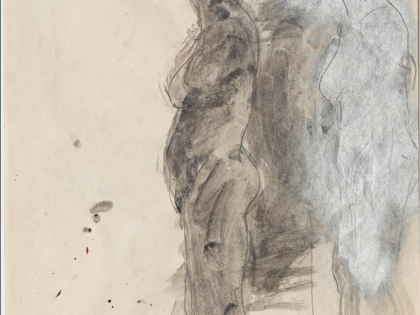
Nakamura was a great source of inspiration for Neri; the time she spent modeling for him led to Makida III, a number of other sculptures, and the works on paper that make up Neri’s Japanese Dancer series.
Like the base, the bust is highly polished: it is composed of a gleaming white marble, streaked with an amber-gold that crackles across the surface of Nakamura’s countenance like lightning across a stormy sky.
The sides and back of the sculpture are decorated with streaks of jaunty pink and teal oil-based enamel paint.
Much as in classical Greek sculpture, Makida III features a face with a straight, prominent nose and full, life-like lips, pressed together in a neutral position. And as in antiquity, Nakamura’s eyes lack irises or pupils. However, while ancient Greek sculpture tends to depict eyes as blank orbs settled into prominent lids, Neri offers viewers only gentle, rounded indentations in the stone to indicate Nakamura’s eyes.
Above those eyes stretches a gently sloping forehead that rises into a crown that suggests the waxed, fan-like updos popular among Japanese women in the 19th century, now often seen worn by maiko and geisha.
Looking at the sculpture in profile, the very top of the artwork features an indentation that creates a valley right at the crown of the head.
The sides of the artwork feature most of the sculpture’s paint; it has been applied asymmetrically, with the right side endowed with the lion’s share of the color. It boasts a field of teal that flows from the curves delineating the hair down the side of an exaggerated, rather wide neck. Streaks of pink speckle the teal, like tie dye.
The color on the left side features the inverse of what is on the right. The color is primarily in the hair, and is predominantly pink, with splotches of green populating the area closer to the back of the head.
The back of the head itself is a smooth curve evoking the nape of the neck, and features a very light application of pink paint—so light, in fact, it seems as if Neri perhaps applied it, then removed 90 percent of it.
Makida III, a carving of [Makiko] Nakamura’s head in veined Carrara marble, suggests a synthesis of Eastern and Western artistic traditions. Its larger-than-life scale and placid expression evoke the contemplative mood of temple statuary found in the Eastern tradition. The polished stone is partially masked with gestural strokes of bright pink-and-green paint used to set off her traditional Japanese hairstyle. When the figure is viewed from behind, the undulating shapes and energetic brushstrokes of her hair seem to morph into abstraction.
In the late 1970s Neri began making regular trips to Carrara, Italy. He established a studio there in 1981 in order to readily access marble from the city’s famed quarries. Neri’s practice was profoundly affected by his proximity to the sculptural traditions of Western civilization, from the art of ancient Etruscans and classical antiquity to the haunting figures of Italian modernists Alberto Giacometti and Marino Marini. In Carrara Neri also met the artist Makiko Nakamura, who would inspire a rich series of work. Nakamura posed for Neri wearing traditional Japanese clothing and hairstyles. As in his works modeled after Joan Brown and Mary Julia Klimenko, Neri’s Makiko series emphasizes his interest in the anonymity of the body as form, as opposed to the individuality of portraiture, though here the body is imbued with an unmistakable Eastern exoticism. The drawings from the Japanese Dancer series, for example, emphasize a generalized sense of movement, suppleness, and coded cultural symbolism.
-Sidney Simon, PhD’18
Artwork Details
- Manuel Neri
- b. 1930, Sanger, CA
- d. 2021, Sacramento, CA
- Makida III
- 1997
- Marble and oil-based enamel.
- 24 x 16 x 22 in.
- 2017.2.02
- Decade:1991-2000
- Medium:enamel, marble
- Movement:Bay Area Figuration
- Currently not on view


![Japanese Dancer Series No. 12 [Makiko], 1980](https://anderson.stanford.edu/wp-content/uploads/2017/07/MN.1980.DWG_.045-220x311.jpg)
![Japanese Dancer Series No. 2 [Makiko], 1980](https://anderson.stanford.edu/wp-content/uploads/2017/07/TAC-58666-220x311.jpg)