William T. Wiley
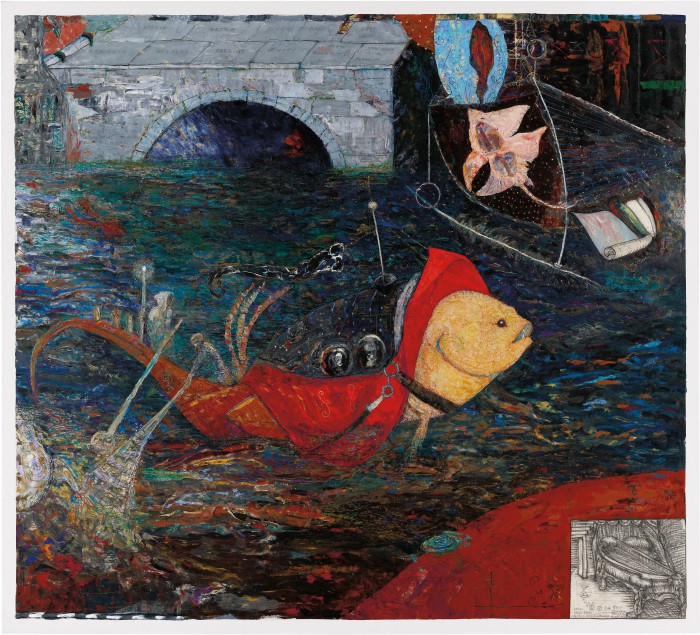
Just to Mention a Few (after Bosch) 1994
© William T. Wiley courtesy John Berggruen Gallery. Reproduction of this image, including downloading, is prohibited.
Audio Description (03:41)
Full Audio Transcript (Expand)
If William T. Wiley wanted to mention a few visual ideas reminiscent of Heironymous Bosch’s, he has more than succeeded. His enormous artwork from 1994 called Just to Mention a Few (after Bosch) reaches a touch over six feet high and exactly six-and-three-quarters feet wide. Made with acrylic, charcoal, and graphite on canvas, the vibrant color palette and painting style show off visible brushstrokes, quite unlike the earlier Dutch painter’s work. In his own style, Wiley has recreated a small segment of the lower middle panel of Bosch’s The Temptation of St. Anthony. He added his own fever-dream-like details to the already surreal scene featuring unrelated objects, people, and creatures painted at strange scales, in and around a body of water. Bright, highly saturated colors like fire engine red and powder blue feel joyful. But with that same red applied to the water’s surface, the beach, and a raincoat on a massive fish-like monster pulling a boat, the painting could border on scary. That is, until you pop over to, say, the bottom right corner to explore a charcoal sketched clawfoot bathtub on pale tan paper with the words “Drawing (no vowels in the word) image from Horapolo Hieroglyphica, Jesús María González de Zárate. Copyright 94, etc?.”
At the upper left is the edge of Bosch’s stone platform standing over a waterway: pale, slate-gray with an arch beneath it that opens to a small black and violet tunnel. On the upper surface, rectangular stones each hold a word or phrase: “Bosnia, Vetka, Korea, Middle, East West, Rawanda, Grebeny, Ireland N, Haiti, North Immigrant South,” and finally, “You name it and blame it.” Along the front face, are other messages on the stones: “The under-rep, flesh wimps, the good war the bad war etc. etc.,” and “After a Detail of The Temptation of St. Anthony by H. Bosch. Wiley 94, copyright, etc.”
To the right of the platform, what was a priest’s torn beige cloak is a powder blue sail with a blood-red gash. Below it, a peach-colored stingray with wings leaps into the air, its long, curved tail nearly touching a floating scroll of paper. At the center of the painting is the enormous pale yellow fish with fangs, a red raincoat, a bridle around its midsection, and reins falling into the dark water. Its tail end is a boat with a tall candle on it shining a bright white flame. The boat is steered by a cloaked gondolier, and joining him is a ghostly fisherman casting a white net into the water.
All over, this painting is exceedingly detailed. Every ripple in the water is colored so that the surface is a wavering rainbow. Thin flourishes, coils, squiggles, hourglasses, and treble clef symbols adorn many of the objects and creatures. Wiley has added dots, bubbles, grids, spirals, and Roman numerals all around, as well as foggy little words on the water that are too grainy and faint to read. The fish-like monster at the center may be the most attention-grabbing, and the various words and messages the hardest to notice. With every inch of the painting filled with activity and vibrancy, it can be hard to know where to begin. But it feels certain that this is a work a viewer could return to time and again and always find something new.
Artwork Details
- William T. Wiley
- b. 1937, Bedford, IN
- d. 2021, Kentfield, CA
- Just to Mention a Few (after Bosch)
- 1994
- acrylic, charcoal, and graphite on canvas
- 72 1/2 x 81 in.
- 2014.1.118
- Decade:1991-2000
- Medium:acrylic
- Movement:Funk
- Currently not on view