



Manuel Neri
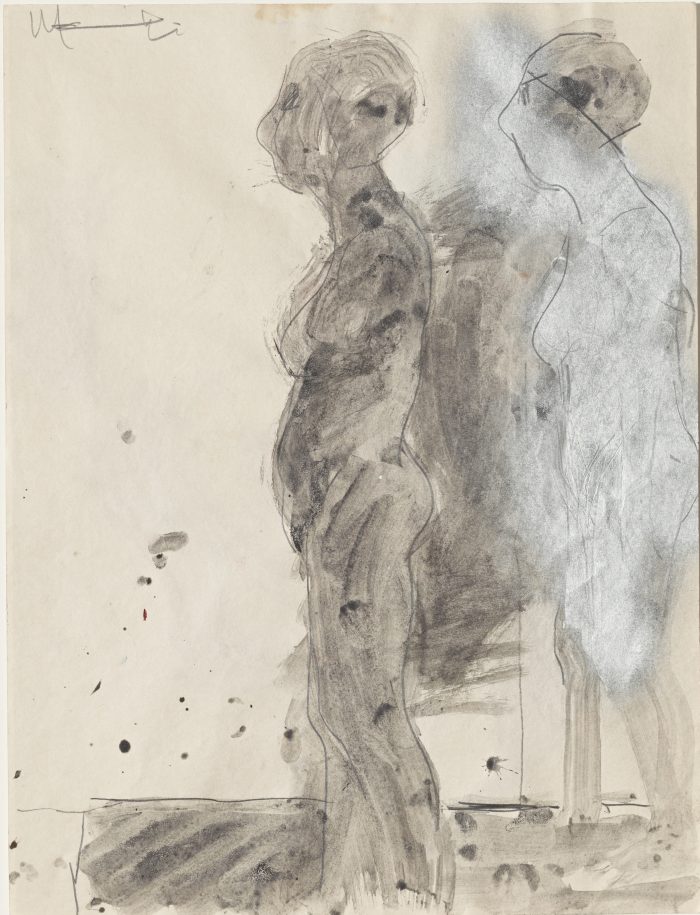
Joan Brown with Neri Sculpture I 1963
Reproduction of this image, including downloading, is prohibited.
Audio Description (02:48)
Full Audio Transcript (Expand)
Joan Brown appears often in Manuel Neri’s artwork. In Joan Brown with Neri Sculpture I (one in Roman numerals) from 1963, she appears twice. Neri used water-based gray pigment, graphite, and gleaming white metallic paint on light tan paper to create two images of Brown standing in profile, nude and facing the left. The paper is nearly two feet tall and just under one-and-a-half feet wide. At the center is a gray Joan Brown, and along the right is the metallic white one, as if in line behind the first. In the upper left corner is Neri’s signature, little more than a fluid M, a long horizontal line, and the E R I of his last name. Not much else occupies the space aside from quickly sketched pencil lines to mark the pigment-painted floor, a vertical line between the two figures, and an odd splatter or splotch of gray pigment.
Though not identical, the figures do appear to be the same slender woman. Like Neri’s sculptures of Brown, these are somewhat anonymous looking and lack hair, facial features, and some limbs. They have a similar facial profile–large nose, small chin, neck jutting ever-so-slightly forward–and are the same height and nearly the same build. The gray Joan Brown, at the center, has a dark pencil outline all around and is filled in with overlapping strokes of watery gray pigment. Where Neri pulled the brush back and forth or pressed it harder against the paper inside her outline, the pigment is darker. He sometimes painted outside the lines, giving a slight sense of movement of her breast and her legs. Brown’s lower belly pokes forward, and her buttocks are small and high. Her left leg is just a bit behind her right, and she is footless; her ankles reach the bottom edge of the painting. Behind her is a shadow against the wall from the top of her shoulders to just above her knees almost like a gray cloud. It mingles with the white metallic paint, which hovers in front of and over the second Brown.
The second Brown has a rounder head and the outline of a left arm. She has shoulders a little stooped, smaller breast and belly, and lower buttocks that are slightly cut off by the right edge of the paper. Her shiny white paint is like thick fog in front of her face, and it floats down to her knees. Her lower legs are thin strokes of the gray pigment only, with no pencil outlines defining them. She has a faint left foot, and her legs are placed further apart than in the first.
The artwork feels like an exploration of ways to depict Joan Brown as a sculpture rather than a finished representation of her. There are additional lines on the heads that appear to demonstrate angles and relationships of the features for the artist, and even two jawlines drawn on the second Brown. This artwork has been described as possibly being a drawing of Brown standing in front of a sculpture of herself that Neri was working on in his studio, as she modeled. Although this artwork does not say “study” in the title, it is clear that Manuel Neri closely studied Joan Brown.
Joan Brown
Neri met the painter Joan Brown at the California School of Fine Arts (now the San Francisco Art Institute) in 1957, when both were taking a painting class with Elmer Bischoff, a central figure of the Bay Area Figurative movement. A romantic and artistic partnership ensued, and Brown became a frequent subject of Neri’s figure studies. His drawings and sculptures of Brown reveal an extraordinary sensitivity to the interconnected volumes of the body, and his intimacy with his model…
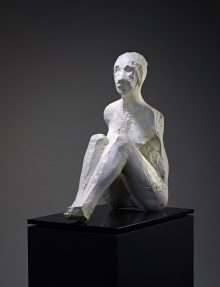
By 1959 Neri and Brown were sharing a large studio on Mission Street near the Embarcadero in San Francisco, where Neri began making life-size sculptures like Joan Brown Seated. Neri shaped the original sculpture in plaster, an inexpensive material he liked for the speed and ease with which it could be worked and reworked. The surface of the figure is rich with the marks of the artist’s hand and tools. Here, coated in Neri’s signature white patina, this unique aluminum cast—Neri’s first metal casting—preserves the look and tactility of the plaster original in a medium meant to last.
-Sidney Simon, PhD’18
Artwork Details
- Manuel Neri
- b. 1930, Sanger, CA
- d. 2021, Sacramento, CA
- Joan Brown with Neri Sculpture I
- 1963
- Water-based pigment, graphite, metallic paint on paper.
- 23 1/8 x 17 7/8 in.
- 2017.2.05
- Decade:1961-1970
- Medium:graphite, metallic paint, pigment
- Movement:Bay Area Figuration
- Currently not on view


![Collage and Ink Figure Study No. 35 [Joan Brown], 1963](https://anderson.stanford.edu/wp-content/uploads/2017/07/MN.1963.DWG_.093rev-220x218.jpg)