Manuel Neri
Japanese Dancer Series No. 2 [Makiko] 1980
![Japanese Dancer Series No. 2 [Makiko], 1980](https://anderson.stanford.edu/wp-content/uploads/2017/07/TAC-58666-700x989.jpg)
Reproduction of this image, including downloading, is prohibited.
Audio Description (02:15)
Full Audio Transcript (Expand)
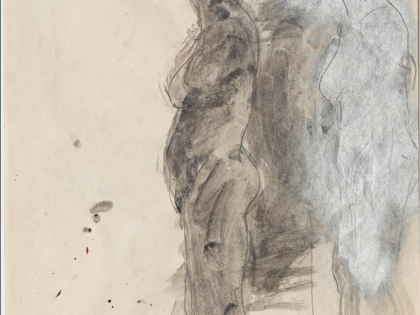
Manuel Neri’s 1980 drawing Japanese Dancer Series No. 2 [Makiko] is a companion to an artwork of the same name but numbered 12. This black charcoal and bluish-gray pigment artwork was made on white paper almost three-and-a-half feet tall by almost two-and-a-half feet wide. In it, artist Makiko Nakamura is in profile, facing the left. She is captured with her back straight and knees deeply bent, crouching near the ground almost to sitting. She is outlined with thick lines of charcoal, sometimes pressed lightly enough against the paper that it appears to be only dark gray, not fully black. Her head, hair, and the bottom of her kimono are filled in with wide, smudgy charcoal lines. A dark black rectangle of very thin, tangled lines sits at her waist, perhaps representing her obi, or waist sash, though it does not appear to wrap around her. A brush with the gray pigment was swept across and in front of her to apply a thin wash. Radiating out from all around her, especially her head and torso, are small drips and faint smudges of this gray. Although blue-gray, against the white paper, they give the appearance that Makiko is glowing.
In this nearly monochromatic artwork, the dancer is anonymous. In fact, her head and hair are filled in such that it can be hard to tell if she appears to be facing forward with a shadow across her face or with her head turned away. Her arms may be tucked in front of her, but they were not drawn; nor does the figure have feet. She is, more than anything else, a strong suggestion of a Japanese dancer. The biggest clues are her hair pulled back and gathered at the nape of her neck and the way the stiff collar of her kimono is pulled away to reveal the back of her neck.
Makiko
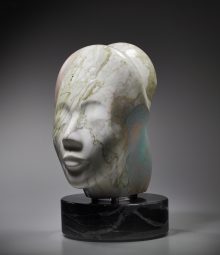
In the late 1970s Neri began making regular trips to Carrara, Italy. He established a studio there in 1981 in order to readily access marble from the city’s famed quarries. Neri’s practice was profoundly affected by his proximity to the sculptural traditions of Western civilization, from the art of ancient Etruscans and classical antiquity to the haunting figures of Italian modernists Alberto Giacometti and Marino Marini. In Carrara Neri also met the artist Makiko Nakamura, who would inspire a rich series of work. Nakamura posed for Neri wearing traditional Japanese clothing and hairstyles. As in his works modeled after Joan Brown and Mary Julia Klimenko, Neri’s Makiko series emphasizes his interest in the anonymity of the body as form, as opposed to the individuality of portraiture, though here the body is imbued with an unmistakable Eastern exoticism. The drawings from the Japanese Dancer series, for example, emphasize a generalized sense of movement, suppleness, and coded cultural symbolism.
-Sidney Simon, PhD ’18
Artwork Details
- Manuel Neri
- b. 1930, Sanger, CA
- d. 2021, Sacramento, CA
- Japanese Dancer Series No. 2 [Makiko]
- 1980
- Charcoal, dry pigment/water on paper.
- 41 3/4 x 29 3/4 in.
- 2017.2.07
- Decade:1971-1980
- Medium:charcoal, pigment
- Movement:Bay Area Figuration
- Currently not on view


![Japanese Dancer Series No. 12 [Makiko], 1980](https://anderson.stanford.edu/wp-content/uploads/2017/07/MN.1980.DWG_.045-220x311.jpg)