Manuel Neri
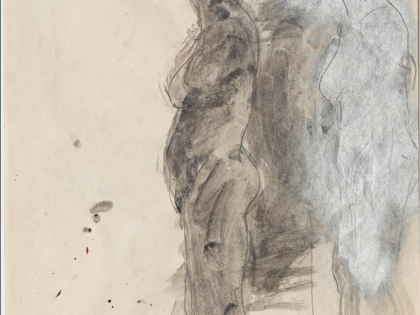
Japanese Dancer Series No. 12 [Makiko] 1980
![Japanese Dancer Series No. 12 [Makiko], 1980](https://anderson.stanford.edu/wp-content/uploads/2017/07/MN.1980.DWG_.045.jpg)
Reproduction of this image, including downloading, is prohibited.
Audio Description (01:59)
Full Audio Transcript (Expand)
In 1980, Manuel Neri created Japanese Dancer Series No. 12 [Makiko] with black charcoal and piercingly bright cobalt blue pigment on white paper. The artwork is almost three-and-a-half feet tall by almost two-and-a-half feet wide. Artist Makiko Nakamura served as the model for the Japanese dancer who takes up nearly the entire height of the paper. She stands in profile, just left of center, and facing the right, with her head softly bowed. Her hair is pulled back and up, winging out from the nape of her long, slender neck. Short, faint cobalt blue lines radiate out from all around her head and torso, as if she herself were illuminated. Around some of these short lines, the paper has puckered from the pigment’s water soaking in. The right side of the paper has a few random streaks of gray and blue, perhaps remnants of color that the side of the artist’s hand picked up as he worked.
The dancer lacks defined facial features, and Neri has colored her hair, face, neck, torso, right hip, and a streak down to her knee in a nearly solid block of the cobalt blue pigment. Her kimono is really only a suggestion of a kimono: thickly filled in with charcoal around the back bottom half, with only gray wisps for the top half and front. Down the front of her legs, Neri dragged a thin tip of the charcoal back and forth to create a cascade of squiggles, which he then gently smudged. The darkest part of her clothing is the large, distinctive square knot at the back of her kimono’s obi, or waist sash. It was made with a more saturated black and finer lines than the rest of the outfit. Based on the shape of her traditional hairstyle and her kimono, the figure in this artwork is unmistakably a female Japanese dancer, but she remains, here, quite anonymous.
Makiko
In the late 1970s Neri began making regular trips to Carrara, Italy. He established a studio there in 1981 in order to readily access marble from the city’s famed quarries. Neri’s practice was profoundly affected by his proximity to the sculptural traditions of Western civilization, from the art of ancient Etruscans and classical antiquity to the haunting figures of Italian modernists Alberto Giacometti and Marino Marini. In Carrara Neri also met the artist Makiko Nakamura, who would inspire a rich series of work. Nakamura posed for Neri wearing traditional Japanese clothing and hairstyles. As in his works modeled after Joan Brown and Mary Julia Klimenko, Neri’s Makiko series emphasizes his interest in the anonymity of the body as form, as opposed to the individuality of portraiture, though here the body is imbued with an unmistakable Eastern exoticism. The drawings from the Japanese Dancer series, for example, emphasize a generalized sense of movement, suppleness, and coded cultural symbolism.
-Sidney Simon, PhD ’18
Artwork Details
- Manuel Neri
- b. 1930, Sanger, CA
- d. 2021, Sacramento, CA
- Japanese Dancer Series No. 12 [Makiko]
- 1980
- Charcoal, dry pigment/water on paper.
- 41 3/4 x 29 3/4 in.
- 2017.2.08
- Decade:1971-1980
- Medium:charcoal, pigment
- Movement:Bay Area Figuration
- Currently not on view


![Japanese Dancer Series No. 2 [Makiko], 1980](https://anderson.stanford.edu/wp-content/uploads/2017/07/TAC-58666-220x311.jpg)