Frank Lobdell
January 1971 1971
Courtesy of Hackett | Mill, and the Frank Lobdell Trust, San Francisco, CA. Reproduction of this image, including downloading, is prohibited.
Audio Description (02:43)
Full Audio Transcript (Expand)
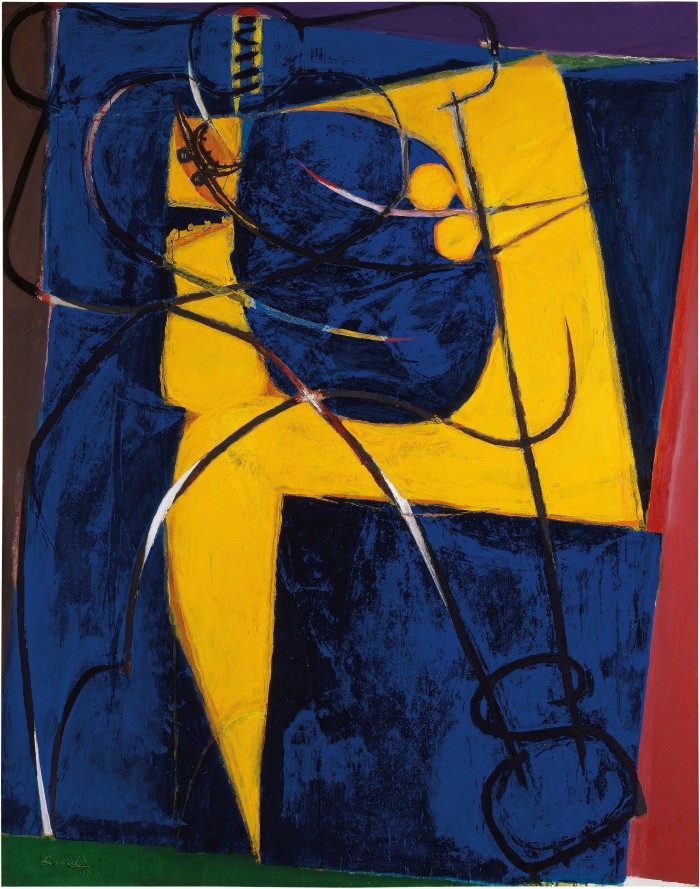
In 1971, Frank Lobdell was just about to shift from creating dark, somber paintings that reflected on war into more whimsical, bright celestial paintings. January 1971, made that year, is seven feet high by just over five-and-a-half feet wide. This surreal oil painting on canvas could be described as both terrifying and playful at the same time. It is darkly, deeply saturated, but it could be argued that a reliance on vivid primary yellow, blue, and red, along with forest green and purple, brightens the mood.
The central focus in this artwork is a bright lemon-yellow shape painted over orange. The yellow is mostly solid, with lighter, sweeping brush strokes here and there that allow the orange to peek through. The shape is like a large, warped letter P. Uneven, squared-off lines create the top, and the left side tapers into a narrow point near the bottom of the canvas. On the left upper edge of
the shape, the yellow line opens like a little mouth with a few square teeth on its lower jaw. At the top left corner is a pair of arcing lines with two circles on top like a small set of eyes on top of eyebrows painted over the yellow. Above this shape, a very small bright yellow shape that echoes the larger P shape has black bars across it and rises to the top of the canvas. On the upper right side of the main P shape, two nearly-perfect orbs like small breasts are fastened to
the inner edge. Swirling over the yellow shape are thin ribbon-like lines that criss-cross and loop: an outline of a dancing figure, with curved arms and interlocked fingers at the top. They are mostly black with short blue, yellow, and red bars and dazzling white flourishes. Two long lines, the legs, sweep down toward the bottom right corner of the canvas where they intersect a rounded shape like an incomplete number 8.
The yellow P shape is ever-so-slightly crooked, leaning to the left, but just how much it leans can be deceptive. The field of smudgy royal blue over black that it sits on is itself skewed. On the right side of the blue and black field is a triangle of red, on the bottom, a slimmer triangle of green, on the left, a long triangle of brown, and on the top, a purple triangle with a small green accent. These colored triangles reach the canvas’s edges and appear not so much like separate shapes as they feel like they create the illusion of a stack of tilted colored papers in need of tidying.
January 1971 has a companion piece called Fall 1971, that repeats many of the same shapes and relationships as this one, though in more autumnal colors and made exactly one-eighth-inch narrower.
Artwork Details
- Frank Lobdell
- b. 1921, Kansas City, MO
- d. 2013, Palo Alto, CA
- January 1971
- 1971
- oil on canvas
- 84 x 66 1/4 in.
- recto, lower left quadrant: Lobdell - 1971 verso, upper right: Lobdell / Jan. 1971 (in black ink) Labels: EB Crocker Art Gallery 1972 ("Winter 1971"); Martha Jackson Gallery ("January 1971"); Smith Andersen Gallery ("Post Dance Jan 1971"); SFMOMA("January 1971")
- 2014.1.064
- Medium:oil
- Movement:Bay Area Abstraction
- On view