



Ed Moses
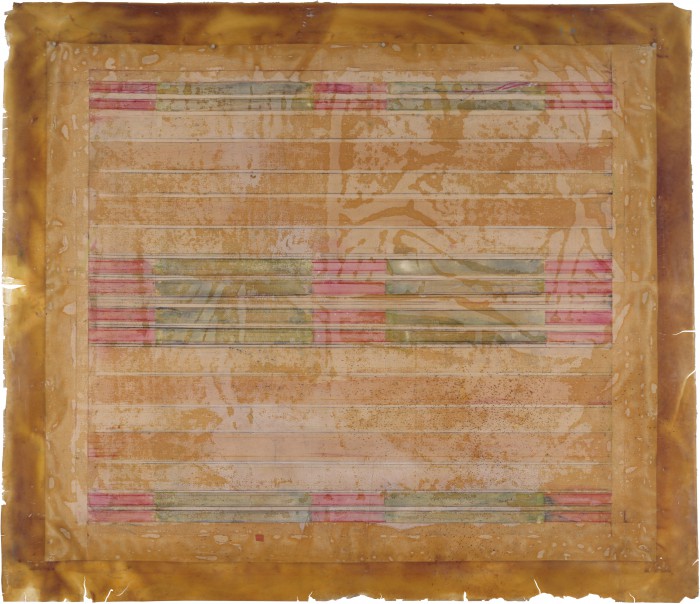
Ill. Hegemann 30 1972
© Ed Moses. Reproduction of this image, including downloading, is prohibited.
Audio Description (02:31)
Full Audio Transcript (Expand)
Ed Moses viewed artmaking as an exploration, and his 1972 journey is apparent in III. Hegemann 30 (the three in Roman numerals). His artwork reaches nearly seven-and-a-half feet tall by just over eight-and-a-half feet long. Moses used muted burgundy and turquoise pigment and resin on canvas. The central image was inspired by a photograph of a striped Navajo blanket by Elizabeth Compton Hegemann, who is acknowledged in the name of this artwork. This blanket design is surrounded by two border rings, first a pale one, and then a darker, outer border. The whole canvas is treated with resin all over that has darkened to brown over time. The resin has darkened unevenly, leaving paler spots, shadowy lines, splotches, speckles, and scratches that bend, flow, and spread across the blanket-like image and the inner border ring around it. The outer border ring is stained the darkest, with smears of walnut brown and gold, as if charred by a quick brush with flames. The outside edge of the canvas is deliberately imperfect. And with aging, the resin has naturally become brittle, giving the edges a tattered appearance, with small and large tears, crackly edges, and missing chunks, reminiscent of Hollywood depictions of ancient treasure maps.
The Navajo blanket-like main section consists of 19 horizontal stripes alternating with 17 very narrow, plain bands that are each outlined in dark blue, like lined school paper. Near the top of this section are two horizontal stripes both colored with short, washed-out burgundy bars, followed by pale turquoise bars about double the length of the burgundy. Each bar also contains extremely narrow lines near its top and bottom borders made of the same colors but darker. The burgundy and turquoise bars repeat, and one last set of burgundy bars completes the pattern across the two stripes. Toward the middle of the canvas, this two-colored-bar design comes back, but this time across four stripes, not two. The bottom of the main section has two more of the burgundy and turquoise-barred stripes. The remaining 11 stripes in this section are colored only by the brown wash. Around the blanket-like section, the plain border is also colored only by the brown. While the combination of colored and plain stripes, speckles, shadows, and tears may seem to be chaotic, it is anything but. The artwork feels like multiple thoughtful works of art all at once, and Moses pulls off this feat expertly.
Artwork Details
- Ed Moses
- b. 1926, Long Beach, CA
- d. 2018, Venice, CA
- Ill. Hegemann 30
- 1972
- pigment and resin on canvas
- 89 1/4 x 103 5/8 in.
- 2014.1.069
- Decade:1971-1980
- Medium:pigment
- Movement:California Light & Space
- Currently not on view


![Japanese Dancer Series No. 12 [Makiko], 1980](https://anderson.stanford.edu/wp-content/uploads/2017/07/MN.1980.DWG_.045-220x311.jpg)
![Japanese Dancer Series No. 2 [Makiko], 1980](https://anderson.stanford.edu/wp-content/uploads/2017/07/TAC-58666-220x311.jpg)