Harold Paris
Homage to Boccioni #1 1969
Reproduction of this image, including downloading, is prohibited.
Audio Description (02:56)
Full Audio Transcript (Expand)
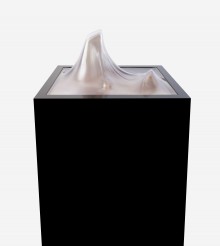
Waist-high atop a rectangular black pillar–and beneath a plexiglass cover–Harold Paris’s 1969 Homage to Boccioni #1 resembles one or two indiscernible objects, draped-over by a satiny cloth. But the smooth, abruptly steepening rise-and-fall of the satiny surface-in-a-box is as likely to remind you of a wave machine, or maybe a lava lamp. It is not obvious what you are looking at.
The lustrous, curvy shape rises out of the pillar into two soft-edged peaks, one of them a foot high with a flat, angled summit, the other only about a fourth as tall, and rounder in outline. A saggy ridge swoops almost straight down from the taller peak and arrives level at the foot of the shorter one, merging and as-if flowing with it. Flat and formless around its perimeter, the shiny surface seems to tuck or plunge into the black pillar-top. An uncovered margin around the edge frames it in black.
Homage stands four and a half-feet tall, the pillar included as an element of the artwork. It is two-feet long by one-and-a-half-feet wide in cross section.
A lingering look at the summits of either peak eventually reveals something disorienting, which you’ll seek to double-check from different angles. The curvaceous form is actually a semi-transparent husk, or shell. Occasional glimpses through it reveal a stack of three or more replica peaks underneath, extending into darkness with gaps in between.
Perhaps the last to strike you is the resemblance of the form to a human figure: Seated upright, legs extended, on a floor–or perhaps on top of a bed–with a blanket draped over them. At first you might note only the likeness of one initially-insignificant-looking tiny bump to a similar one, both on the opposite sides of the taller and more massive peak. In their size and position, they too coincidentally resemble the way a seated figure might plant their two hands. The shorter peak is exactly the size, shape and position of a flanking pair of feet–softened and obscured by a blanket over top of them. Yet if the angular summit of the taller form is a human head, more than a blanket is obscuring it.
You might next try to imagine what hat or headdress would resemble the summit beneath a blanket. But that may be a tangent. Umberto Boccioni, the artist in Homage to whom Paris titled the artpiece–sculpted people in such a distinctively stylized, and many-surfaced way, the resemblance to them mostly rested on their posture and gross proportions. If Homage does represent a human figure, then Paris has literally done the same. The satiny form seems at first to have only one surface and none of the hard edges of a Boccioni sculpture–and less obvious resemblance to a person. But what if Homage is a person with facets inside?
Artwork Details
- Harold Paris
- b. 1925, Long Island, NY
- d. 1979, El Cerrito, CA
- Homage to Boccioni #1
- 1969
- vacuum-formed butyrate
- 54 x 23 x 19 1/2 in.
- signed and dated on top surface of work: Harold Perseus Paris '69
- 2014.1.016
- Decade:1961-1970
- Movement:California Light & Space
- Currently not on view