William Allan
Half a Dam 1971
© William Allan. Reproduction of this image, including downloading, is prohibited.
Audio Description (04:10)
Full Audio Transcript (Expand)
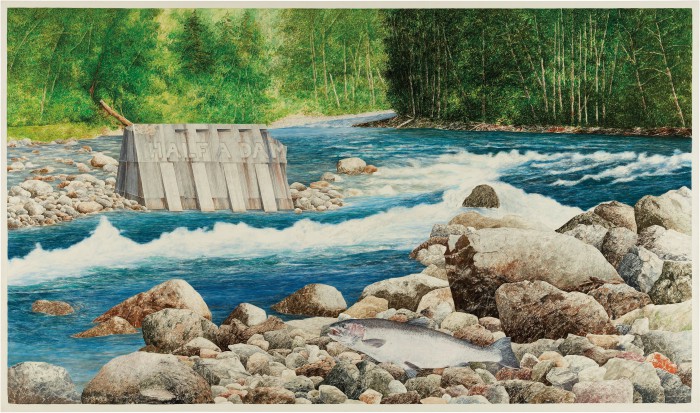
William Allan’s 1971 Half a Dam was painted with acrylic on canvas. The artwork spans a little over eleven feet wide by just over six-and-a-half-feet tall. With extremely realistic detail, it depicts a curving section of a small river—maybe a few dozen feet wide—as it winds through a dense forest. The bend farthest away is lined by tall, slender trees, perhaps a mix of lodgepole pine, paper birch, and others. The left side of the forest is grassy. On the right, trees have exposed roots that spread right up to the water’s edge. The nearer riverbends are defined by rocky banks, from pebbles to big rocks in white, red, pink, tan, and brown. A few lumpy boulders poke up from the middle of the water. Although calm near the back, toward the center of the river, the water develops forceful, rushing rapids, with white froth building on the fast-moving surface. Near the bottom center of the painting, a dead salmon lies on its side in the rocks. Its scaly back is black, its belly and side silvery-white, its cheek magenta, and its open mouth is dark-red. Tucked near the bottom right corner of the painting is a bright orange-red rock almost the color of salmon roe.
Although very realistic overall, the artwork has a surreal, almost joking quality to it. On the left riverbank, near the rapids, a segment of a faded gray, miniature concrete buttress dam stands on small river rocks, its surface streaky and weathered. It appears to be about a dozen salmons long, tiny indeed for a dam. Its right edge is shattered, with the rest of the construction nowhere to be found. Even if it were whole, the dam would hardly have reached half the river’s width. That said, a river this small would never have had a dam, so its presence feels more like a statement than a depiction of an unadulterated scene Allan observed in nature. Carved into the front face of the dam in all capital, blocky letters are the words, “Half a dam,” (spelled d-a-m, not d-a-m-n). It is in this wordplay that the artist’s statement lies: What does it mean to not give a damn, but to only give, say, half a damn?
The trees on the right are in shade with dark, nearly black leaves. The sun pours through behind them to bathe the paler left-side trees in light, casting a slightly yellow glow. On both sides, the trees are packed in tight, with a million leaves and the odd trunk that tilts at an angle into the other trees. One has fallen on the left, tumbling into the river, with its top, leafy half hidden behind the half-a-dam. The rocks are painted in exquisite detail with rugged, faceted surfaces, shadows in the nooks, and algae-covered crags. No two stones are at all alike, though most of them are sun-bleached on top and darker on their bottom halves. The deceased salmon scales are depicted with fine cross-hatch marks and light speckles, giving its flesh as much texture as the rocks on which it rests. The dam itself also shows great detail, from the exposed top left
corner of the multi-colored stone aggregate in the concrete, to black, gray, and red streaks slipping down between the buttresses where water would have streamed and left behind stains from sediment. Despite the presence of this broken man-made object, the water continues rushing, and the solitary dead salmon signals the natural order of the river is still intact.
Artwork Details
- William Allan
- b. 1936, Everett, WA
- Half a Dam
- 1971
- acrylic on canvas
- 79 x 133 1/2 in.
- 2014.1.021
- Decade:1971-1980
- Medium:acrylic
- Movement:Funk
- Currently not on view