Al Held
Hadrian’s Court I 1982
© 2014 Al Held Foundation, Inc. / Licensed by Artists Rights Society (ARS), New York. Reproduction, including downloading of ARS member works is prohibited by copyright laws and international conventions without the express written permission of Artists Rights Society (ARS), New York.
Audio Description (03:04)
Full Audio Transcript (Expand)
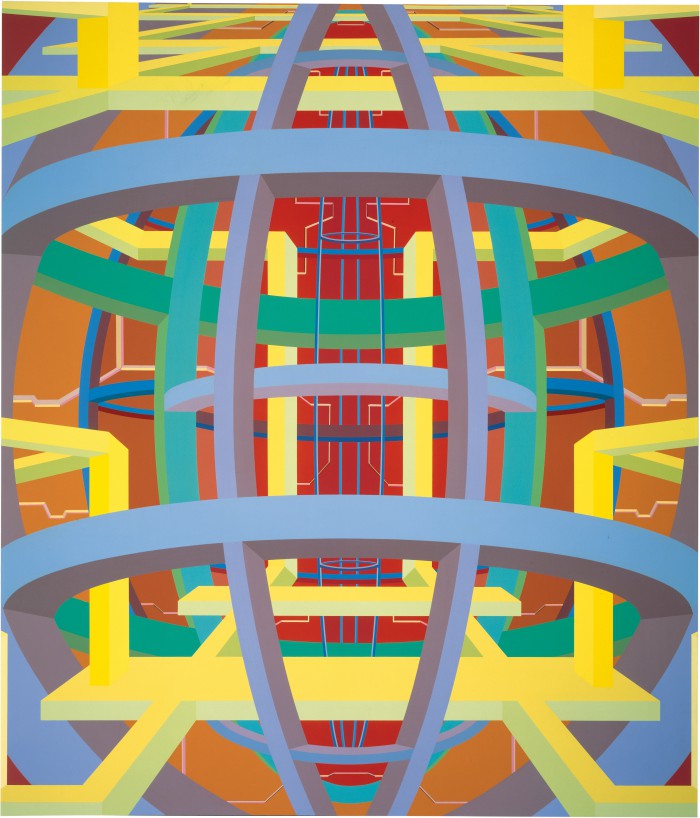
Hadrian’s Court I (one in Roman numerals) might be named after the ancient Roman Emperor Hadrian, but Al Held’s 1982 acrylic painting feels like a glimpse into the inner architecture of something straight out of 1980s science fiction. A tall, slim, blue central oval capsule is surrounded by an array of squared-off three-dimensional tubes and scaffolding filled with sharp angles and 90-degree turns as well as more ovals and even larger circles. The painting creates a sense of peering down a long space with floating, sometimes interlocked, geometric forms. Because many of the tubes overlap, and the circles and ovals seem to bulge forward off the canvas, it feels difficult to get a firm grasp on perspective. With each fresh look, the shapes may seem to switch places or change size. What appeared to be a free-floating oval suddenly makes sense as being part of a much larger circle, all of it made of tubes. Each tube or scaffolding face is painted in one unvarying color, whether bright and appearing to be well lit or in shadow. Shadowing appears on lower and inner edges of the surfaces all around, giving the feeling that lights are being shined from above and the front. The canvas stands just over seven feet tall, a little more than six feet wide, and just over three-and-a-half inches deep. The geometric shapes were painted right up to the borders. The edges of the outermost shapes are cut off, so it feels like a close-cropped photograph. If only the viewer could zoom out, the rest of the architecture might be revealed, like it just might go on forever.
Hadrian’s Court I was made in the hard-edge style with bright, vivid colors. True to the style’s name, the edges of every tube or platform are crisp and clean, without any blending or streaking of the colors. A central column of the background is cherry red, with much of the rest burnt orange. Rich burnt umber peeks through the web of tubes in the four corners of the canvas.
The structures that seem the furthest back are made of slender white tubes, mostly sharply angled. A sparse honeycomb-like skeleton reaches to the borders. At the center, the white tubes are like a stack of rocket engines, flaring out and narrowing again from top to bottom. Next is the cobalt blue central capsule, with thin, rounded tubes surrounded by a slightly thicker oval capsule of the same color. Angular lemon yellow tubes and scaffolding are next, though in places, they spill out in front of and above everything else, further disorienting the viewer. A rounded cage of turquoise encases the blue capsules. A lilac oval with somewhat narrow tubes is the front face of a larger, thick-tubed lilac circle that seems to be the outermost capsule.
Maybe this artwork was inspired by Emperor Hadrian’s villa with its arched doorways, rings of tall columns, and grand porticos. Maybe not. Held was dedicated to nonrepresentational abstraction, and he seems equally dedicated here to delighting the viewer with this energetic and colorful puzzle.
Artwork Details
- Al Held
- b. 1928, Brooklyn, NY
- d. 2005, Todi, Italy
- Hadrian’s Court I
- 1982
- acrylic on canvas
- 84 1/4 x 72 1/4 x 3 5/8 in.
- 2014.1.060
- Medium:acrylic
- Movement:Hard-Edge Painting
- Currently not on view