Donald Sultan
Factory Fire, August 8, 1985 1985
© Donald Sultan. Reproduction of this image, including downloading, is prohibited.
Audio Description (03:02)
Full Audio Transcript (Expand)
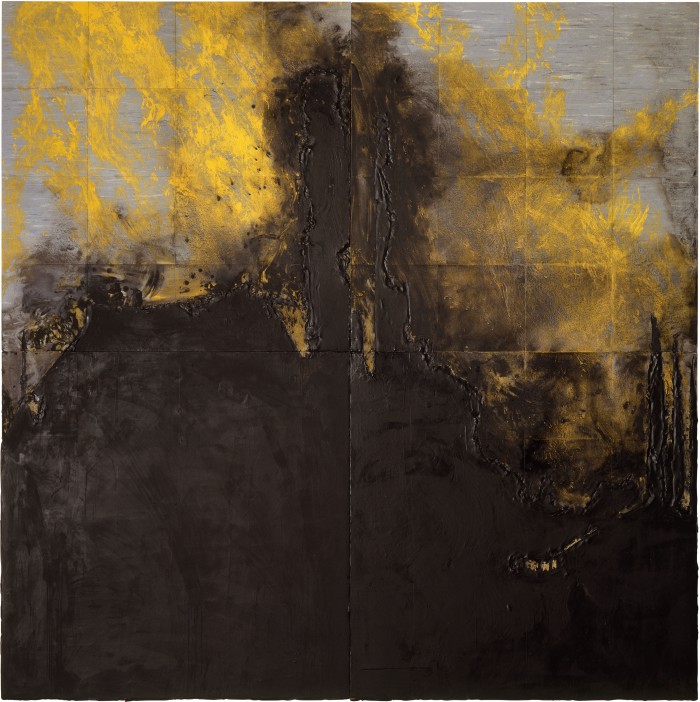
Factory Fire, August 8, 1985 is from Donald Sultan’s series The Disaster Paintings, where his subjects are actual disasters reported on in the daily newspaper. This 1985 artwork is painted onto a grid of 64 one-foot-square gray vinyl floor tiles. The tiles are neatly arranged eight wide by eight high. Sultan’s nebulous image of a burning factory is made on the tiles with jet-black tar and yellow latex paint, and the 64-tile grid is mounted on an imposing eight-foot-by-eight-foot square of masonite. The juxtaposition of smooth lemon-yellow paint against chunky, smeary black tar is striking. Perhaps even more so is the idea that all the elements of this artwork about a factory on fire are materials that could be found in a US factory at the time.
The tidy little vinyl squares are a soft gray with randomly applied short horizontal, chalky strokes of white and darker blue-gray. This is standard-issue office flooring with an unobtrusive pattern designed to reduce the appearance of shoe scuff marks and dirt. But here, these short lines give the impression of tiny clouds–some filled with ash–floating serenely past the disaster. The gray tiles are only visible through the flames and smoke in parts of the top five rows. Sultan represented fire in the top half and to the right of the building midway down, where it gives way to charred earth. The yellow was painted with short, frenzied strokes and splotches that mimic the constant, organic movements of rising flames; there is no order or pattern in the way it is applied. Thick areas are piercingly bright, thinner areas are dull and orange-tinted, and dusky, chestnut brown dominates the places where paint and tar are blended closer to the building and the ground. In some places, the paint has pooled in the seams between tiles, highlighting their straight edges in an otherwise amorphous image. The black-tar building is on the left, reaching about four or five tiles high. It is difficult to tell for certain. The roof is distinguishable, but the rest of the building is swallowed up by chunky, bubbly black smoke that fills much of the space. Black with a few tiny spots of dirty yellow completely obscure the bottom three rows of tiles as murky, tar-covered land.
At the painting’s center, a tall tar plume shoots up, with wisps of smoke tumbling off of it, and small sprays falling through the fire. This plume seems to be outlined with a very thick application of tar that trails down to the ground on the right and up to two slender trees near the right border, scorched and branchless. Where the tar is thickest, it catches the light, creating sparkles that stand out against the matte gray vinyl tiles.
Artwork Details
- Donald Sultan
- b. 1951, Asheville, NC
- Factory Fire, August 8, 1985
- 1985
- latex and tar on vinyl tile on masonite
- 96 X 96 in.
- 2014.1.080
- Decade:1981-1990
- Medium:tar
- Movement:Contemporary Painting
- On view