Bill Jensen
Exit 1985-1989
Courtesy Cheim & Read, New York. Reproduction of this image, including downloading, is prohibited.
Audio Description (03:30)
Full Audio Transcript (Expand)
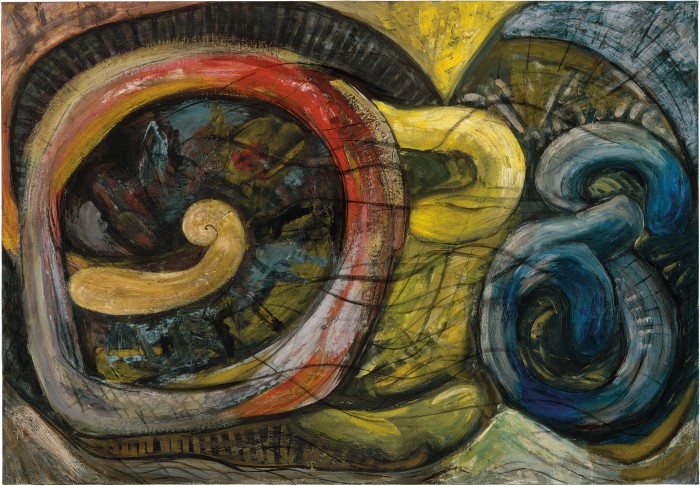
It would be understandable if someone discovered an object they thought they recognized from everyday life within Bill Jensen’s painting, Exit. But it would not be long before the viewer realized that the biomorphic, writhing forms, rows of short hash marks, and wavering and long, crossing lines are likely something else altogether, things that may not have a name. Exit is painted in oil on linen about two-and-a-half feet wide and three-and-a-half feet tall. This small surface contains multitudes–overpainted, packed-in tight, and swirling–without a realistic sense of perspective. Jensen used heavy black outlines around the shapes and alternated between dark, dusky colors and very bright ones to bring a sense of layered depth to the artwork. Brush strokes are thick and bristly all over, sometimes chunky, but never dripping.
Much of the left half of the painting is dominated by a large red ring, rounded on the top and squared off on the bottom. Most of the left and the bottom are gray and mottled, like thick fog passing over the ring that thins toward the top and the right. This foggy portion is overlaid with rows of thin gray Xes. Fiery sunset red and orange glitter over the top left curve. Emanating from the center of the ring, wavy wisps of thin black lines undulate to nearly the right edge of the painting. And the ring is not just an uneven circle; it is jam-packed with a whole universe. A gleaming, fat beige noodle lies across the center and arches up into the beginning of a spiral. All around this bright object, and filling up every bit of the inside of the red ring, are dark smears of turquoise and pea-soup green with little accents of blood red. Thick black lines separate the colors, creating shapes like crystals half-hidden in shadow.
At the center of the canvas, a glowing lemon-yellow intestine-like curving tube sits atop a chalky yellow block smeared all over with alga green. Below the block sits an oil slick of the same yellow and green. This combined mass stretches less than half the width of the red ring. To the right of these, and filling the last quarter of the painting, are looping cobalt blue snakes curled into an odd figure-8. Highlights are created along the curves with teal, pale blue, and gray-white. One segment is etched with narrow horizontal black bands and short spurts of white lines.
Before the viewer can get too comfortable with the major shapes filling most of the canvas, they are confronted with embellishments that occupy every last inch of the painting around those shapes and pour out to the edges. Wedges, triangles, rolling waves, lines like braces on a row of orange teeth, a dark, banded caterpillar, and a streak the color of sunset-pink-tinted clouds are but some of the things that may come to mind when scanning the painting.
Artwork Details
- Bill Jensen
- b. 1945, Minneapolis, MN
- Exit
- 1985-1989
- oil on linen
- 30 x 43 in.
- 2014.1.101
- Decade:1981-1990
- Medium:oil
- Movement:Contemporary Painting
- Currently not on view