Tony DeLap
Erdnase 1985
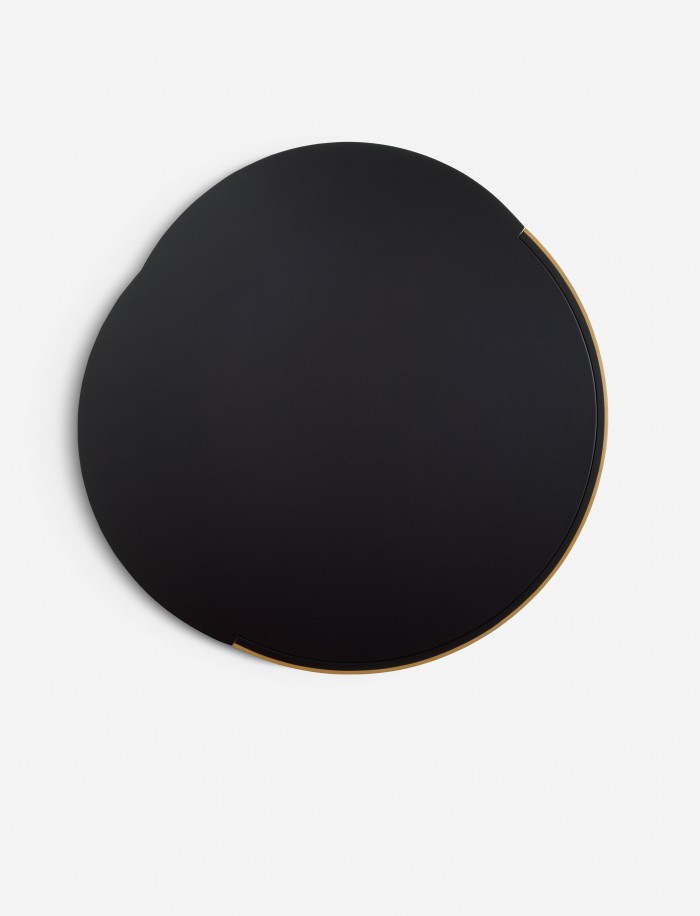
Reproduction of this image, including downloading, is prohibited.
Audio Description (01:44)
Full Audio Transcript (Expand)
Tony DeLap’s 1985 Erdnase is a black painting in acrylic on a three-and-three-quarters-inch-deep shaped canvas. From a distance the shaped canvas might seem to be a circle. Coming in closer, deviations from a perfect circle start to become clear. At just over six-and-a-half feet across and a little more than six-and-three-quarters feet high, it is a great challenge to identify exactly where this difference in size is coming from. It could be a bulge at the top, or one on the left side. Or is it that a part of the circle squeezes in just a bit before widening again, so that it really is not a bulge at all? And is it only one or two bulges?
Another clever trick DeLap played with the artwork was to precisely slice off a narrow band of the canvas from about one o’clock to about seven o’clock. It was replaced with a curved blond-wood band that fits snugly against the canvas’s edge except for at its ends. This creates tiny slivers of space where the wall behind shows through. The left side of this curved wooden band is painted with the same perfectly solid jet-black acrylic as the canvas. This could make it nearly impossible to detect from a distance unless light from above strikes it just so to create highlights on the borders where they touch. The wood was left unpainted on the band’s outer third, playing with the idea that a painting’s wooden frame would typically be completely hidden behind a canvas. “Erdnase” is the pseudonym used by the author of a classic 1902 book on card magic, something that uses visual distraction to fool and delight people. It seems DeLap took to heart what Erdnase had to offer in his magic book all those years ago.