Tony Berlant
Dutch Landscape 1986
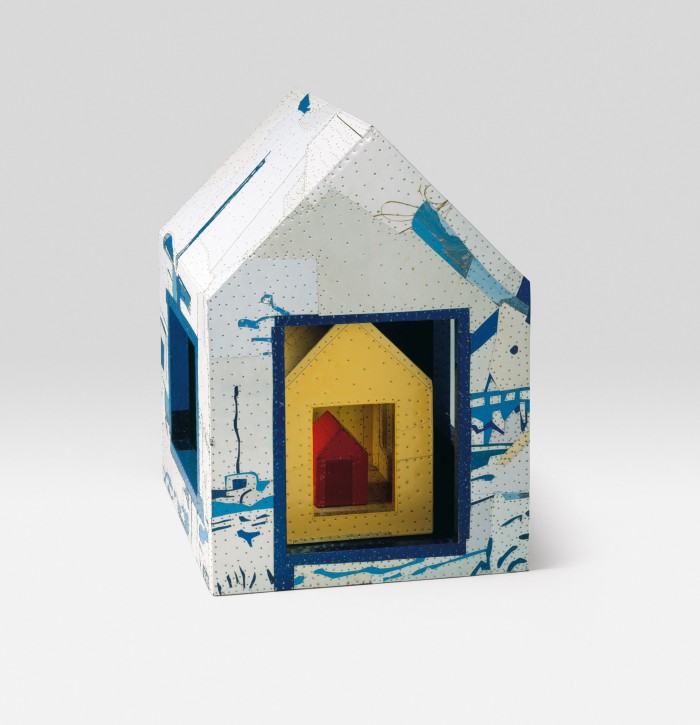
© Tony Berlant. Courtesy of L.A. Louver, Venice, CA. Reproduction of this image, including downloading, is prohibited.
Audio Description (03:15)
Full Audio Transcript (Expand)
Tony Berlant’s 1986 Dutch Landscape is a three-dimensional metal on plywood work of art. It is over two feet long, just shy of two feet wide and almost two feet tall. The piece consists of three traditional Dutch style houses, with front gable roofs, a door-less frame in the middle of the front,
with proportionally sized glassless windows on either side. The houses range from large to small, each fitting inside of the other. The largest house has various shades of Royal Delft Blue paint applied in a fashion that is reminiscent of a Dutch landscape. The house within is a pale yellow and the smallest house within that is fire engine red. Each house has metal sheets that have been sliced into all sorts of shapes and joined together like puzzle pieces. Each house is also marked with small dots, which upon closer examination are revealed to be tiny nails that perforate both the interior and exterior of the houses in an orderly and scattered fashion. The
perforations create pops of silver on all three pieces which creates contrast, shadows and depth on the painted piece as well as the monochromatic smaller structures.
In the bottom left corner of the larger house, there are six wisps of dark blue paint similar to blades of grass. Immediately above that are four blue, horizontal, thin strokes of paint, two on either side with a small circle in the middle. A dark blue open door-less frame allows the patron an unobstructed view into the larger piece and the smaller pieces within. A horizontal application of light blue paint starts at the left front edge of the house and extends to the door frame then outward forming a figure that resembles a slanted rectangular structure casting a shadow. Four strips of light blue paint extend from the upper left corner of the door frame.
The front exterior wall shifts from white to an angular, off white piece of metal that extends almost from the point of the roof to the right edge of the house. Along the right edge of the roof is a combination of three shades of Royal Delft Blue paint. The lightest shade is at the top of the roof, with the darkest shade of blue toward the bottom, along with a pale strip of yellow paint just below it. Royal Delft Blue markings similar to those that resemble the blades of grass are just below that and the doorframe. A long strip of blue that resembles a pier wraps around the piece to the right side. Thin connected strips of blue paint extend from the glassless window on the side of the house and strokes of dark blue are below. A gray application of paint covers almost the entirety of the right rear side of the piece from the glassless window to the edge. Similar markings appear elsewhere on the right side of the piece, with dark blue markings above and below.
The monochromatic pale yellow house sits within the largest house. Its roof is obscured by the doorframe of the largest house. The smallest, fire engine red house, fits inside of the pale yellow house and can be seen in its entirety. However, the red house does not have the same open door frame as the two larger houses it sits within. Instead, what would be the doorframe of the smallest house is a perforated piece of metal painted an even deeper shade of red, that resembles the shadow of an open door frame. The deep red covering prevents the patron from viewing the inside of the smallest red house, in the same manner as the two larger houses.