Terry Winters
Dumb Compass 1985
© Terry Winters. Reproduction of this image, including downloading, is prohibited.
Audio Description (02:58)
Full Audio Transcript (Expand)
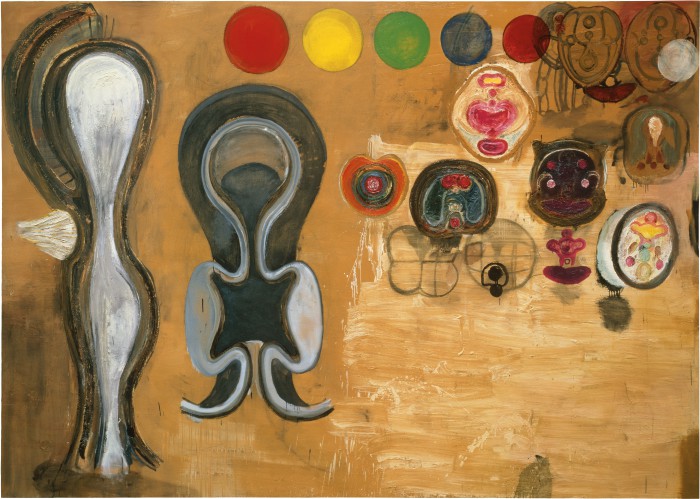
Terry Winters’ Dumb Compass is a huge oil painting on linen from 1985. It spans eleven feet and one-half-inch across and over seven-and-three-quarters feet tall. At this size, two dozen miscellaneous shapes and forms featured across a streaky marigold-orange field feel like they tower over the viewer. Very little seems to tie the collection of shapes and objects together beyond perhaps Winters’ desire to explore them in one place in paint.
On the left side are two large figures. The first reaches the full height of the painting and resembles a gleaming white, sandless hourglass. To its right is something like a black cephalopod with pale blue-gray outlining its body and two curvy, striped tentacles below. Inside a glassy orb near its top sits a slate-gray blob that narrows and streams down a column at the center only to disappear into, or maybe to fill, a dark gray star-shaped belly.
The upper right side is like a roll call of a floating array of globes and puppets; maybe a cell or half-cut fruit with an overly-huge, colorful pit; maybe a brain scan; an eerie cartoon character face; a face full of smudged clown makeup; diagrams; and perhaps children’s toys. Or maybe these shapes are really none of those things. They could be something different each time a viewer revisits the painting.
Spanning the middle third of the upper border are circles, like planets, diminishing in size and heaviness of paint as they go: cherry red, lemon yellow, forest green, royal blue, and thinner red again. Bumping up against the right-side border, and overlaying what could be outlines of a set of ornately-decorated shields, is one more, smaller circle in diaphanous white. Separated from the group, the viewer may wonder if this small one could be a moon that fell out of orbit with the row of planets above, if they indeed are supposed to be planets. Some of the objects–like one that seems like a small painting of an erupting volcano–are painted with thick strokes full of bristle lines. Others–like a butterfly shape–are like faded outlines that almost look as if they were drawn in pencil and partially erased instead of drawn with oil paint with a slender brush.
The left bottom corner of the canvas is dimmed with a thin application of black, and much of the right side is brightened by wide back-and-forth lines of off-white streaked with amber. Thin white drips fall down the left side of this bright patch. There are smaller swatches and slim drips of black here and there around the odd space. And the occasional small pool of black falls like a shadow below some of the miscellany filling the top right quarter of the painting.
While the takeaway of this painting might feel ambiguous, one thing is for sure: Winters used his brushes to ask questions about nature, science, and paint pigments themselves, not to answer them.
Artwork Details
- Terry Winters
- b. 1949, Brooklyn, NY
- Dumb Compass
- 1985
- oil on linen
- 94 l/2 x 132 l/2 in.
- 2014.1.114
- Decade:1981-1990
- Medium:oil
- Movement:Contemporary Painting
- Currently not on view