Bill Jensen
Denial 1983-1986
Courtesy Cheim & Read, New York. Reproduction of this image, including downloading, is prohibited.
Audio Description (05:27)
Full Audio Transcript (Expand)
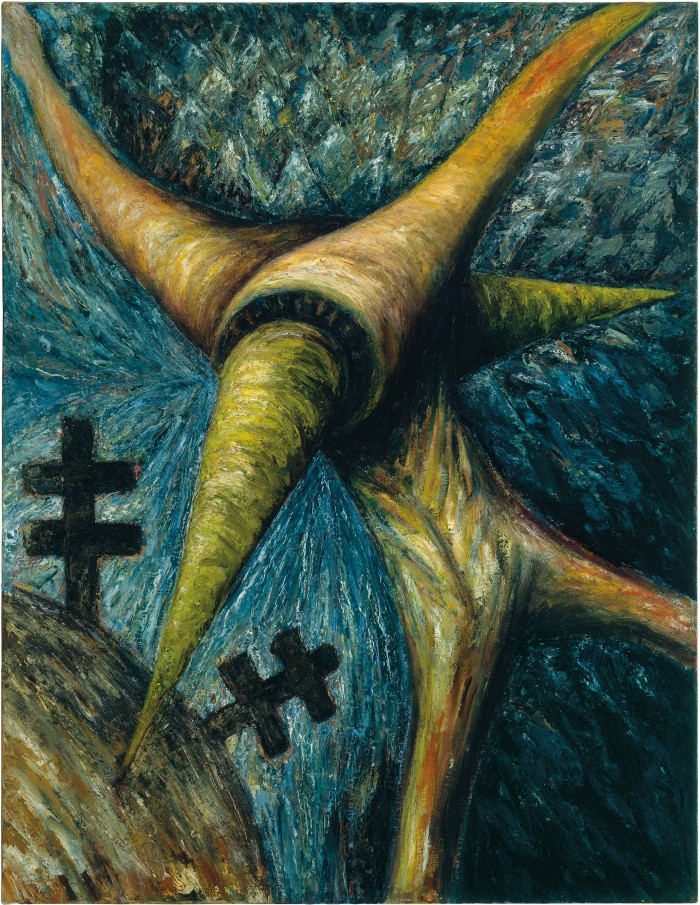
Denial, a painting by Bill Jensen, created in the years 1983-1986, is an oil on burlap work of three feet, four inches by two feet, seven inches.
The piece is dominated by large, elongated, conical forms that meet, forming a neuron-like mass, just above the center of the frame. They seem to float, and have an organic quality, each shaped slightly differently.
The foregrounded form appears a bit like a carrot. It runs diagonally along the upper right-hand part of the work; its thickest part is at the intersection of the objects, jutting out. It tapers as it stretches upwards, its end—if it has one—seeming to come off panel. It is comprised of myriad dusky oranges, wan yellows, and russet reds, and is streaked, near its thickest part, with slim bands of off-white.
Emerging from the flat top of the thickest part of this central object—like the stalk that springs from the top of a carrot—is a cone of various ghoul-like, moldy greens reminiscent of jaundiced skin under sodium lights, cut here and there with white and black. The cone punctuates in a sharp, drill-like tip that points at the bottom left section of the painting. It is nearly as long as the orange tubular form it is attached to.
Running perpendicular to the orange section of the conjoined objects is another tubular, carrotesque body, this one slightly thinner than the first. It curves upward gently, like a stalk of celery gone rubbery, running diagonally up the upper left-hand side of the piece. It too, is made of an array of ashen oranges, washed out yellows, and a dash of rusty red, but appears slightly muddier in hue, as if it floats further from some unseen light source.
A green cone, also darker in hue than the first, stretches out to the right side of the canvas, forming a roughly 30-degree angle with the first orange object described. Whether it is connected to the second carrot-like body is unclear; the place they would be joined is hidden by that first object.
A fifth flange completes the central group of objects: an object that suggests a tree trunk that runs towards the bottom right part of the painting, and that terminates in two forked limbs, that evoke the roots of a tree. Each of these “roots” run off the edges of the artwork. The trunk itself continues the diagonal line made by the second orange object; together, they bisect the painting.
The trunk is heavy with stripes of dirty white and every shade of amber, and veins of blue that are reminiscent of a spine and rib cage; the forked bits are ochre and brick red, and black. Whereas the strokes of paint making up the other parts of this central mass are more or less horizontal, here the strokes are vertical and diagonal.
There are two parts to the background of this work.
On the left, situated in the distance behind the central element, is a quarter of a sphere, stretching from edge to edge of its corner of the painting. The object is studded with two large patriarchal crosses, each of their two horizontal lines of equal length; they appear like squat utility poles. The crosses are nearly half the size of the quarter of the sphere, and are largely black, with a few threads of white and blue peeking through. The sphere is of many colors, layered in a manner that suggests the colors of a planet seen from space—there is a base of dark gold and speckled black, with short curving strokes of off white that feel like clouds. The crosses are embedded in a region rich with dark blue, that are also cut with lines of white.
Behind all these elements is a dynamic field of blue, in hues that range from that of the midday sky to the depths of the ocean. It’s made of a mass of curved lines that cover the left side of the painting, and that converge on the space behind the nexus of the central forms, as if their intersection occludes the center of a vortex.
The top third is filled with triangles that grow smaller as they approach the edge of the canvas; they appear as small, stylized feathers or scales, all a universe of color: largely deep blue, but each flecked in its own way with whites reminiscent of snow covered in dust, and mucous-like yellows; overripe oranges and shadowy blacks—and, near the upper right hand corner of the
painting, all those colors plus bright reds and dark magentas as well.
The swirl of the vortex is blue too, bright, more streaked with white and cobalt than the triangular forms. The lines seem comprised of short strokes, whereas the triangles seem almost pointillist in construction.
Artwork Details
- Bill Jensen
- b. 1945, Minneapolis, MN
- Denial
- 1983-1986
- oil on burlap
- 40 x 31 in.
- Recto: CONSERVATORS BEWARE / TONAL GLAZES TOP (with arrow below)/ inscribed in black paint "DENIAL" / 1983-1986 / Bill Jensen / 40" x 31"
- 2014.1.106
- Decade:1981-1990
- Medium:oil
- Movement:Contemporary Painting
- On view