Frank Lobdell
Fall 1971 1971
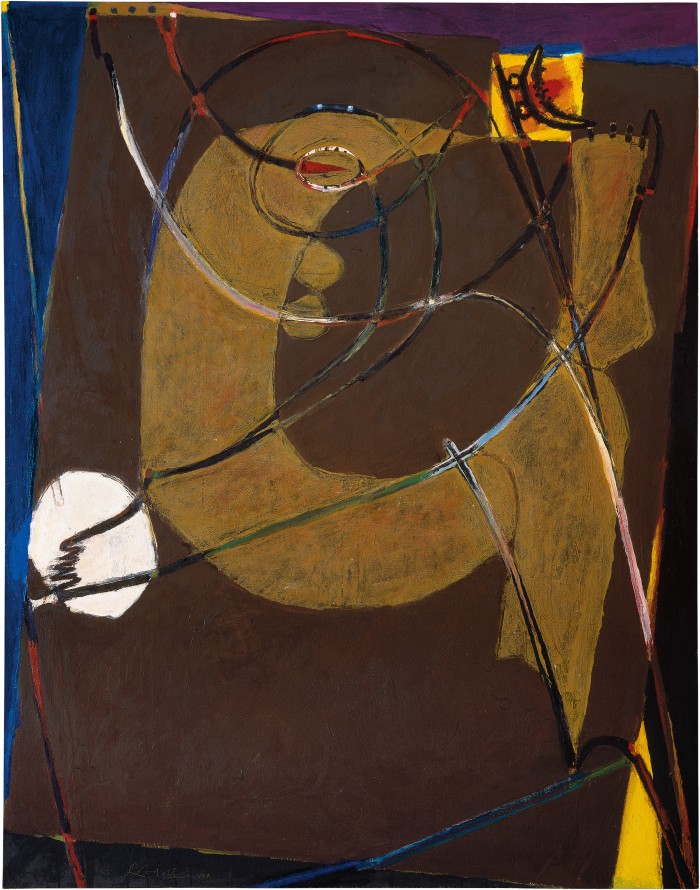
Courtesy of Hackett | Mill, and the Frank Lobdell Trust, San Francisco, CA. Reproduction of this image, including downloading, is prohibited.
Audio Description (02:57)
Full Audio Transcript (Expand)
Fall 1971
Frank Lobdell’s Fall 1971 is an oil-on-canvas painting that stands seven feet high by just over five-and-a-half feet wide. Browns, from walnut to golden, dominate this artwork, both in a central abstract figure and in much of the background. Bright accents course across and around the canvas. Like January 1971, a companion painting completed in the same year and of similar size, this painting has a central image painted onto a dark rectangle, and the rectangle is tilted a few degrees to the right. All around it are slender triangles that reach the canvas’s edges, creating the illusion of being a stack of colored papers in slight disarray. Those colors include
purple and blue up top, a streak of red, then black and yellow down the right, black along the bottom, and blue smudged with black along the left edge.
The central image is a large, surreal, and hard-to-pin-down shape. It could be a distorted capital letter G. It could just as plausibly be reminiscent of a fetus, curving around from a pointy head on the left to fat feet on the right–one foot raised straight up and the other foot pointing down–and with little nubs for arms on the inside edge, near the head. The shape is made of dull brown with terra cotta orange streaks all painted thin enough that a muddy brown background shows through in places. The paler paint layers are rough, almost scaly. Near the upper left of the shape, they have been scratched with a thin, sharp object in tiny criss-crossing scribbles. At one o’clock on the canvas, a bright yellow square with orange and red accents balances between the tip of the pointy head-like part of the shape and the top-left corner of the raised foot-like part. Superimposed on the bright square is a pair of arcing lines with two circles on top like a small set of eyes on top of eyebrows. At eight o’clock on the canvas, a vivid white orb is nestled between the lower left of the shape and the brown background.
Accenting the whole canvas, but mostly on and around the central shape, are thin, curving lines painted in black. Much of the length of these overlapping and winding lines are painted over with fire-engine red, royal blue and ice blue, dark green, and white bands, and smears. Some appear to slip off the edges of the canvas, while others fit within–or seem to be hooked onto–the central
muddy brown rectangle. They outline a dancing figure, with one arm raised and fingers pointed to the top of the canvas overlaid on the upper foot. Where the black-line fingernails lay at the top edge of the foot, they appear like outlines of long toenails. Near the upper center, two white dots and a white-accented loop below them could be eyes and a mouth. Legs extend toward the bottom left and right. The other arm sweeps across the canvas. Its hand lays atop a bright white circle, its zig-zagging fingers like the filaments inside a glowing light bulb.
Artwork Details
- Frank Lobdell
- b. 1921, Kansas City, MO
- d. 2013, Palo Alto, CA
- Fall 1971
- 1971
- oil on canvas
- 84 x 66 1/8 in.
- Recto lower left quadrant: Lobdell / 1971 (in green paint) Verso lower left quadrant: Lodell Fall 1971 (in black on white paint)Labels: Martha Jackson Gallery ("Untitled"); Smith Andersen Gallery ("Fall 1971 Post Dance"); SFMOMA 1983 ("Fall 1971"); SFMOMA 2000-2001 ("Fall 1971")
- 2014.1.065
- Medium:oil
- Movement:Bay Area Abstraction
- On view