Bill Jensen
Guy in the Dunes 1979
Courtesy Cheim & Read, New York. Reproduction of this image, including downloading, is prohibited.
Audio Description (03:00)
Full Audio Transcript (Expand)
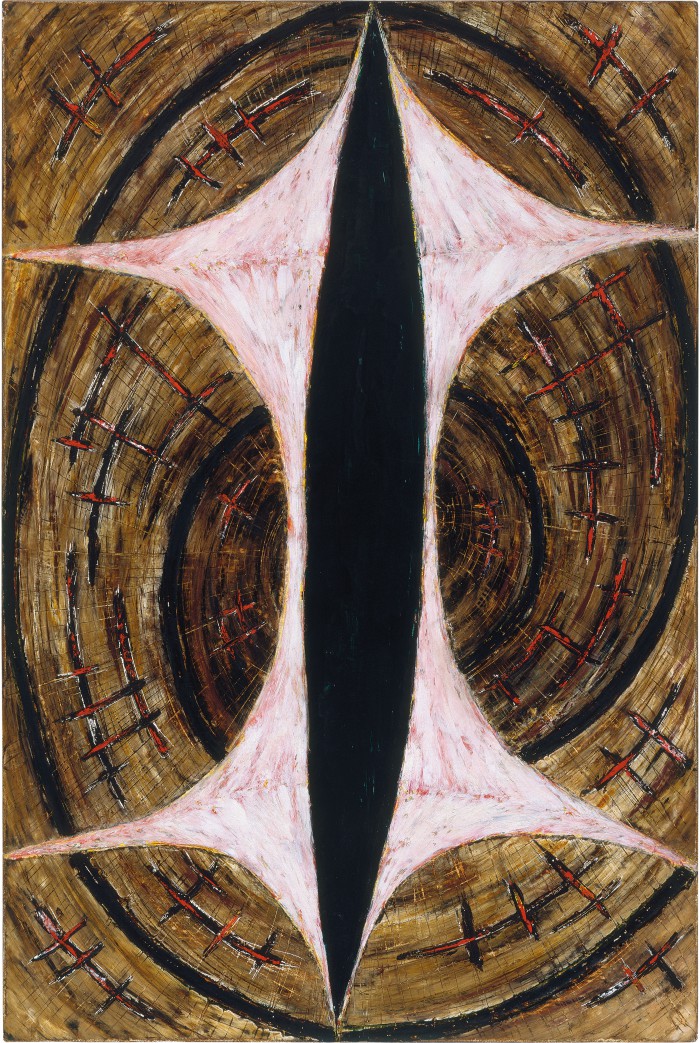
Guy in the Dunes is an oil on linen painting created in 1979 by Bill Jensen. Measuring at three by two feet, this contemporary painting oddly enough features no human-like figures. No “Guy” is present in the artwork.
Instead, in the middle of the artwork spanning vertically from the very top to the very bottom, Jensen paints a black oval slit down the canvas. This slit draws parallels to a cat eye when hunting in the dark or perhaps the visage of the All-Seeing Eye. It is by far the most captivating, yet unsettling element of the artwork. A faint layer of a teal blue can be seen under the black oval, faint blue streaks that were not covered completely appear jagged along the edges and smooth in the middle. Perhaps this layering of colors is used to breathe life into this pupil-shaped object. Furthermore, these blue streaks underneath the top layer of black create the illusion of a strained gaze that watches your every move.
Extending from both sides of the black oval, at the top and bottom, four inflexed arches reach out horizontally to the end of the canvas. These arches connect to each other creating a deep U-shape on either side of the oval. The arches are a bright white, with rosy pink undertones. Notably this is the only bright color on the canvas, like a quick burst of light piercing through darkness. Along the edge of the U-shape faint yellow strokes accompany the rosy pink light. The strokes follow the direction of the arches, flowing up towards the points, then back down when in the gorge.
The background of the painting could be referring to “The dunes”. The entire background is painted different shades of brown, getting progressively lighter towards the edges on the canvas. A single thick black line swirls inward behind the oval. The point in the middle of the canvas where the swirling line originates from is obstructed by the oval. This line closely resembles the infamous hypnotic swirl, used to induce trance-like states. The hypnotic swirl typically causes eye fatigue and/or optical illusions of movement where there is none. The swirling line used in this artwork might signify getting lost in or succumbing to harsh environments of deserts, where dunes typically form. Perhaps in this case, the All-Seeing Eye’s gaze leads to paranoia and hallucinations.
In between the black circling line, red-black patchwork lines resembling stitches also swirl towards the middle. They appear in different sizes and lengths with a different amount of cross hatches on each one. Across the entire painting, light scratch marks have been made perpendicular to the swirling black line. These scratches over the brown paint resemble the tree rings on an old stump.
These elements in their togetherness create an uneasy feeling of being perceived in a strange space. Imagine—you are alone at night in a desolate sandy wasteland. The fear is hypnotic and the eye is watching.
Artwork Details
- Bill Jensen
- b. 1945, Minneapolis, MN
- Guy in the Dunes
- 1979
- oil on linen
- 36 x 24 in.
- Inscribed verso: TOP Bill Jensen 1979" "Guy in the Dunes" 24"x36" Also see exhibition labels on back documenting inclusion of this work in LACMA Exhibition, "The Spiritual in Art: Abstract Painting 1890-1985"
- 2014.1.102
- Decade:1971-1980
- Medium:oil
- Movement:Contemporary Painting
- Currently not on view