Al Held
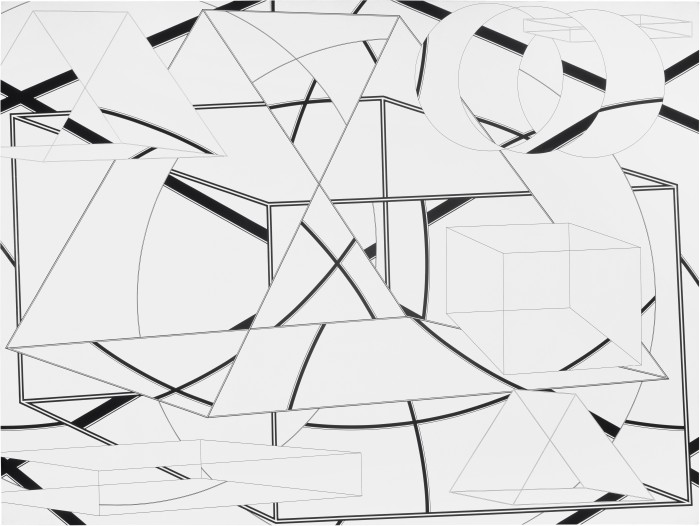
Inversion X 1977
© 2014 Al Held Foundation, Inc. / Licensed by Artists Rights Society (ARS), New York. Reproduction, including downloading of ARS member works is prohibited by copyright laws and international conventions without the express written permission of Artists Rights Society (ARS), New York.
Audio Description (02:42)
Full Audio Transcript (Expand)
Al Held painted Inversion X (10) in 1977 as part of his Inversion series. This black-and-white acrylic painting is just over six feet wide and barely more than eight feet tall on a canvas that is four inches deep. The sharp geometric abstractions that fill the space are a cascading array of optical illusions that encourage the viewer to question what they observe on this towering canvas. Because even as triangles, circles, rectangles, and variously-shaped prisms crowd over every inch of the canvas, most of the space, in fact, is actually blank. The shapes are only black outlines; the space within, and around, every shape is the painted white canvas.
When attempting to take in the bigger picture, it may seem that lines randomly criss-cross all around in a hodge-podge, some fat, some thick, some singular and pale, some double-lines very dark. But taking in the canvas bit by bit, it becomes clear that there is nothing random about the placement of straight or curved lines. Held has layered the geometric shapes and prisms in ways that bring incredible three-dimensionality to the artwork. This painting may require one to approach and retreat several times, and move around to view it from different angles, before all of the shapes and their relationships can be perceived.
A large triangle is shattered by smaller pyramids. A cube appears to be transparent, except that a black line it was painted over seems to disappear behind one wall of the cube. So is it white or is it transparent, hiding something or somehow simply not revealing it? Some sides of the solid shapes are adorned by extra intersecting lines in startling ways. This makes them appear to have small convex facets cut into the sides. It feels like these facets are reflecting other shapes floating in the air that were not painted onto the canvas, turning this painting into a mirror. Some elements seem to start in one area of the painting, disappear, and pop up again at a far edge. It feels impossible to determine which elements are in front and which in back because of how often shapes and prisms overlap and overtake each other.
In the end, one must conclude that there is a giant, thick-lined cube as the base image. On top of that are a large central triangle outlined by thin black. And hovering over that in an odd array are various prisms facing different directions: rectangular, triangular, and a cylinder outlined with lighter, thinner black. The artwork is utterly mesmerizing; even after coming to the conclusion of what exactly the pieces are, Held’s precision and playfulness lead the viewer to delight in doubting it all and start again from scratch.