Sam Francis
The Beaubourg 1977

© 2014 Sam Francis Foundation, California / Artists Rights Society (ARS), NY. Reproduction, including downloading of ARS member works is prohibited by copyright laws and international conventions without the express written permission of Artists Rights Society (ARS), New York.
Audio Description (02:43)
Full Audio Transcript (Expand)
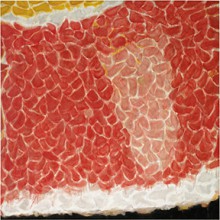
The Beauboug is a painting by the abstract expressionist Sam Francis, created in 1977. It is acrylic on canvas. And it is just over seven feet, two inches by nine feet, ten inches.
Scrambled gridlines of hallucinogenic color—canary yellows, periwinkle blues, midnight magentas, dried blood reds, acid greens, pine greens, mold greens, navy blues, shadowy blues, sherbet purples—cover the eggshell white background of the painting.
The gridlines are of uniform thickness, but vary in length. The colors that populate them appear to have been dabbed on in globs. Loose splotches of paint, largely dark blues, lightly pepper the negative space between gridlines, Pollock-style.
The lines do not create a true grid—they are not even; they collide at odd angles, creating a tangle that appears like the work of an amateur urban planner.
Patterns in the grid emerge and recede as one looks at the painting; shapes resolve and dissipate.
For instance, a large pentagon, bisected by one of the painting’s two perfectly vertical gridlines, precipitates on the canvas’ left side. But as one’s eyes become less focused, that shape disassembles into five lines, pathways of color—predominately dark blue, purple, and green—that terminate when they intersect.
Nearly parallel diagonal gridlines connect with the other vertical gridline on the canvas’ left side. They’re dense with dark green, purple, and blue, and are brightened by blots of orange and yellow. Together, they create parallelograms and triangles of white that sharpen under an unfocused gaze, and that become nearly invisible in the face of the potpourri of color that engages the eye when it takes a more considered look.
These shifts are made possible by a few things.
The painting has a sense of limpid energy due to the manner in which the paint was applied—blobs of one color flow seamlessly into the next in a loose, decidedly organic fashion.
And the painting has a sense of motion thanks to Francis’ heavy reliance on diagonal line—every gridline, in fact, is diagonal, except for the aforementioned two vertical lines and a broken horizontal line, which runs—with a small gap—perhaps two feet from the bottom of the canvas, like a latitude line that a child has taken an eraser to.
These three gridlines feel like axes about which all the other, dashing, diagonal lines pivot.
The effect is of expression that is free flowing despite being possessed of clear structural elements; in this way, The Beaubourg is like jazz made visual.
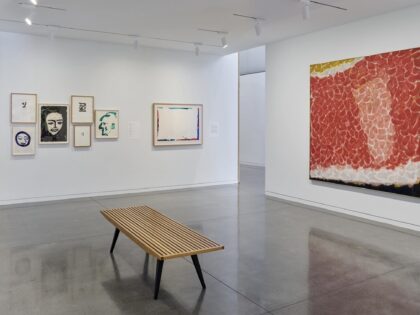
On view in Sam Francis Centennial in the Wisch Family Gallery.
Artwork Details
- Sam Francis
- b. 1923, San Mateo, CA
- d. 1994, Santa Monica, CA
- The Beaubourg
- 1977
- acrylic on canvas
- 86 3/4 x 118 1/4 in.
- Verso: Sam Francis "The Beaubourg"
- 2014.1.053
- Decade:1971-1980
- Medium:acrylic
- Movement:Bay Area Abstraction
- On view