Laddie John Dill
Untitled 1982
Reproduction of this image, including downloading, is prohibited.
Audio Description (03:21)
Full Audio Transcript (Expand)
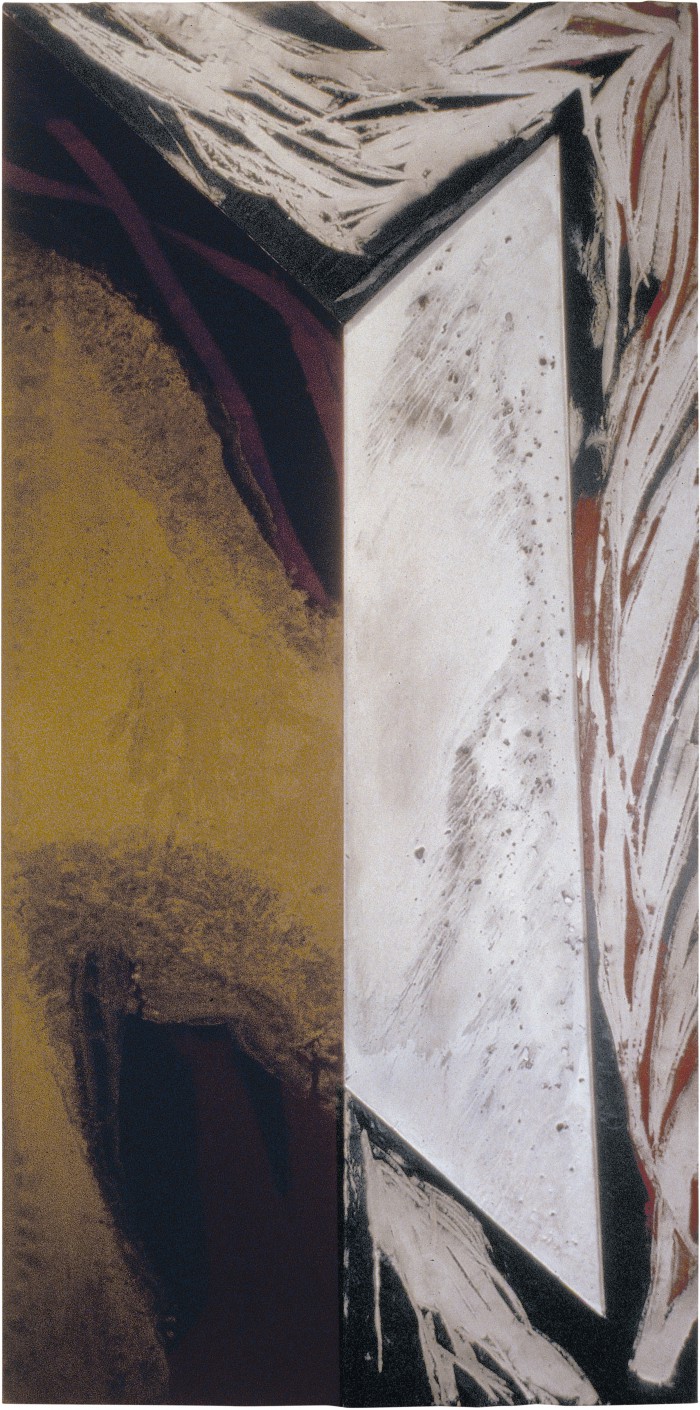
Laddie John Dill has created many artworks called Untitled. This one, from 1982, is made of cement, glass, pigment, and silicone on wood. It feels cool and autumnal, with its combination of gray, black, dark green, and brick-red paint. The work is dull in places and shimmering in others. It stands just under ten feet tall, almost five feet wide, and nearly three inches deep. Some portions are sharp and dagger-like, while others are wispy or bubbly. The work is made of three distinct sections that use materials, depth, color, and texture differently to create an organic, yet very much manmade, piece.
The left half of Untitled is covered by a thin sheet of pale tan glass that was cut on a diagonal so that it only reaches the top of the artwork in the left corner. Below the glass, a wide diagonal band of black paint at the top follows the cut. A meandering brick-red X is painted over the black and appears burgundy under the tan glass. Below the band, areas of white paint appear yellow, and near the bottom, more dark paint was poured. Where the dark areas meet the white, the red and black bleed, creating brackish spots much like where freshwater meets saltwater near an ocean’s shore.
The second major section to describe begins back at the top, flush against the glass’s upper diagonal cut: a raised portion that acts something like a frame overlaid on parts of the artwork. It is composed of a cement and silicone mixture. This framelike portion is laid over the artwork’s top and right edge, rather than all around the outside edges of the piece. Its top border dips down onto the painting in a triangle, creating a jagged point. The right side of this point casts a shadow into a shallow area on the artwork’s right side that will be described later. The raised
border continues down the right side as a thick strip, becoming slightly narrower toward the bottom edge. A nearly triangular wedge reaches from the bottom up a short way to meet the panel of glass at the midline of the artwork. This partial frame-like border was painted dark green and rusty red. Much of the painted surface was carved away about a quarter-of-an-inch deep, leaving sharp peaks and revealing the whitish material beneath. These carved lines are mostly wide, with some thin and feathery. They arch, sweep, and criss-cross over each other like blades of beachgrass.
The final section is the smallest: a trapezoid defined by the raised, carved border on the right side and the glass panel on the left. It is rough, a gray-white cement and silicone mixture with a wash of only slightly darker gray pigment. Where the cement is bumpy or textured, the darker gray sticks to it, leaving freckles along the top and left side of this portion. Little rivulets were formed by the wash running over the surface. It resembles an aerial view of dunes on a sandy beach, framed by the flowy estuary on the right and the breeze-blown grasses on the left.
Artwork Details
- Laddie John Dill
- b. 1943, Long Beach, CA
- Untitled
- 1982
- cement, glass, pigment, silicone on wood
- 119 7/8 x 59 3/4 x 2 7/8 in.
- 2014.1.063
- Decade:1981-1990
- Medium:glass, pigment
- Movement:California Light & Space
- On view