Willem de Kooning
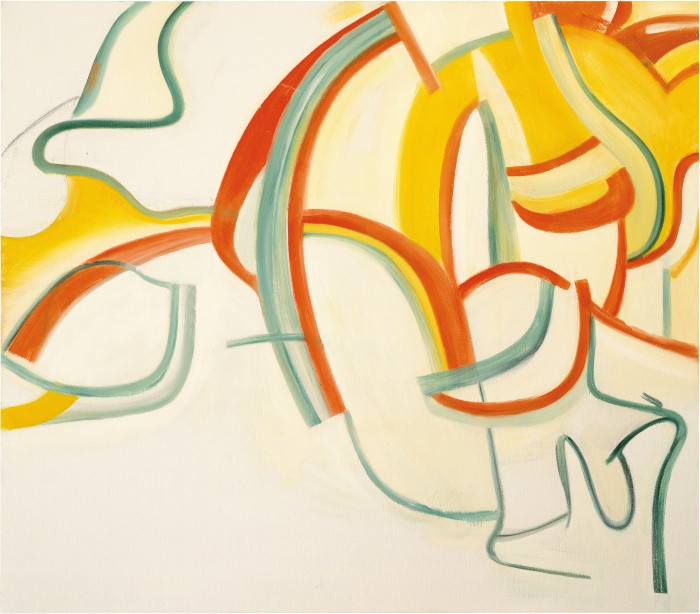
Untitled V 1986
© 2014 The Willem de Kooning Foundation / Artists Rights Society (ARS), New York. Reproduction, including downloading of ARS member works is prohibited by copyright laws and international conventions without the express written permission of Artists Rights Society (ARS), New York.
Audio Description (03:12)
Full Audio Transcript (Expand)
Untitled V (five in Roman numerals), painted by Willem de Kooning in 1986, is an oil on canvas work of six feet, five inches by eight feet, four inches.
An abstract work, it is predominately made of three colors: a yellow like that of aged corn; a red-orange like that of an off-season tomato; and a sea foam like that of a forgotten green buttermint, covered in years of dust.
There are also, here and there, a darker green, and a yellow so pale as to be nearly translucent.
Much of the canvas is negative space, a creamy off white often seen in antique paper.
One could read the positive space in Untitled V from any direction: the curved lines that form the composition do not offer the eye any guideposts or signs as to where to settle. This description will move from left to right.
Filling the left side of the canvas are the following:
Two thin green lines—one lighter, one darker—run down from the top left of the painting. Each is curved; the line on the right slightly, while the one on the left is full of bends and switchbacks, like a winding road.
Beneath these are a few more green lines: two that form a lime-like shape, and one that runs parallel to the bottom of the “lime.” This shape floats right at the canvas’ left edge, and sits about halfway down from the top of the painting. It is joined by a thick stripe of yellow that runs off the canvas and connects to the bottom of the “lime,” a thick stripe of red that curves from the edge of the canvas towards the painting’s midpoint, and a field of yellow that fills in much of the space between the aforementioned thin green lines and the “lime” shape.
That is the left third of the canvas. The other two thirds contain a cacophony of overlapping, intersecting curved lines of various thicknesses and lengths.
In the middle third of the canvas are bundles of curved lines that form a lowercase “h” shape—the stem (from left to right) a stripe of red, green, and then red again. The hump features a band of yellow sandwiched between arcs of red and green.
The rightmost third of the canvas is the densest with paint.
The upper right hand corner features a thick arch of yellow, as well as a rounded field of yellow, from which thick red strokes sprout, like a cockscomb from a rooster’s head. A sinuous pair of green lines—a thicker one of sea foam and a thinner one of dark green—wiggle over the yellow field, like a long, papery slice of cucumber.
Those lines are abutted by a slash of red attached to a band of translucent yellow, connected to a thick, red U shape; the three lines appear like a yellow eye with a red eyebrow cushioned by the kind of bag that forms under one’s eye after a week of sleepless nights.
Out of this collection of color emerges a parade of lines and shapes. Moving downwards from the upper right hand corner, one comes across a red line that evokes a hill, and red and green lines that form a banana shape.
Moving down even further, into the bottom right hand corner, are thin green lines that squiggle across the canvas, at times forming hook like forms, a sine wave, and a question mark shape.
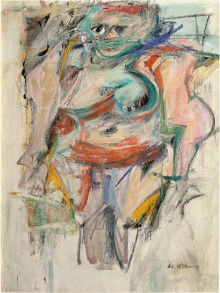
Untitled V was created during de Kooning’s “late style”, a period that began around 1980 and continued until the artist stopped painting in 1991. Here, we see a move away from the aggressive handling and heavy application of paint, as seen in Woman Standing—Pink, to one that appears more lyrical and fluid. The emphasis seems to be on the rhythm of color, line and form shown silhouetted against a toned white field. In speaking about de Kooning’s work from this period, the noted curator John Elderfield remarked:
“De Kooning truly reinvented himself in these extraordinary canvases. He had the confidence to give up the lush painterliness and visibly reworked appearance of his earlier works in favor of something more reductive; but they remain not only spatially complex, but also extremely physical pictures, both visually open and densely embodied.”
Artwork Details
- Willem de Kooning
- b. 1904, Rotterdam, Netherlands
- d. 1997, East Hampton, NY
- Untitled V
- 1986
- oil on canvas
- 77 x 88 in.
- Recto: Signed on stretcher on right.
- 2014.1.088
- Decade:1981-1990
- Medium:oil
- Movement:New York School
- On view